



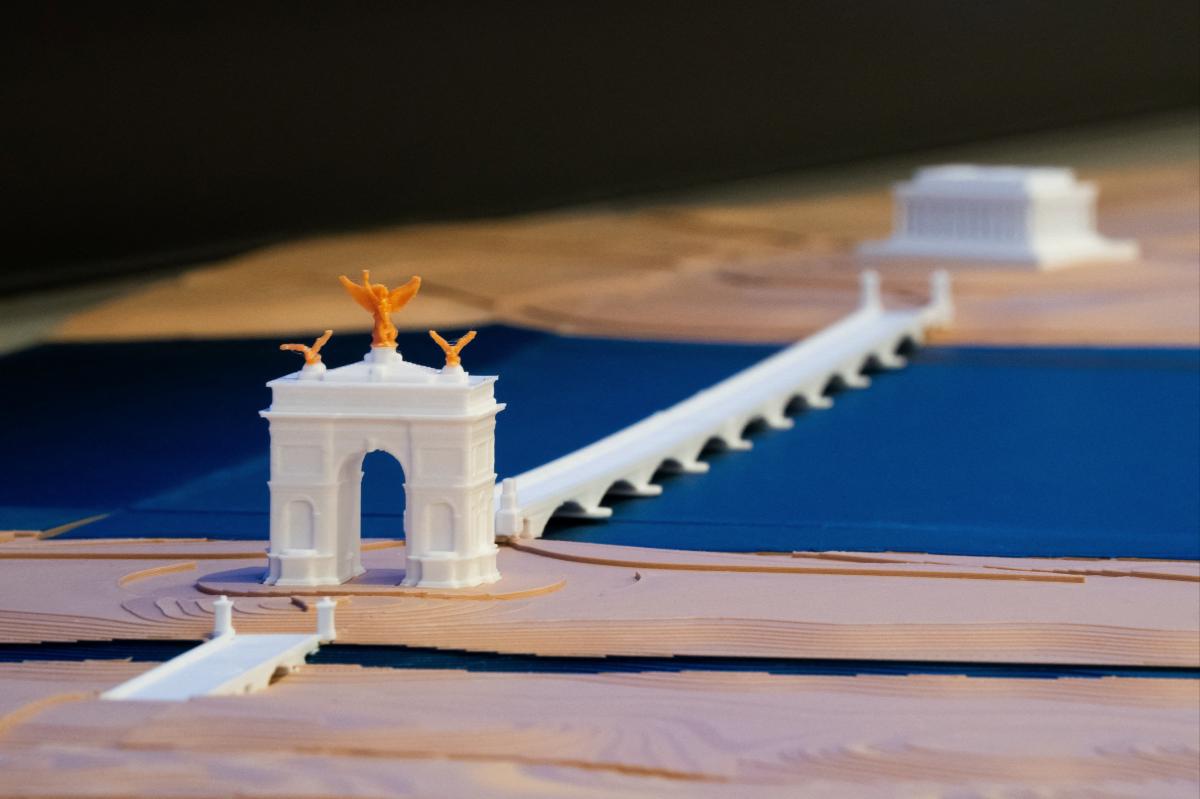
WASHINGTON – The National Capital Planning Commission on Thursday gave preliminary approval to President Trump’s massive memorial arch and signaled its support for his plan to change the shape of DC’s skyline.
The proposal still faces a final vote – likely at the commission’s September meeting – and the lingering question of how high it will ultimately reach.
Trump wants a 250-foot memorial that would sit on a traffic circle between Arlington National Cemetery and Arlington Memorial Bridge. If approved, it would obstruct the view between the Lincoln Memorial and the site where the nation’s soldiers are laid to rest.
The president’s hand-picked commissioners indicated they favored his height plan, rejecting a compromise by the commission’s staff that would honor a federal law intended to protect the skyline while giving the president his 250-foot arch.
Commission staff suggested the memorial be revised so its arch stood at 130 feet – meeting the requirements of the 1910 Height of Buildings Act – but expand the size of the statues that would line its top so the overall size would hit the 250 mark.
The statues, they contend, are an architectural embellishment and therefore do not apply to height requirements.
But Commission Chairman Will Scharf, hand-picked by Trump to lead the board, overruled them. He noted he’d ask the Interior Department, which is overseeing construction of the arch, to provide an argument of why the law doesn’t apply.
“Those materials provide what I believe is a compelling argument that the Height of Buildings Act is not applicable to the federal government,” he said.
Ultimately, the commission decided to leave the question of the arch’s height for a future meeting where they will also debate if the Height of Buildings Act, which forbids construction over 130 feet, applies to federal buildings.
If they rule the law doesn’t apply to federal construction, Trump could be given carte blanche to build any government building to any height he wishes.
The arch is one of several projects Trump has in the works. The commission already approved his ballroom to replace the East Wing. The president is also looking at rebuilding a Washington DC golf course and has made several changes to the White House. He’s also remodeled the reflecting pool and Lafayette Park.
Commissioners had other concerns about the arch, including possible traffic accidents and how the height would affect the flight path at Reagan National Airport.
The arch would be constructed on Memorial Circle, which is land between Arlington National Cemetery and Arlington Memorial Bridge, one of Washington DC’s heaviest traffic areas. Visitors would have to cross busy highways in order to see the arch and travel up to its observation deck.
Planners are considering installing traffic lights in the area to safely move pedestrians across the streets to and from the arch.
Another issue surrounding the arch’s height is how it would affect air traffic going into Reagan National Airport, which sits six miles away on the banks of the Potomac River.
The arch would sit in the busy airport’s flight path. And the cranes to construct the arch could be higher than the arch itself. The commission said the final plans for the arch need to include a plan for safety lighting and an FAA study on the issue.
Much of Thursday’s discussion was devoted to public comment, most of which was against the arch’s construction. People cited the disruption to the view from Arlington National Cemetery to the Lincoln Memorial and a lack of Congressional approval as reasons for their objections.
One commenter had another worry.
Linsay Burnett, an Army veteran who qualifies for burial at Arlington National Cemetery, expressed her concern about the noise.
“The Park Service’s own report says this can be built twenty hours a day, year round, for up to three years, under cranes taller than the arch itself. Arlington buries its dead close to thirty times a day. Under this plan, families would lower their loved ones into the ground to the sound of pile drivers. Taps against a concrete pump. We ask our dead for everything. The least we owe them is silence,” she said.
Later, Scharf asked the arch’s team to come back with ways to address her concerns. The noise, he said, “is not something we would want given the solemnity of Arlington.”
Another commenter argued the arch, which is estimated to cost $1 billion, is not the best way to honor the nation’s veterans.
“If you want to support veterans, put the money where it’s needed, not in an object,” said Frederick Gottschalk, a veteran who qualifies for burial in Arlington Cemetery. “Surely whatever money is being spent on this memorial can be better spent on veterans’ needs.”
“If you want to commemorate veterans, take care of veterans,” he concluded.
Read the full article here


