



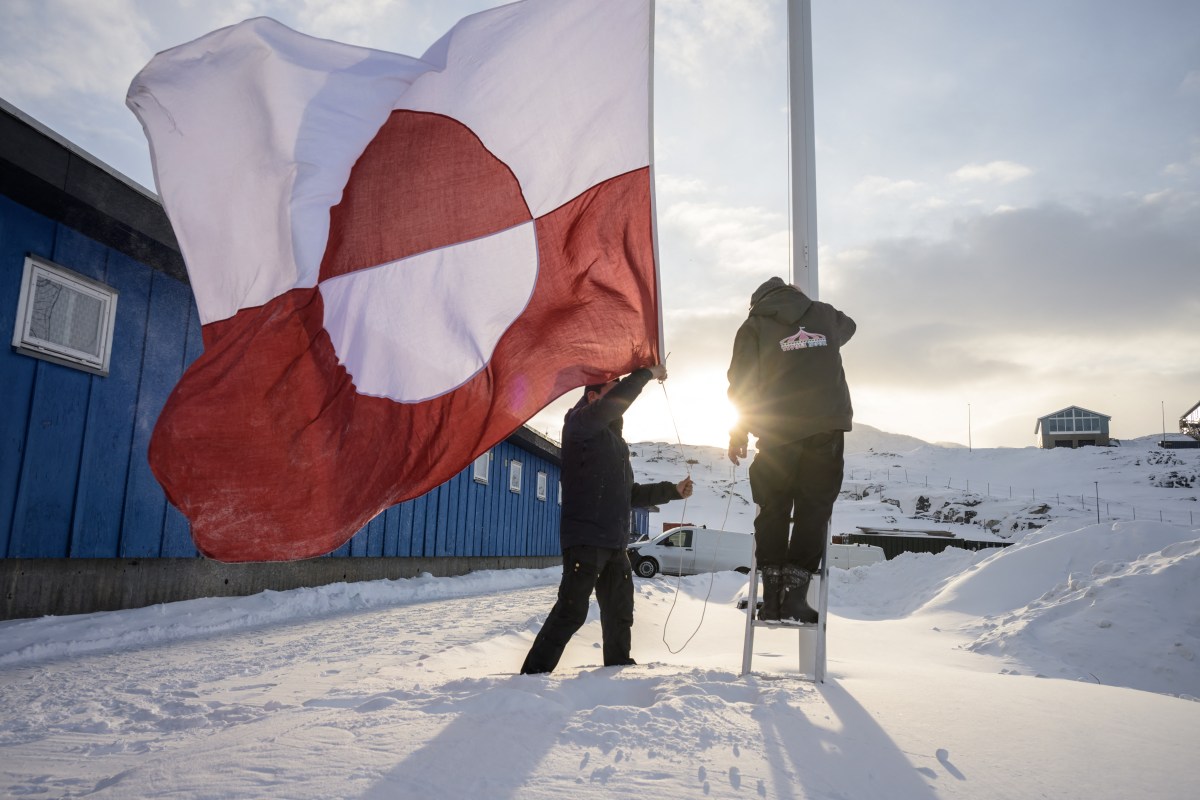
At first glance Greenland and Iran have little in common—one icy, the other with scorching deserts.
Yet the U.S.-Israeli war on Iran may, unexpectedly, have strengthened President Donald Trump’s arguments that America needs to own Greenland—arguments he made most forcefully in January, horrifying European allies in NATO and the public—most of all in Denmark which owns the territory.
So when some NATO allies declined to support the U.S. in its Iran war that began six weeks ago, Trump’s stated goal of better protecting the U.S. in a fast-changing geopolitical and technological era may just have made owning Greenland even more pressing, especially with the island on a potentially unpredictable path to independence, experts have told Newsweek.
Others, however, say that with the congressional midterm elections in November approaching fast, Trump’s hands are tied on any further moves on Greenland. As much as he wants to own it, further action could cost him votes, even among his core MAGA supporters who increasingly are unhappy about his growing foreign interventions.
The White House pointed to the connection between Greenland and Iran this week, reposting the president’s remarks on its X account on Friday as the U.S. and Iran prepared for talks in Islamabad on ending the war: “NATO WASN’T THERE WHEN WE NEEDED THEM, AND THEY WON’T BE THERE IF WE NEED THEM AGAIN. REMEMBER GREENLAND, THAT BIG, POORLY RUN, PIECE OF ICE!!!” Messages earlier in the week by the president on his Truth Social account linked Iran, Greenland and NATO.
The path between Greenland and Iran may be winding, but a stake may be nothing less than the future of NATO, the post-World War II defensive alliance that kept the peace during the Cold War and which turned 77 years old a week ago.
Perception of Security Threats
At the heart of Trump’s arguments for owning Greenland. is a gulf between American and European perceptions of security threats, said Michael Lucci, the founder of State Armor, a political organization that works for national security resilience at the state level in the U.S.
Lucci pointed to how some NATO allies including Britain, France and Spain were unwilling to fully or partially support the U.S. in its war on Iran, refusing basing or overflight to the U.S. Air Force, or to send warships to patrol or open the Iran-controlled Gulf of Hormuz.
“The gap between American and European perceptions of security threats is quickly becoming unsustainable,” Lucci told Newsweek.
“In January, European capitals took great offense when President Trump argued for U.S. ownership of Greenland. By March, America’s military was being denied the use of bases and airspace…because some NATO allies do not view Iran as a threat, and therefore took the position that undermining American lethality against the Iranian regime was the right thing to do,” Lucci said.
“This underlines why President Trump argued for American ownership of Greenland,” Lucci continued.
“European capitals do not perceive the same threats America perceives, and they went out of their way to kneecap us in the Iranian conflict even though the Iranian threat is much closer to Europe than to America,” Lucci said, adding: “Greenland has dramatic security implications for North America…and the gap between American and European perceptions of external threats continues to grow.”
4-D Chess or Chaos?
For sure, it’s complicated.
Trump’s supporters point to his penchant for deliberately convoluted deal-making and what they say is his ability to play “4-D chess.”
But others see less “4-D chess” in Trump’s maneuverings and more chaos, albeit one underlined by an “America First” policy.
“The thread is naked self-interest and absolutism around America First. And anything else is transactional,” said Andy Pryce, a former British diplomat who specializes in countering information threats and cognitive defense, who today is a senior non-resident fellow at the Center for European Policy Analysis (CEPA) which is headquartered in Washington, D.C. with branches in London and Brussels.
Yet Pryce said that something even bigger underlined the logic of this complex geopolitical moment: China.
And that was connected to vital rare earths, which China largely controls and has used to pressure the U.S. for concessions as it rises and seeks to displace America’s global standing.
“So, Greenland is rare earth metals, and potentially the sort of more peripheral arguments on defense, but they’re sort of taken care of anyway, in terms of the current treaty and the current capability they have in Greenland,” Pryce said, referring to a 1951 defense agreement between U.S. and Denmark which allows Washington to maintain military installations in Greenland. Three-way talks between the U.S., Denmark and Greenland on the island’s future began in January and are ongoing.
“The starting point is that 77 million people voted for Trump and a decent proportion of those people knew what he is and what his agenda is globally, or lack of agenda globally. At the moment [he] has few guardrails, few checks and balances,” Pryce said.
“So I think any government in Europe would be crazy to think within the next 20 years that you’re going to have any degree of stability of the Atlantic…European governments really need to think long and hard about every aspect of their national security,” Pryce said.
Right About Russia
For years, Europe failed to see that Russia threatened its security, deeply exasperating the U.S. and weakening the trans-Atlantic bond, said Lucci.
“American leaders have become exasperated with Europe’s leaders because our European allies have consistently taken a much narrower view of security threats at the expense of European security. The American view of Russia as a persistent threat to Europe was proven correct, but America’s leaders were unable to convince Europe’s leaders to stop buying Russian gas, strengthen their economies, and build up their militaries until three years into Russia’s second invasion of Ukraine,” in 2022, Lucci said.
Russia is also waging hybrid war across Europe, with governments scrambling to respond.
“Today, the U.S. argues that China, Russia, and Iran are threats to both American and European security. European leaders do not seem to recognize [the] need for serious action to counter Iran and China, despite both of those regimes quite openly supporting Russia’s invasion of Ukraine and despite the broader threats of Iranian-sponsored terrorism and CCP [Chinese Communist Party] economic and hybrid warfare upon Europe and the U.S.,” Lucci said.
Still, the midterm elections will dampen any further effort to push for outright control of Greenland, at least kinetically, says Nathalie Vogel, a research fellow with the Center for Intermarium Studies at the Institute for World Politics, which is in Washington, D.C.
“The Greenland debate won’t flame up again because before the midterms it would provide food for those who oppose it, and that’s both the breakaway MAGAs and the Democrats,” Vogel said.
“They’re saying, ‘He wants to involve us in another foreign adventure, but we have enough problems at home.’ It would cost him the election and I don’t think it will happen,” Vogel said, pointing out that most Americans oppose the U.S. seizing Greenland, and that bipartisan legislation has been introduced in Congress to prohibit the use of federal funds to annex or seize the territory without consent.
With the Iran war, “the mood has gotten even worse within MAGA about foreign intervention,” Vogel said.
Read the full article here


