



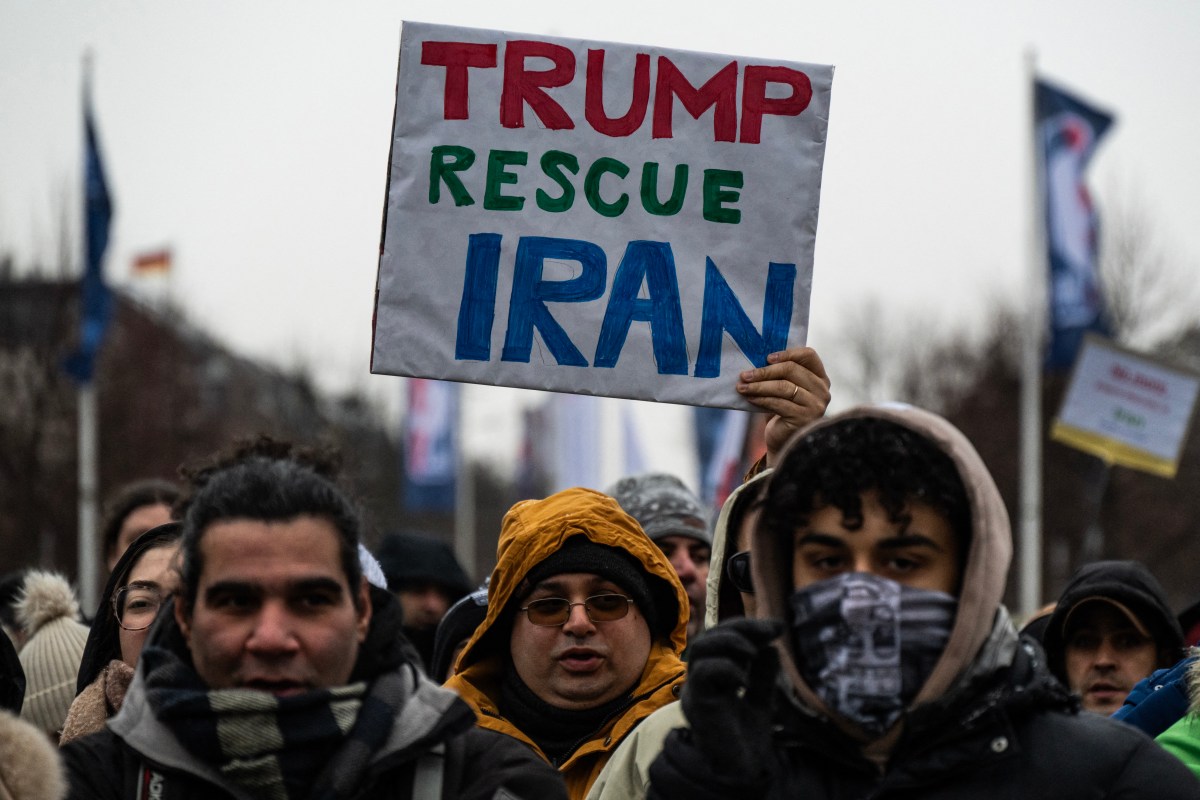
On Monday in Tehran’s Grand Bazaar, a trader told Reuters about his frustrations with the regime. “We are struggling. We cannot import goods because of U.S. sanctions and because only the Guards or those linked to them control the economy. They only think about their own benefits.” The scene is a small window onto a much bigger story: the worst antiregime protests in years, triggered partly by a collapsing economy and a currency in free fall. This week, President Donald Trump assured protesters that help was on its way, even in the form of tariffs on countries that trade with Iran, with China squarely in his sights.
The history of U.S.-Iranian relations provides an interesting example of how tariffs can work in practice, with direct relevance to today’s protests. One of the regime’s most valuable non-oil earners is pistachios. And for four decades, a significant U.S. antidumping duty on Iranian pistachios has helped California—99 percent of U.S. production—steal a march on Iran in global markets, including, crucially, China. California growers now sell far more pistachios into China than Iran does, even as Chinese buyers remain Iran’s lifeline for oil and commodities. California’s orchards have steadily rerouted billions away from Esfahan and Kerman and toward Fresno and Kings County.
The decline of Iranian pistachios is an illustrative part of the economic malaise now sparking protests across the country.
Common Knowledge
Trump is not equivocating. “Effective immediately, any Country doing business with the Islamic Republic of Iran will pay a Tariff of 25%,” he posted on Truth Social, as the White House weighs further steps in response to Iran’s crackdown.
On the left, his critics call tariff brinkmanship an abuse of an economic tool to satisfy foreign-policy whims. “total, random chaos” and “an abuse of the tariff tool… to threaten countries based on foreign-policy whims.”
Hawks counter that pressure works, and that supporting Iranian protesters is not only ethically sound but a necessary protection against Iranian influence in the region and its nuclear ambitions.
Uncommon Knowledge
In 1979, Iran dominated the global pistachio trade. The revolution and hostage crisis put an end to that. In 1986, the United States imposed an antidumping duty on Iranian in-shell pistachios, after California growers accused Tehran of selling below cost. The order—51 Fed. Reg. 25922—has been upheld across reviews and is a prohibitive 241.14 percent rate. The upshot: a crop once synonymous with Iran started to shift to California.
The state’s first commercial crop was just 1.5 million pounds in 1976; by 1980 it had jumped to 27.2 million pounds, and over the next four decades export shipments exploded—from 1.6 million pounds in 1985/86 to 847.8 million in 2023/24. By the mid-2000s, U.S. growers had even become the top pistachio supplier to the European Union, long Iran’s key battleground.
By 2024, California accounted for 99 percent of U.S. pistachio production and shipped a record crop; the state’s pistachio harvest is now a multi-billion-dollar business supported by industrial-scale processors.
Iran, once the undisputed global leader, still relies heavily on pistachios as a non-oil export. Official and industry tallies place recent annual pistachio exports near $1 billion. Yet it is under huge pressure. China’s 2023 pistachio imports from the U.S. ($395.9 million) were over six times its imports from Iran ($62.6 million). Even after a surge in late 2024, China still bought more from the U.S. by value ($584.4 million vs. $268.5 million).
The numbers matter because pistachios are a bellwether for how trade pressure reshapes revenue streams inside sanctioned economies. Oil can be laundered; agricultural products are harder. Now layer on Trump’s 25 percent tariff on countries that “do business with Iran.” It’s not a sanction on Iran per se; it’s an attempt to tax its partners—China, the UAE, India—raising the cost of being Tehran’s outlet to the world. Whatever the legal durability, the threat signals that pistachio-adjacent markets could be weaponized.
None of this means pistachios topple regimes. But it does show how unintended coalitions—a Reagan-era trade remedy, Chinese consumers’ Lunar New Year snacking, Fresno agribusiness, California groundwater—converge to constrain Tehran’s room to breathe. When protesters in Tehran curse the currency spiral, they’re feeling dozens of shocks at once: sanctions, misrule and capture by the Guards, and a hostile global trading environment.
If you’re enjoying Uncommon Knowledge, please share. If you have suggestions for future editions or feedback, email subscriber.feedback@newsweek.com. We want to hear your voice.
Read the full article here


