



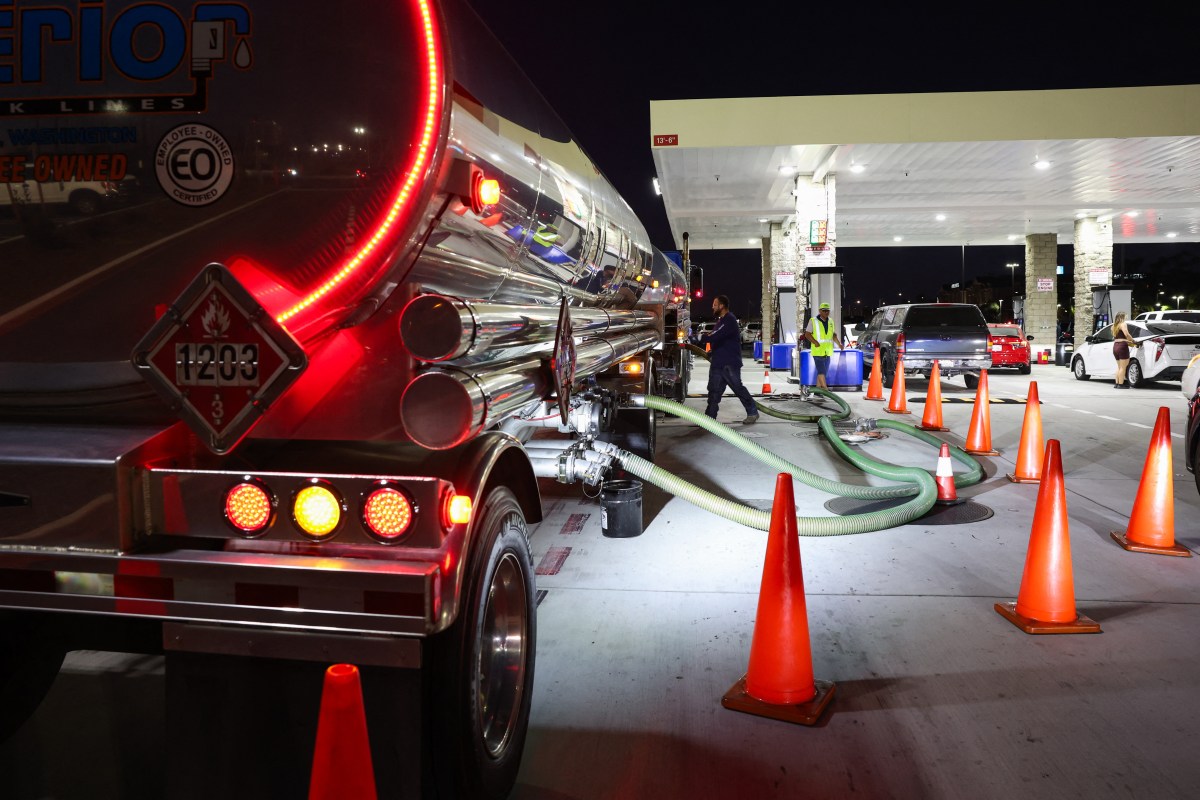
Gas prices continued their climb on Thursday, creeping closer to a nationwide average of $4 per gallon—a level not seen since 2022, when the Russian invasion of Ukraine and the COVID-19 pandemic disrupted global oil supplies.
The nationwide average cost of a gallon of regular gas was $3.884 on Thursday, according to data from the American Automobile Association (AAA), up from $3.842 on Wednesday, $3.598 a week earlier, and $2.929 a month earlier.
Patrick De Haan, head of petroleum analysis at GasBuddy and one of the most respected authorities on the topic of gas prices, wrote on X on Wednesday that, considering “where things stand now,” the U.S. has “a 90 percent chance” of hitting an average of $4 per gallon of regular gas “perhaps by the end of the month.”
Why It Matters
President Donald Trump returned to the White House with the promise of lowering the cost of living—including gas prices—for all Americans, bashing his predecessor Joe Biden for higher inflation during his mandate. Only four days before the U.S. and Israel launched their joint strikes against Iran on February 28, the White House was bragging about recent declines in gas prices, attributing them to “American energy dominance.”
But being the world’s leading oil producer did not shield the U.S. from the global rise in oil prices that has followed the start of the conflict in the Middle East and the restriction on travel through the Strait of Hormuz, where one fifth of the world’s oil usually transits.
While gas prices remain below the pandemic peak of over $5 reached in June 2022 under Biden, Trump and the Republican Party risks facing a backlash from disgruntled voters at this year’s midterms because of higher prices at the pump.
What To Know
Since Trump jointly launched attacks on Iran with Israel, the average gas price nationwide has risen by nearly a dollar, going from under $3 to nearly $4 as of Thursday.
Energy Information Administration’s (EIA) data comparing prices in mid-February and mid-March shows the second-largest four-week increase in at least 30 years, as reported by the New York Times, bigger even than the hike reported after the start of the war in Ukraine in 2022.
In the past few weeks, gas prices have increased in every state and the District of Columbia. In California, where drivers already paid the highest prices in the nation, the average cost of a gallon of regular gas has now reached $5.616, up from $4.593 a month earlier.
Prices would have risen during this period even without the conflict in the Middle East, as demand for gas spikes as spring break begins and drivers hit the road. But what would have been a modest, seasonal increase has been turbocharged by the hike in global crude oil prices caused by the Iran war, which has reached over $100 a barrel.
What People Are Saying
Vice President J.D. Vance said on Tuesday: “Look, gas prices are up. And we know they’re up, and we know that people are hurting because of it. And we’re doing everything we can to ensure they stay lower. This is a temporary blip.”
Trump said in an interview with Reuters earlier this month that he was not concerned about rising gas prices: “If they rise, they rise. I don’t have any concerns about it. They’ll drop very rapidly when this is over, and if they rise, they rise, but this is far more important than having gasoline prices go up a little bit.”
Karoline Leavitt, White House press secretary, said earlier this month: “Once the national security objectives of Operation Epic Fury are fully achieved, Americans will see oil and gas prices drop rapidly, potentially even lower than they were prior to the start of the operation, and we will live in a world where Iran can no longer threaten the United States or our allies with a nuclear bomb.”
What Happens Next
While the Trump administration has appeared to downplay the rise in gas prices, there are hints suggesting the president and his circle are in fact concerned about it and trying to counteract it.
The U.S. has recently announced that it will release 172 million barrels of oil from its strategic reserves over four months to help offset rising prices, as part of a broader effort by the International Energy Agency to release a total of 400 million barrels of oil.
This week, Trump has also declared he will loosen shipping rules, issuing a 60-day waiver of a 100-year-old law requiring shipping between U.S. ports to be conducted by U.S.-flagged ships, the Jones Act, to lower gas prices. “President Trump’s decision to issue a 60-day Jones Act waiver is just another step to mitigate the short-term disruptions to the oil market as the U.S. military continues meeting the objectives of Operation Epic Fury,” Leavitt wrote on X on Wednesday.
Experts believe oil and gas prices would likely continue rising until transit across the Strait of Hormuz is restored.
Read the full article here


