



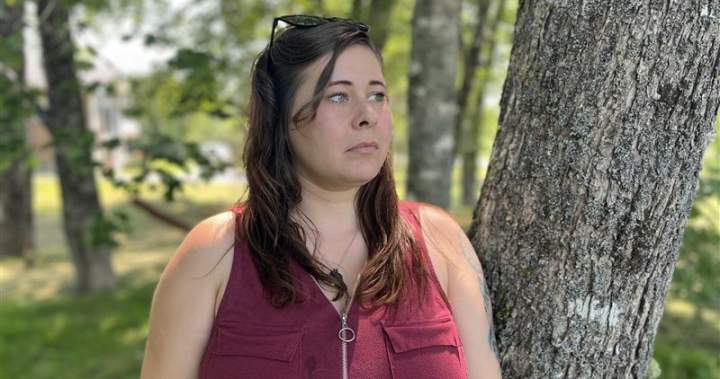
A Nova Scotian woman says the justice system has failed her in her intimate partner violence case.
Brandi Whynot has waited years to read her victim impact statement aloud in court after her ex assaulted her in 2021.
But a joint submission entered into between Crown prosecutors and her ex’s defence counsel means Whynot will no longer get the chance.
“I wish I could have had my opportunity in court to say to the judge and the Crown, ‘This is exactly how this has affected my life,’” she says.
According to court documents, the assault occurred between Nov. 25 and Dec. 9, 2021, just after Whynot had given birth to their daughter.
In a March 2025 interview with Whynot at her home in Liverpool, she described the attack that prompted her to report her ex to police.
She says he then pinned her against the wall and began to choke her.
“And the last thing I remember before I blacked out was, ‘I’m going to die and I’m never going to see my daughter again.’”
For the last four and a half years, her case has slugged through the court system as her ex skipped out on court dates and struggled to retain legal representation.


Get breaking National news
Get breaking Canada news delivered to your inbox as it happens so you won’t miss a trending story.
After breaching his release conditions, he was arrested in January and remanded into custody until his trial, which was eventually set for early May 2026.
“So, I got from January until May, where he did serve solid time, which was the best six months that I’ve had to be able to process and be at peace and not feel scared of things,” Whynot says.
“And then all of a sudden, they said, ‘No, there’s no trial. Instead, we’re offering him a deal.’”
The Crown offered Whynot’s ex a plea deal — a guilty plea in exchange for enhanced credit for time served on remand.
Global News reached out to Whynot’s ex for comment in 2025, at which point he denied the allegations against him.
But on May 19, he accepted the deal, pleading guilty to six of 12 charges, including assaulting Whynot, intimidation and breaching conditions and avoiding a trial.
He was sentenced to a remaining one day in custody and two years of probation with conditions.
His other charges were dismissed and he was released later that day.
“It’s an absolute slap in the face to me,” Whynot says. “I just feel totally dismissed in every way (…) To me, a victim is a victim. And this is something that needs to be taken far more seriously than what it ever was.”
According to the public prosecution service, due to multiple bench warrants since he was initially charged, Whynot’s ex had served 202 days in custody.
This means after applying remand credit at a 1:1.5 ratio, he had banked 303 days in custody, prompting the Crown and defence to strike a deal.
Rebecca Jaremko Bromwich, a lawyer and professor in Carleton University’s Faculty of Law and Legal Studies, says that although it’s hard for the public to wrap their heads around, it is actually the minority of cases that end up going to trial and guilty pleas are considered to be in the interest of justice.
“So, none of that is unusual in our system,” Bromwich says. “But it does highlight the fundamental challenge that it can be very frustrating and alienating for individuals who have suffered at the hands of somebody and have been victimized to be further re-victimized by a lack of agency in the proceedings.”
While victims are not official parties in the court proceedings, Bromwich says there are ways Crown lawyers can give survivors of intimate partner violence agency in the process.
“I’d love to see the Criminal Code fundamentally altered and have comprehensive criminal code reform,” Bromwich says.
“But … until the revolution comes, Crowns could simply make it part of their practice to contact victims before they accept a joint submission and say, ‘How do you feel about this?’ And consult in a meaningful way with victims before accepting a joint submission.”
Something Whynot says she wishes had happened in her case.
Despite intimate partner violence being declared an epidemic in 2024, she says she’s heard of lots of victims still falling through the cracks.
“We’re told to go and ask for help if we need it and then those cries for help are ignored,” Whynot says. “I just feel like the province has totally failed in that aspect.”
According to Bromwich, while some progress is being made, the justice system has a long way to go.
“More work needs to be done and work is being done, but I think governments need to pay more attention to the seriousness of this epidemic situation,” Bromwich says.
In the meantime, Whynot hopes to do her part by advocating and supporting other victims of domestic violence.
“My child is my life, and I really push through all of this for her protection and for her because I want her to have a better world to grow up in and it to be safe,” Whynot says.
“I sincerely hope going forward, no case is ever treated like mine.”
Read the full article here


