



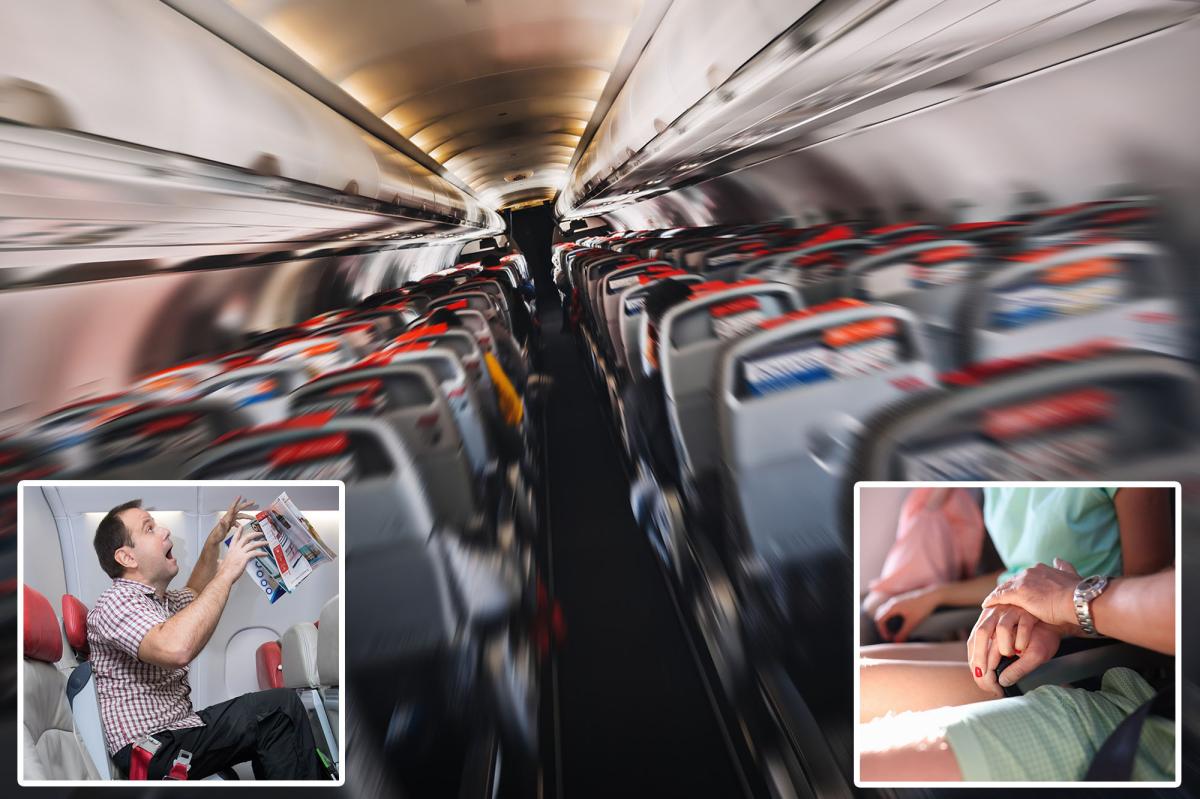
Things that go bump in the flight.
Soaring levels of turbulence have increasingly turned air travel into a real nightmare at 30,000 feet. Just last month, two people suffered broken ankles after a British Airways flight encountered severe turbulence en route to the UK.
The most infamous recent incident occurred in May 2024 when a 73-year-old British grandfather was killed and more than 30 others were injured after a Singapore Airlines flight hit severe turbulence — plummeting 6,000 feet and sending unfastened travelers crashing into overhead bins.
Unfortunately, air passengers likely face more turbulent times ahead. According to a 2023 study out of the University of Reading in the United Kingdom, clear-air turbulence — high altitude bumps that occur in the absence of clouds — has increased in regions around the world.
Between 1979 and 2020, the total annual duration of severe turbulence over the North Atlantic — one of the world’s busiest flyways — soared by 55%. Meanwhile, moderate turbulence skyrocketed by 37%, and light turbulence saw a 17% increase.
These increasingly bumpy rides have been chalked up to climate change, experts have said.
“Following a decade of research showing that climate change will increase clear-air turbulence in the future, we now have evidence suggesting that the increase has already begun,” said Professor Paul Williams, an atmospheric scientist at the University of Reading who co-authored the study.
As a service to readers, we’ve compiled a turbulence survival guide to help passengers stay safe in the unfriendly skies.
Stay strapped
There’s no “Bourne Identity”-esque super move to avoiding injury during a tumultuous plane trip. Rather, staying safe is often as simple as — to reiterate the airline safety briefing — as strapping in.
“The thing you want to do is be seatbelted when you’re in your seat,” A View From the Wing contributor Gary Leff told the Post, noting that most turbulence-induced injuries involve people who weren’t belted in.
“What you don’t want is to fly out of your seat, hit your head on your hip end,” he declared.
Unfortunately, Leff noted, fastening one’s belt doesn’t negate other dangers that occur during plane gyrations, such as “heavy stuff that other passengers may have yourself that could go flying.”
He noted that crew members are “more at risk than passengers because they’re the ones who are most up and about.”
While wearing a seatbelt is vital, airline experts don’t believe in laws mandating that they be fastened for the duration of the flight — for several reasons.
For one, people need to be able to get up and use the bathroom, per American Airlines Captain Dennis Tajer, who argued that keeping it on for the entire flight can also diminish its importance.
“What we’ve learned is that by leaving the seat belt sign on, when it’s really not necessary, and there is smooth air, you normalize ignoring the seat belt sign,” declared the flyboy. He added that “just having it on all the time doesn’t make it unique and people get used to it, and then they start to just ignore it.”
The answer isn’t “having a law that says you must have your seat belt on anytime you’re seated…the answer is continued education,” he said.
Seat selection
While most turbulence isn’t dangerous, even moderately rough skies can cause panic — or even nausea — for those who have a fear of flying.
Thankfully, turbulence-averse travelers can mitigate the effects of a mid-air rumble by sitting over the wings or toward the nose of the plane and not the back of the plane.
“The wings are more closely located to the center of gravity of the airplane, therefore, the ride while sitting near the wings may feel less turbulent than near the tail of the aircraft where vertical input is felt the most,” Tajer previously told Fox News.
Although Tajer noted that while the sitting aft is generally less table, “depending on the movement of the air, the ride may feel different.”
However, curbing the “turb” isn’t the only benefit to the middle of the plane. It “also makes it a lot easier for you to move about the plane, easing the feelings of claustrophobia,” a British Airways flight attendant, who opted to go anonymous, previously told the Daily Mail.
Jelly roll
When sitting in the “fly” of the storm is unavoidable, flyers can still employ various techniques to make the bumps less brutal.
One secret method flight attendants employ? Rolling with the airplane punches….so to speak.
“When turbulence hits, basically, just pretend you’re jelly or submerged in jelly,” a flight attendant explained in a viral TikTok video. “Wiggle in your seat like a little jellyfish; you’ll feel so much better.”
By moving in tandem with the motion of the airplane, flyers can reduce the tension in their muscles and minimize the impact when the rubber hits the air.
Read the full article here


