






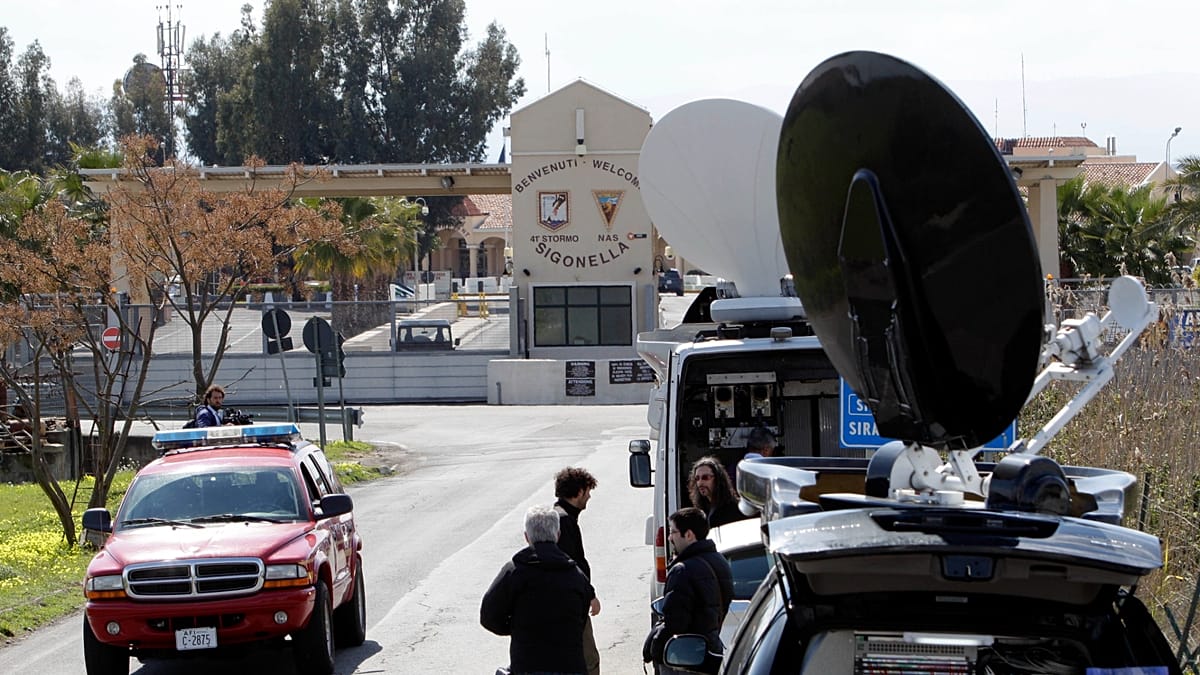
Between 27 and 28 March, Italy refused a request from the US military for aircraft to land at the Naval Air Station Sigonella on the island of Sicily in the Mediterranean, before continuing towards the Middle East.
The decision came shortly before Spain announced it would close its own airspace to US planes reportedly involved in strikes on Iran, prompting speculation about a coordinated political stance from the two European countries.
On social media, some users have claimed the refusal reflected a political stance by Prime Minister Giorgia Meloni, suggesting Italy was distancing itself from US policy or reacting to broader tensions involving NATO and Iran.
However, these claims miscontextualise the truth.
A procedural issue
Reporting by the Italian newspaper Corriere della Sera indicates that Washington requested authorisation to use Sigonella after the aircraft had already departed from the US. Under Italian regulations, prior approval is required for foreign military aircraft to access national bases.
This requirement is part of pre-established administrative procedures, meaning requests are assessed in advance and on a case-by-case basis, according to the Italian government.
In this instance, because the request was submitted after take-off, it did not meet the necessary conditions and was therefore denied.
What do the agreements say?
The presence and use of US military forces in Italy are governed by a set of bilateral defence agreements dating back to 1954, established in the early years of the NATO alliance and regularly updated since. These agreements allow the US access to certain facilities, including Sigonella, but under clearly defined conditions.
In practice, most routine activities fall under what Italian authorities describe as “technical authorisations” — covering logistics, transport and support operations.
These are often referred to as “non-kinetic” missions, meaning they do not involve direct military action or physical force.
Speaking to Italian radio station RTL 102.5 earlier in March, Prime Minister Giorgia Meloni reiterated that these agreements allow logistical and non-combat activities only, adding that “there will be no use of the base outside this agreement.” She also stated that any request involving military operations would be evaluated on a case-by-case basis, potentially involving parliament.
More broadly, addressing the Senate on 11 March, Meloni described Italy’s position in cautious terms, stating: “We are not at war, and we do not want to enter a war,” and emphasising that any changes in how Italian bases are used would need to go through the proper political channels.
What has the government said?
According to an official statement released by the Italian government, the refusal to allow US planes to use the base must be understood within an established legal and procedural framework rather than as a political message.
In the press release, Palazzo Chigi, the prime minister’s official residence, said that Italy “acts in full compliance with existing international agreements” and in line with the policy guidelines set out by the government to parliament.
It describes the government’s position as “clear” and endorsed by parliament, with no change in policy.
It also underlines how decisions are made in practice. Each request to use military bases is “examined carefully, on a case-by-case basis”, following procedures that have “always been the case in the past”.
This suggests a structured review process rather than a one-off or politically motivated refusal.
The remarks come amid rising tensions within NATO, after Donald Trump renewed criticism of the alliance and the leaders of member states, reportedly raising the prospect of a US withdrawal and accusing European allies of insufficient military support.
European leaders, including French President Emmanuel Macron, have warned such rhetoric could undermine unity and strategic credibility, while calling for continued cooperation.
In London, Prime Minister Keir Starmer has reiterated NATO’s role as a cornerstone of collective defence, highlighting a widening transatlantic divide over security priorities.
Read the full article here


