



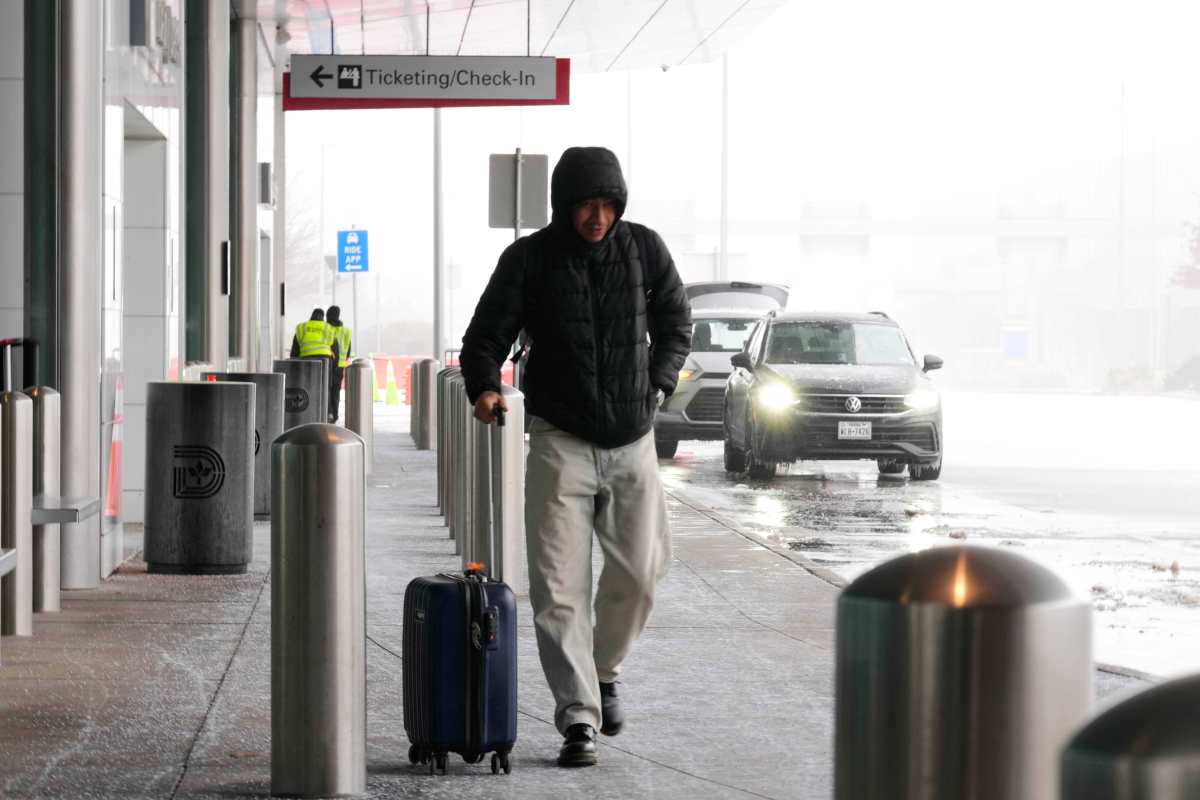
A massive winter storm has disrupted travel and cut power to thousands across the United States, with more than 13,000 flights canceled over the weekend as the system threatens nearly 180 million people—more than half the U.S. population—with widespread heavy snow, sleet, and freezing rain.
The storm stretched from the southern Rocky Mountains to New England on Saturday, prompting President Donald Trump to approve emergency declarations for at least a dozen states. About 140,000 power outages were reported in the storm’s path, including more than 58,000 in Louisiana and 50,000 in Texas, according to poweroutage.us.
Meteorologists had warned the storm’s severity could rival that of a hurricane, particularly in areas facing significant ice accumulation. On Friday, WCNC chief meteorologist Brad Panovich issued a stark warning to residents in the Carolinas.
“This isn’t a ‘fun snow day.’ This is a damaging ice event,” Panovich posted on X. “We have been lucky for a long time, but the data is showing a setup that demands respect and preparation.”
The National Weather Service (NWS) warned that snow and ice would be “very, very slow to melt and won’t be going away anytime soon,” hindering recovery efforts. Homeland Security Secretary Kristi Noem said the Federal Emergency Management Agency (FEMA) pre-positioned commodities, staff, and search and rescue teams in numerous states.
“We just ask that everyone would be smart—stay home if possible,” Noem said.
In Shelby County, Texas, near the Louisiana border, ice weighed down pine trees and caused branches to snap, downing power lines. About a third of the county’s 16,000 electric customers lost power on Saturday. In DeSoto Parish, Louisiana, more than half of all electric customers were without power, with trees “completely saturated with ice,” according to local officials.
Sunday’s flight cancellations are already the most on any single day since the coronavirus pandemic, according to aviation analytics firm Cirium. All Saturday flights were canceled at Will Rogers International Airport in Oklahoma City, with Sunday morning flights also called off. Dallas–Fort Worth International Airport saw more than 700 departing flights canceled Saturday, with nearly as many arriving flights scrubbed. By late Saturday afternoon, nearly all departing flights scheduled to leave Ronald Reagan Washington National Airport on Sunday had been canceled.
Georgia officials advised people in the state’s northern regions to get off roads by sundown Saturday and prepare to stay put for at least 48 hours. Will Lanxton, the senior state meteorologist, said Georgia could experience “perhaps the biggest ice storm we have expected in more than a decade.”
“Ice is a whole different ballgame than snow,” Lanxton said. “Ice, you can’t do anything with. You can’t drive on it. It’s much more likely to bring down power lines and trees.”
Georgia deployed 120 National Guard members to northeast Georgia, with 1,800 highway workers on 12-hour shifts treating roads with brine. After sweeping through the South, the storm was expected to dump more than 1 foot of snow in the Northeast.
The Midwest experienced windchills as low as minus 40 degrees Fahrenheit, where frostbite could set in within 10 minutes. Rhinelander, Wisconsin, recorded minus 36 degrees Saturday morning, the coldest reading in almost 30 years.
Panovich had warned Friday that areas could see up to 1 inch of ice accumulation, with particularly dangerous conditions expected in Charlotte, Asheville, Spartanburg, and Boone. AccuWeather senior meteorologist Tom Kines previously told Newsweek that long-lasting power outages could persist up to a week in some of the hardest-hit areas.
“At 0.25 inches, tree limbs snap and power lines go down. At 0.50 inches or more, we are talking about widespread, long-duration power outages and impassable roads,” Panovich said in his Friday warning.
Schools announced Monday closures in Dallas, Houston, Philadelphia, and Memphis, while universities including the University of North Carolina at Chapel Hill and the University of Mississippi canceled classes. Mardi Gras parades in Louisiana were canceled or rescheduled, and the Grand Ole Opry in Nashville held its Saturday night radio performance without fans.
New Jersey Gov. Mikie Sherrill announced restrictions on commercial vehicle travel and a 35 mph speed limit on highways Saturday. “We are expecting a storm the likes of which we haven’t seen in years,” she said. “It’s a good weekend to stay indoors.”
NOAA meteorologist Josh Weiss noted the storm’s unusual characteristics. “You’ve got 2,000 miles of country that’s being impacted by the storm with snow, sleet, and freezing rain,” he said. “The other part of this storm that’s really impressive is what’s going to happen right afterward. We’re looking at extreme cold, record cold.”
Reporting from the Associated Press contributed to this article.
Read the full article here


