



Even for Australians, the island of Tasmania is obscure. For Americans, it’s frightfully far-fetched. Its capital, Hobart, is known as the gateway to Antarctica, and that should give you some idea of its place in the world, a good deal farther south than Cape Town.
“People want to go to areas that feel remote and exclusive,” says Stuart Rigg, owner and director of Southern Crossings, a luxury travel agency specializing in Australia. “Travel used to be icon-driven. A North American visitor wanted to see the Sydney Opera House, the Great Barrier Reef and the rock [Uluru]. Now, Tasmania is on the radar, because you can go to these places where you aren’t going to really see other people except for your fellow travelers.”
Most Tassie expeditions begin at this harbor city, reminiscent of a fossilized New England fishing town, with lobster traps piled on the decks of wooden dories. Hobart has some of the cleanest air in Australia — and, therefore, the world — and you come here to get out in it.
In less than an hour, you can be hiking among prehistoric ferns born in ancient Antarctica under the canopy of a temperate rainforest, or tracing dolomite column coasts that jut 1,000 feet from the sea like transcendental organ pipes. Drive an hour more and you’ll discover giant gum trees the size of American redwoods. Choose between otherworldly highland lakes, turquoise bays or snow-capped mountains beautiful and treacherous enough to claim the lives of the ill-prepared.
On the trails, you’re sure to find wallabies, echidnas, wombats and, if you’re very lucky, a Tasmanian devil. The coats of the endemic marsu-pials here are fluffier (i.e., cuter) than their mainland cousins thanks to the colder climate — and with the thylacine (or Tasmanian tiger) extinct, they have few or no predators, making them less perturbed.
All this talk of rugged bush could lead, however, to the wrong conclusion: that you’ll be pitching a tent and surviving on primitive provender. Not a chance. Tasmania knows what it has and who it’s for, and they’ve built the five-star infrastructure to move through it in epicurean style.
The best hotel in Hobart is the Tasman, a masterwork of adaptive reuse. Opened in 2021 within Marriott’s Luxury Collection portfolio, it’s a pastiche of three buildings — one Victorian sandstone and one Art Deco, with a newly built three-story curtain-glass penthouse pavilion atop. The presidential suite comes with a roof terrace and asks around $2,100 a night during summer high season.
The hotel is steps from the harbor, so spend your time here eating. Hobart has the best seafood scene outside of Japan, with the freshest, richest oysters, rock lobsters and mussels clean, cold waters can produce.
The Tasman’s in-house restaurant Peppina is also a pippin, and one of the best in the city. Although it ostensibly serves trattoria-style Italian, a panoply of pickled vegetables and a menu of clean preparations, relying on quality ingredients for flavor gives the restaurant an almost Scandinavian character.
You’ll leave here with the Tasmanian Walking Company (part of Great Walks of Australia) on a multiday luxury hiking adventure. There are several to choose from, including Cradle Mountain to the west, the Bay of Fires to the northeast and the iconic Three Capes — Pillar, Hauy and Raoul — to the southeast.
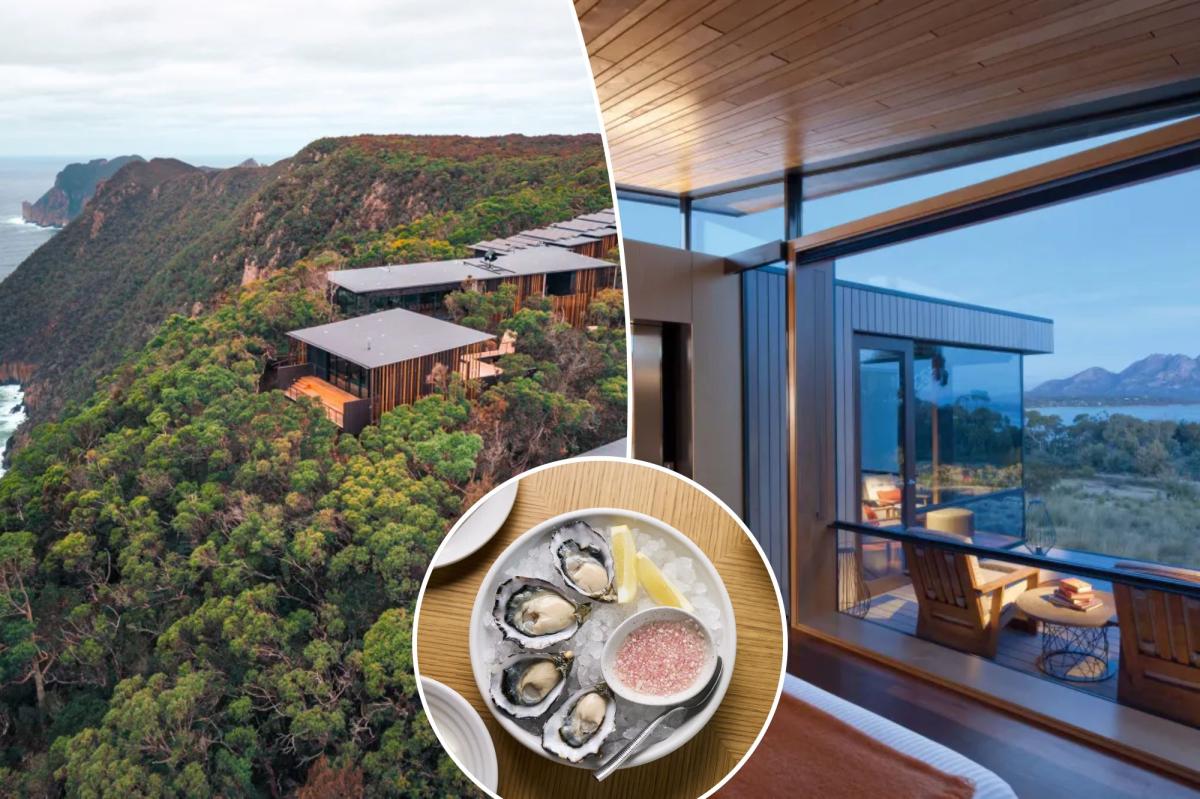
The latter is a good place to start. It’s a small-group, four-day journey between gemlike eco-lodges, where your portered luggage will be waiting, within the Tasman National Park. It’s slow and convivial, and the perfect way to reconnect with a loved one as you float through fairy-tale environments that exist only here. Your two guides will treat you to a master class on native flora and fauna as you amble toward your daily destination, where warm towels, hot showers, cold Champagne and chef-prepared suppers await. It starts at roughly $2,500 per person, and you’ll want to book a year ahead to get a spot.
There’s similar year-out demand at Luxury Lodges of Australia member Saffire Freycinet. It’s easily Tasmania’s most senior resort, situated in Freycinet National Park on Tasmania’s east coast overlooking pink-hued mountains and a bodacious bay. Nowhere does effortlessly sophisticated all-inclusive service quite like Australia — where you’ll never be asked to “sign” and the response to every request is a “Too easy, mate.” But with just 20 rooms and suites, Saffire is one of the world’s most competitive bookings.
In 2023, when Paul McCartney couldn’t get a reservation during his Australian tour, the owners decided to put things right. This spring, they’re unveiling a three-bedroom “super villa” with a private heated pool, an outdoor spa bath and an alfresco entertainment area for private dining. It’s bookable for around $17,000 per night.
That’s not Luxury Lodges’ only new trick for adventure hounds who snoot at budgets. On Board — the operator of Odalisque III: a five-star, purpose-built expedition cruise with just seven cabins — has begun sailing from Hobart to UNESCO World Heritage-listed Port Davey and Bathurst Harbour starting this month. With sculpted coastlines covered in ancient Huon pine forests, these are some of Australia’s last true frontiers. The two-day journey starts at roughly $4,000 per person.
“This southwest wilderness area used to be so hard to access,” says Rigg. “A little seaplane would run down, and you’d get a couple of hours to walk before flying back. With the multiday cruises, you can kayak and walk in areas that are really remote and untrodden.”
Read the full article here


