



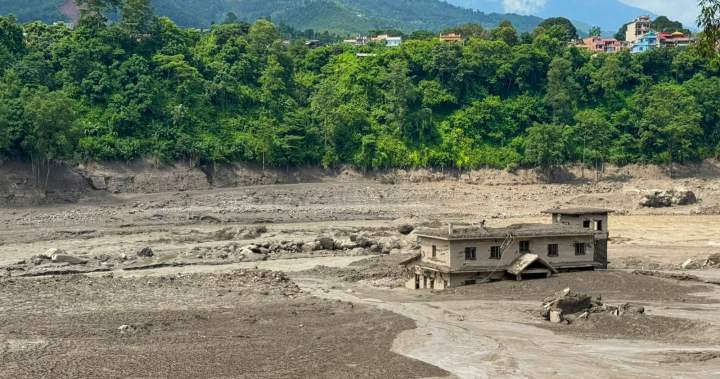
Ten Torontonians are missing in Nepal after devastating flash flooding and mudslides, a non-profit in the region says, as the death toll for the disaster passes 500.
A spokesperson for the Isha Foundation, a spiritual group based in India, said 10 people from Toronto had arrived at the Nepal-China border minutes before the flooding hit.
The group said they were considered missing in Nepal after reaching the Chinese Immigration Centre at 9:05 a.m. local time, around the same point the flooding began.
Global Affairs Canada has previously said that at least 30 Canadians were reported missing near the Nepal-China border. More than 500 people are reportedly dead and a further 1,500 are missing.


Get breaking National news
Get breaking Canada news delivered to your inbox as it happens so you won’t miss a trending story.
China’s state media previously said 558 people were missing on the Chinese side. Hundreds of the missing are foreigners in the area to work, trek or make a pilgrimage to a sacred peak.
The flooding and mudslides appear to have come after a falling glacier triggered a catastrophic series of events high in the Himalayas.
According to the U.S. Geological Survey, a magnitude 5.2 seismic event occurred near the border between Nepal and Tibet, an autonomous region of China, on Aug. 26 at 8:37 a.m. local time.
The event was initially reported as an earthquake, but additional analysis determined the seismic event was caused by a glacial collapse that is believed to have resulted in the flow of debris that caused “catastrophic impacts downstream.”
“It is biblical — the amount of power when we get ice falling large distances. The amount of kinetic energy is really enormous. And when it hits the water, it just produces these incredible floods downstream. It’s hard to imagine that devastation,” Kent Moore, a professor of atmospheric physics at the University of Toronto, previously explained.
“A lot of these glaciers are what are called hanging glaciers, and so they’re kind of on very steep slopes and they’re frozen onto the rock. As the area warms, that adhesion with the rock is becoming less strong, and so there’s a greater kind of tendency for these avalanches to occur.”
— with files from Global News’ Ariel Rabinovitch
Read the full article here


