



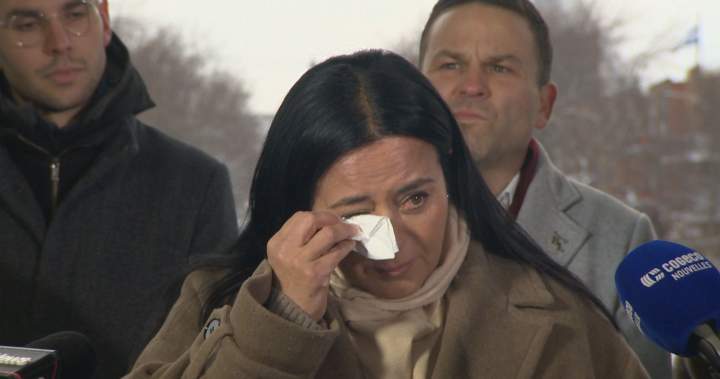
News that two unhoused people died in 24 hours this week reduced Montreal Mayor Soraya Martinez Ferada to tears during a routine city announcement Thursday.
Asked by a reporter how she was feeling, she replied, “A day like today, a bit powerless.”
Ferada made the revelation during an announcement that the city will provide $412,000 to community organization l’Anonyme to help the unhoused living in the Notre-Dame Street encampments get off the streets.
City officials say the two men died at different shelters and were well known to community workers.
They had been living on the streets for years. Later in the day during an urban agglomeration council meeting, the mayor revealed the names of the two men: Serge and Valmont.
Benoit Langevin, Montreal city councillor and executive committee member responsible for social development and cohabitation, also expressed sorrow during the morning announcement.
The former outreach worker said he, too, feels frustrated.
“You feel powerless because you see the relationship you build with those people, with these neighbours,” he said, fighting back tears. “(Those feelings) always come back when these things happen.”
The two deaths weren’t the only recent losses in the homeless community. Workers who support the Indigenous unhoused community are also grieving this week.
“There is a person who I know personally for years who died just a few days ago and has been … in Cabot Square park,” David Chapman, head of Resilience Montreal, told Global News.

Get daily National news
Get daily Canada news delivered to your inbox so you’ll never miss the day’s top stories.
That makes the number of unhoused people who died in Montreal in under a week at leaast three.
He added that the Indigenous woman who also passed away at a shelter — one that supports the Indigenous population — is just one of many from that group who died recently in Montreal.
According to him, “Just from (Resilience) alone, every two weeks somebody we know is dead and, obviously, it’s a lot to take for the staff. It’s traumatizing over time”
The number of deaths in Montreal’s Indigenous community is rising, a point he and Resilience staff made last November during a memorial to remember 32 of their clients who had died in less than two years.
“Twenty-six of the 32 were actually Indigenous,” Chapman stressed.
Most of the deaths he’s seeing are caused by drug overdoses at encampments.
The deaths at shelters announced by the mayor don’t come as a surprise to people like Sam Watts, Welcome Hall Mission CEO and executive director.
“I think in the ecosystem of care in Montreal it happens about once a month,” he noted, adding that it’s often for health reasons, because they don’t get the care they need.
“People who experience homelessness are often people who already are struggling with health concerns,” he observed.
Chapman acknowledges that there are programs being planned to help people on the streets, but insists that there has to be an official tally of the number of unhoused people dying in the province.
“Then perhaps we can begin to adapt our services accordingly,” he reasoned. “If we don’t know the number of unhoused deaths every year, with a certain degree of clarity, it’s going to be really difficult to calculate the sort of services that are needed.”
The mayor insists that all levels of government need to do more.
“We cry because we’re sad, but also because we’re mad,” she said through tears. “We need to do better. All of us, all governments. We need to do better.”
Quebec Solidaire MNA Guillaume Cliche Rivard blames the CAQ government for not properly funding initiatives to fight homelessness.
“Quebec has the money,” he insisted, “and it’s a choice not to invest. We’ve been seeing that there is money for multiple other projects from the government.”
Those working with the unhoused say the deaths are a shame and are preventable.
Read the full article here


