



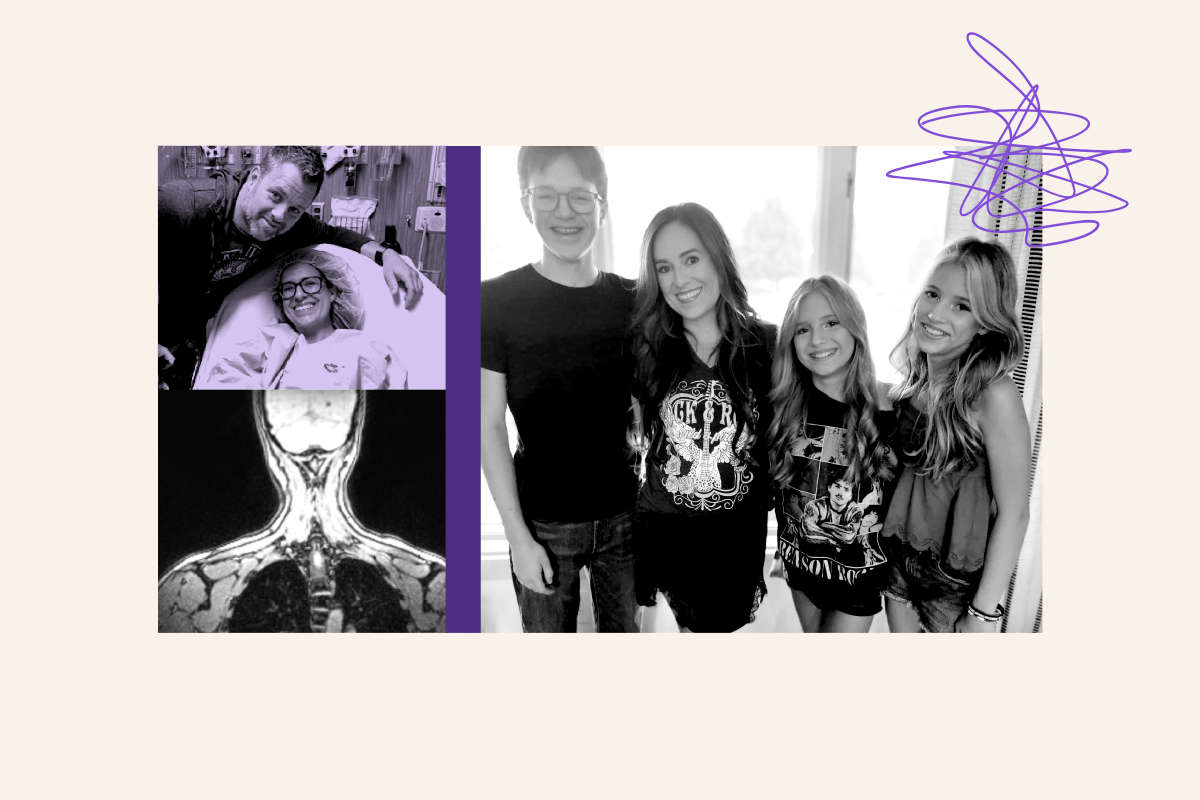
The night before Christmas Eve in 2024, my life changed suddenly and without warning.
I was a busy mom of three and a wife, juggling a full schedule while preparing for the holidays. Earlier in December, I had gotten sick with what felt like a typical cold. It lingered longer than usual, but I chalked it up to exhaustion and the chaos of the season. I was actually looking forward to the two-week Christmas break, hoping rest would finally help me feel normal again.
Instead, I woke up the next morning with what I can only describe as the worst headache of my life.
My vision began to tunnel. I felt an aura-like sensation I’d never experienced before. Friends who suffered from migraines told me it sounded familiar and urged me to go to the emergency room. That visit marked the beginning of a yearlong and still ongoing medical nightmare.
At the ER, a quick CT scan showed nothing alarming. The doctor told me it was most likely a migraine. I was given the standard migraine cocktail and fluids and sent home with instructions to rest and expect improvement within 24 to 48 hours.
The opposite happened. I got worse.
Forty-eight hours later, I returned to the ER, desperate for help. Once again, I was told it was a migraine. Once again, I was offered the same treatment and sent home. I remember saying over and over, “This is more than a migraine. Something is wrong.” I felt dismissed and unheard, but I didn’t know what else to do.
The next morning, things took a terrifying turn. I could barely walk, talk or move. I knew what I wanted to say, but the words wouldn’t come out. My husband rushed me to a different emergency room, where extensive testing was done only to be told, yet again, that doctors believed this was a severe migraine. I was given a third round of migraine medications and sent home.
For weeks, this became my daily reality: dizziness, crushing headaches, nausea and profound fatigue. Then came the double vision.
I visited a chiropractor, who noted extreme inflammation and fluid retention in my face and neck. My primary care physician diagnosed me with a sinus infection and prescribed antibiotics. I wanted to believe this was finally the answer.
It wasn’t.
The only time I felt any relief was when I was lying completely flat on my back. When my double vision became so severe that I could no longer function, I called my eye doctor in tears. She brought me in immediately. After less than 30 minutes, she told me I needed to go directly to the ER, for the fourth time.
She called ahead and requested an MRI, concerned that I might have lesions on my brain.
I sat in the emergency room next to my husband, quietly rehearsing how I might have to explain to my children that their mom had a brain tumor. The hours stretched in silence and hand squeezes; we were filled with fear, grief and anxiety. When the results finally came back, I was told I didn’t have a tumor, but I did have signs of brain sagging, two subdural hematomas and a cerebrospinal fluid (CSF) leak.
Relief collided with: What the heck is that?
We had never heard of a CSF leak. No one had ever mentioned it as a possibility. I spent the next week hospitalized, monitoring brain bleeds caused by my brain sagging due to the loss of protective CSF. When CSF leaks, the brain can literally drop within the skull, leading to shocking, debilitating pain and bleeding.
I underwent two blood patches and was sent home believing the worst was behind me.
Two weeks later, my symptoms returned.
I was then diagnosed with a spontaneous CSF venous fistula, which is different from my initial CSF leak diagnosis. In my first imaging, doctors identified what appeared to be a tear in my dura, the protective membrane around the spinal cord, which was treated with a blood patch. A venous fistula, however, might occur when a vein outside the dura begins siphoning cerebrospinal fluid directly into the venous system, without a visible tear. This type of leak is often harder to detect and does not respond well to traditional blood patches, according to research. To treat it, I underwent a catheter embolization procedure. Doctors accessed the fistula through my groin; they then used imaging to help guide them to the site of the leak and embolized the abnormal vein before sealing the area with fibrin glue.
For several months, I felt some relief—until one day, a familiar wave of dizziness washed over me. I felt a pit in my stomach. I knew, instinctively, that I was leaking again.
My neurologist was skeptical until I demanded further imaging. A CT myelogram confirmed a fourth leak on my spine At that point, I was referred to a specialist team at the Mayo Clinic in Rochester, Minnesota, about 90 minutes from where I live. Four months later, my new doctor confirmed the ventral leak and told me this time I would need an extensive surgery: a laminectomy, which would involve spinal cord manipulation to reach the front of my dura to close off the leak.
I had that surgery on November 10, 2025.
Now, I am recovering not only from one of the hardest physical experiences of my life (and I’ve given birth to three children) but from nearly a year of medical trauma. I continue to struggle with high intracranial pressure, which feels like that sensation you get on an airplane when your ears won’t pop, or the deep, pounding pressure that comes with a sinus infection. Doctors tell me this will eventually go away as I continue to heal. They cannot tell me whether I will ever experience another CSF leak. That uncertainty lingers quietly in the background, something I carry with me even on good days. I’m still healing from the intense spinal surgery, living with ongoing neck and upper back pain, nerve shocks and strict physical limits. I am out of work for now, learning how to pace myself and adjust to what it means to be a mother who cannot always keep up with her three active children. That reality carries its own emotional toll.
What I didn’t fully realize while I was fighting for a diagnosis and going through treatment was how exhausting it is to constantly advocate for yourself in a medical system that prioritizes speed and simplicity. Complex cases don’t fit neatly into short appointments or standard protocols. Too often, doctors don’t have the time, resources or training to stop and listen deeply.
And as a woman, it’s hard not to notice a pattern. Nearly every story I’ve encountered about spontaneous CSF leaks involves women who fought for months if not years for diagnosis and treatment. It should not be this way. CSF leaks are more common in women than men, according to the Cleveland Clinic, but it’s also true that there’s a long history of women’s pain and health issues being dismissed in medical settings.
CSF leaks are frequently misdiagnosed as migraines or sinus infections. Experts at Cedars-Sinai note that because symptoms often overlap with more common conditions, CSF leaks are frequently overlooked in early evaluations, and published research shows many patients are initially misdiagnosed, delaying proper treatment.
As I searched for answers, I read story after story from patients whose experiences mirrored my own. It was both comforting and heartbreaking, validating that I wasn’t alone. Even as awareness grows, patients’ lives are put on hold while they fight for their own answers. I’m sharing my story to say this: If you are fighting, please keep fighting. Find support. You are not crazy, and you are not alone.
It is only now, in the weight of recovery, that I’ve begun to reflect on what happened. When you are chasing answers, moving from doctor to doctor, test to test, you don’t stop to consider the emotional cost. You focus on survival. Fighting takes the front seat.
Moving forward, I am giving myself permission to slow down, to process what I didn’t have time to feel while I was fighting for answers. To sit with all the emotions and uncertainty and to make space for healing, as recovery is not just physical but emotional, too.
Xilonen Walton is a wife and mother in New Prague, Minnesota, raising awareness of CSF leaks.
Read the full article here


