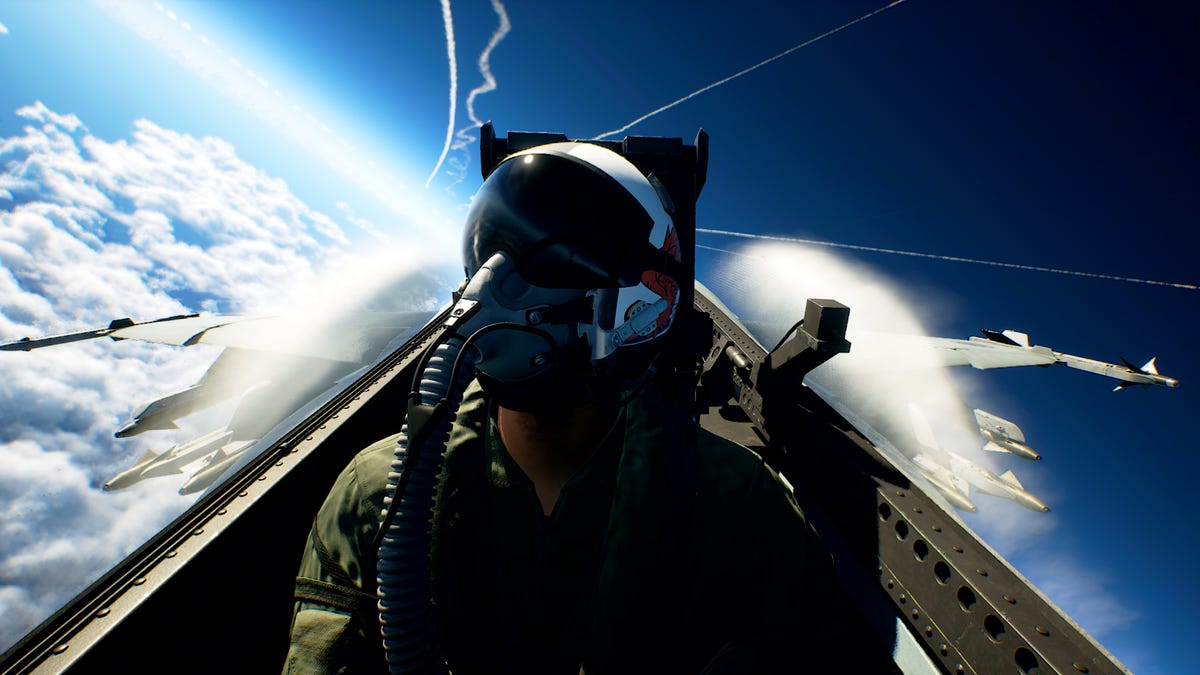
Next year, I’ll be sitting on my couch with a controller in hand, but on my TV, I’ll be up in the sky, chasing enemy planes through the clouds at 10,000 feet. In 2026, Bandai Namco will launch Ace Combat 8: Wings of Theve, the next game in the near-future air combat simulator series.
Hours before The Game Awards, held Dec. 11 in Los Angeles, I walked into a nearby hotel room and sat down with Kazutoki Kono, Ace Combat series brand director, and Manabu Shimamoto, producer of Ace Combat 8: Wings of Theve, to chat about the game. As the game’s predecessor, Ace Combat 7: Skies Unknown, came out in 2019, this will be the first game in the franchise to come out on this generation of consoles (as well as PC).
Ace Combat 8 includes a virtual hanger full of new features. The team behind the series, Project Aces, pushed the visuals to harness modern gaming hardware and developed a graphics technology to simulate cloud physics (called, yes, Cloudly). This not only realistically trails your aircraft wings through the clouds as you carve a path through the sky, but this also allows for the tactical advantage you’ll get when picking out an enemy plane in the distance by its contrails after leaving a cloud bank.
That’s the kind of true-to-life realism that Project Aces sought out, which is why they interviewed former combat pilots to advise them on the modern realities of flying fighter jets.
“What they told us is that it’s too scary to go into clouds; [they] actually avoid it altogether,” Shimamoto said through a translator. “Which means the players and the pilot in the game actually have a lot more courage than the real fighter jet pilot!”
Jokes aside, it reflects the careful line that the Ace Combat series has walked between slavish simulator and unrealistic arcade game. It gives the games serious stakes while loosening up some of the more tedious realities of flight (to say nothing of a near-endless bay of missiles).
“We are going for a certain level of reality, but we do want to give the player a lot of decision-making agency for Ace Combat 8,” Shimamoto said.
Don’t miss any of our unbiased tech content and lab-based reviews. Add CNET as a preferred Google source.
Ace Combat 8 replicates real-world jets in the fictional setting of Strangereal.
When to keep it real and when to get Strangereal
Consulting pilots provided the Project Aces team with air combat details they could incorporate to boost realism — like being able to spot distant enemy aircraft from the sunlight reflecting off their cockpits, much like sniper scope glints in first-person shooters like Battlefield 6. But that realism is tempered by another feature of the Ace Combat series: Its setting, Strangereal, is a world of fictional nations that play host to an ever-churning war that swings one way or another from game to game.
Ace Combat 8: Wings of Theve takes place 10 years after its predecessor in the somewhat far-off future of 2029. The Federation of Central Usea (FCU) has been defeated and completely subjugated by the Republic of Sotoa. The player, an unnamed pilot, wakes up floating in the ocean after a fierce air battle, only to be rescued by an outdated aircraft carrier filled with the last holdouts of the FCU forces.
Forced on the back foot with an antiquated aircraft, the player starts Ace Combat 8 off in a scrappy situation with a ragtag crew their everyman pilot will grow closer to. It’s clear the Project Aces team is shooting for more interpersonal experiences on the ship to contrast with fast-paced air combat. To add to the underdog feel, the player’s character takes on the mantle of the titular Wings of Theve, a heroic pilot from yesteryear.
On the aging aircraft carrier Endurance, the game’s setting, players will grow bonds with the ship’s crew between missions.
The setting of Strangereal in the Ace Combat series has become a beloved fixture of the franchise. Filled with vague analogues to modern nations and multinational alliances, the countries of Usea, Osea, Erusea, Sotoa and others sound straight out of George Orwell’s 1984, yet the fictional veneer gives the games license to stage international clashes with high stakes and melodrama.
In each game of the series, players are treated to twists and turns of global politics and military turnabouts. This is all the result of laboriously intensive background lore and world-building that may not even be represented in the game.
While still in the planning stage of the game, the team physically pulled out a map of Strangereal to plot out invasions. They roleplayed different nations as they invade and counterattack across their world’s geography, Kono said. All of which contributes to the game’s world but isn’t seen. As an example, the team built out the antagonist country Sotoa’s culture and history, but players may only get hints of that in the country’s flag.
Of the planning done, “10%, I want to say, is what you see in the game,” Kono said.
Project Aces, the team behind Ace Combat 8, developed the new technology Cloudly to create advanced cloud effects for players to fly through.
What to take and what to change from our world in Ace Combat 8
Ace Combat 8’s new Cloudly and graphics tech push the game closer to photorealism, and the game’s litany of fighter jets are meticulously re-created from their real-life counterparts. However, the Project Aces team backed away from reality in certain areas. The game’s setting of Strangereal allows them to shape their use of warfare tech that veers from real-world battlefields in specific ways to make gameplay more fun for players — something they’ve learned from how players have reacted to previous games.
“In Ace Combat 7, we actually included a lot of UAVs [unmanned aerial vehicles], but the feedback from the fans that we got was that they actually enjoyed the man-on-man dogfight experience with the radio chatter and the heated discussions and conversations,” Kono said.
Even as the real world of aviation shifts to unmanned drones and firing missiles at unseen enemy aircraft far over the horizon, Ace Combat still needs to preserve a level of game-ness for players to enjoy.
“There is always going to be this reality line that we’re going to want to aim for. That being said, we still can’t go for that line at the expense of the player experience. For the player to have fun is always going to be a priority for us as a game design philosophy,” Kono said.
The F-18E fighter jet is well suited for aircraft carriers, and thus the mascot of the game.
While the game will come out at some point next year, there are more aspects that the developers couldn’t talk about, including how many planes will be in the game. But both Kono and Shimamoto agree on one thing: their favorite plane.
“Ace Combat takes a lot of real-world fighter jets that exist and integrates them into the game, so of course, I love all of them. But I’m going to specifically call out the F-18E Super Hornet,” Shimamoto said.
It helps that the F-18E is heavily featured in the trailer, and it’s no coincidence that as one of the most famous jets stationed on aircraft carriers. It fits Ace Combat 8’s setting on its own venerable aircraft carrier. Kono, as director of the Ace Combat series, admits that he tends to fall in love with the jet used as the key visual for each game — like the hero you see on the box art — spending so much time looking at it that he starts noticing and appreciating granular details.
“For example, looking at the F-18’s nose cone, I notice this little hole. What is this hole for? Or the way the bolts are lined up, or where the parts meet. I begin to notice that type of stuff,” Kono said.
When I’m on my couch, controller in hand, I’ll try my best to look for details like that, but something tells me I’m going to be locked in evading enemy Republic of Sotoa jets trying to take advantage of those beautifully rendered cloud edges.
Read the full article here