



Published on
Europe needs to become sovereign and fully in control of its industrial capabilities to strengthen its competitiveness, according to Belgium’s Labour, Economy and Agriculture Minister David Clarinval.
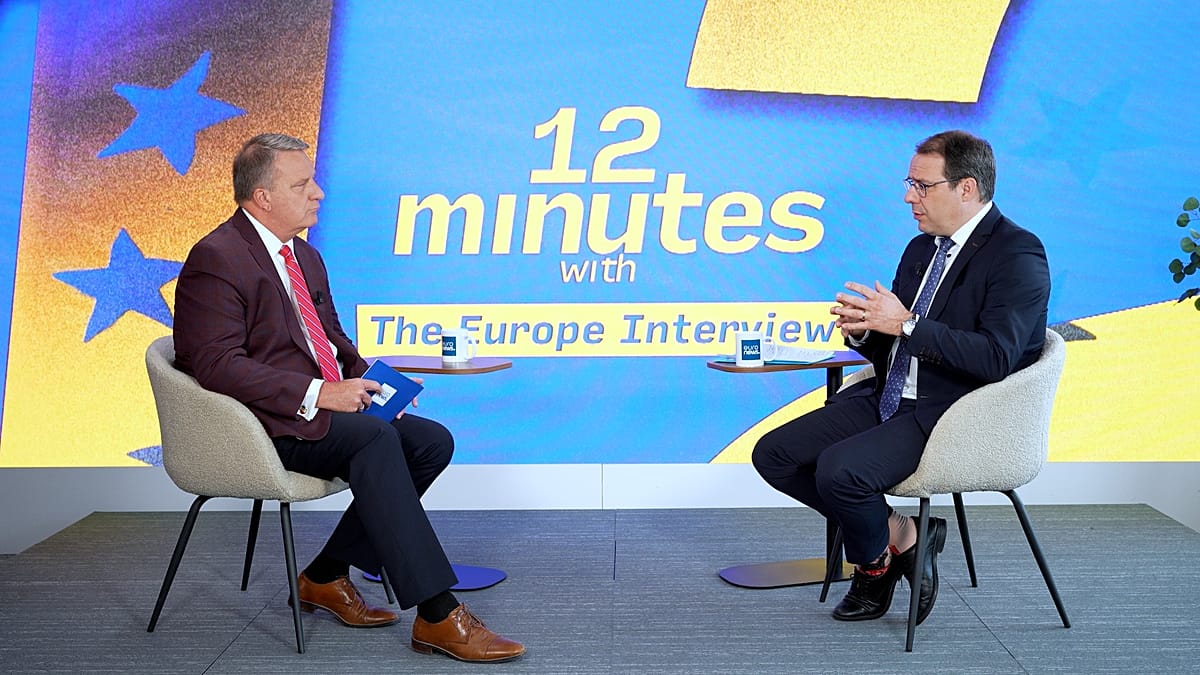
“We are now embracing a vision that focuses on supporting the competitiveness of businesses and recognising that European sovereignty is fundamental,” he told Euronews’ interview programme 12 Minutes With.
“European sovereignty requires control: control over its industrial capabilities, control over its energy resources, and control over its defense … and agriculture,” he added.
“These four pillars must truly guide us; if we no longer control these four pillars, we are no longer a state — or at least a group of sovereign states—and we lose control. And so we are at the mercy of neighbouring continents,” Clarinval said.
Asked whether the various EU programmes to enhance the competitiveness of the European economy achieve the intended goal, Clarinval was optimistic. But Europe eas coming from behind.
“For years, Europe was still a bit naive in the face of the international situation, where we were subjected to massive Chinese dumping across a wide range of products and also facing a fairly aggressive stance from the Americans,” he said.
“I believe Europe has understood the message that it was now time for a paradigm shift,” he said.
Europe is currently in a critical, “make or break” phase regarding its global competitiveness, with early signs of stabilisation after years of declining productivity relative to the US and China.
While the continent faces deep-seated structural challenges — fragmented markets, high energy costs, and a shrinking workforce — a renewed sense of urgency, driven by reports from Mario Draghi and Enrico Letta, has sparked a concerted effort to boost economic, digital, and defence capabilities.
The long-term effects of the wars in Ukraine and Iran are risking complicating the situation.
The oil and gas price increases due to the Iran war are already having a significant impact on citizens and businesses, Clarinval said.
“But there are also indirect effects; for example, we are already seeing an increase in the cost of materials, with a whole range of products that are already more expensive.”
Therefore, his government is planning to reduce tax rates and lower the taxes Brussels collects on fuels to help offset the rise in energy costs.
An additional measure is the “commercial diesel system”, specifically aimed at entrepreneurs and transport companies, to cap energy costs.
“These are two measures that will provide some breathing room for both citizens and businesses,” Clarinval said.
On another aspect of the Iran war, Clarinval said he was ready to seize assets and financial interests in Belgium belonging to Iran’s new Ayatollah Mojtaba Khamenei.
Official sanctions registries, company filings, and land registry records have revealed a vast financial network in Europe that may be linked to the son and successor to the late Ayatollah Ali Khamenei.
“If there are international resolutions from the UN or other international bodies calling on Belgium to take action, we will do so. But of course, we will only do so under an international mandate that is broad and widely supported,” Clarinval said.
Read the full article here


