



It’s the kind of email no architect wants to read.
In 2021, after several COVID-related delays, the extension to a 1920s Paddington workers’ cottage was finally completed. Architect Christopher Bligh had added a treehouse-like master bedroom to the back of the house, with an origami-style ceiling and a playful two-storey vine mesh screen.
Five months later, the house burned down in a fire started by a mosquito repellent burner.
“We had an email from the client and a phone call just a day or two after the fire,” Bligh said.
“Obviously they were quite traumatised, but were wanting to quickly get on with trying to get their home back.”
While the bulk of the dwelling was reduced to ashes, Bligh’s extension, due to being only narrowly connected to the main house, remained standing.
His firm, Bligh Graham, was given the task of designing a new home in response to their initial addition to the old home.
Christened the Hakea House, it has now made the shortlist for the best House Alteration & Addition Over 200m2 in the 2026 Houses Awards.
“Hakea is an Australian native tree which blooms after fire, and we thought that was appropriate given its history,” Bligh said.
The Houses Awards recognise residential architecture and act as a lens for trends in Australian home design.
“Many homes in this year’s shortlist are innovative reworkings of existing dwellings rather than knock-down rebuilds,” said Houses magazine editor and awards jury chair Alexa Kempton.
Kempton said the five-bedroom Hakea House was unusual as it was “designed in reverse”.
“Designing a house for the extension has resulted in a rich home, and a contemporary spin on the climatically attuned Queenslander house,” Kempton said.
Bligh said the original front cottage section was largely rebuilt as it was to retain its character and “avoid a fight with the council”.
Some of the front facade had remained intact in the blaze, and some cottage windows and doors were also salvaged for reuse.
A brick fireplace and the backyard pool also survived.
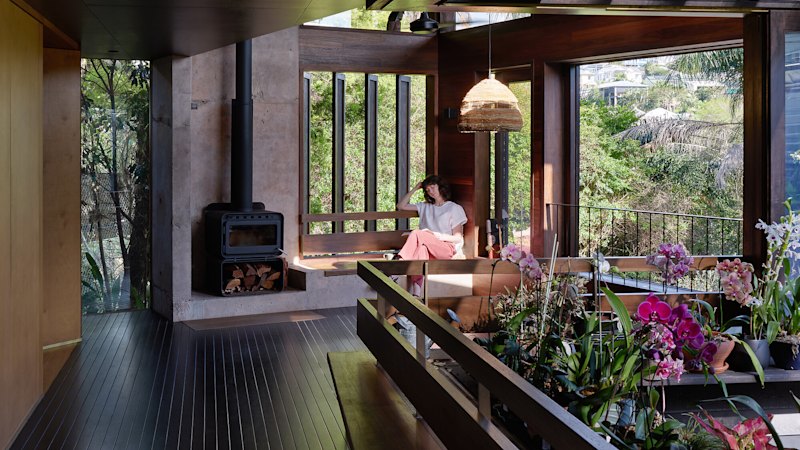
The rebuild included an “interior deck” that allows the outside in with sliding doors. “It’s almost like a contemporary version of the built-in veranda, the classic old Brisbane way of grabbing more space out of the Queenslander,” Bligh said.
The space overlooks a garden court and allows winter light deep into the downstairs living space.
Darker wood tones are a deliberate response to hot Brisbane summers.
“There’s a real trend in Brisbane for everything to be white and schmick,” Bligh said. “We wanted to nod to our part of the world, living in Asia and in a subtropical climate.”
Blight said the clients, a family with teenage children, are delighted with the results.
“It’s a happy end to the difficult journey … Architecture is always problem-solving, and this is just a different type of problem.”
Twenty Queensland homes are among those shortlisted for the Houses Awards, and winners are announced on September 4, 2026.
Get alerts on significant breaking news as happens. Sign up for our Breaking News Alert.


From our partners
Read the full article here


