



Beijing’s justification aligns with its longstanding preference for “more generalised, less attribution-heavy formulations”, said Burton, the independent political analyst.
“The claim that the resolution was ‘unbalanced’ is not simply rhetorical – it reflects a genuine feature of Chinese diplomatic positioning at the UN,” he said.
“However, it also serves a clear political function: it allows Beijing to avoid a public rupture with Iran.”
That pattern has been visible across other conflicts.
In Syria’s civil war, China repeatedly resisted draft resolutions that blamed the Assad government or sought punitive action. One example came in 2017, after a chemical weapons attack on the rebel-held town of Khan Shaykhun, when China voted with Russia against a draft condemning the attack and pressing Damascus to cooperate with investigators.
On Russia’s invasion of Ukraine, the contrast was clear. In 2025, the third anniversary of the conflict, China backed a more general UNSC resolution that mourned the loss of life and called for a swift end to hostilities, without naming Moscow or assigning blame.
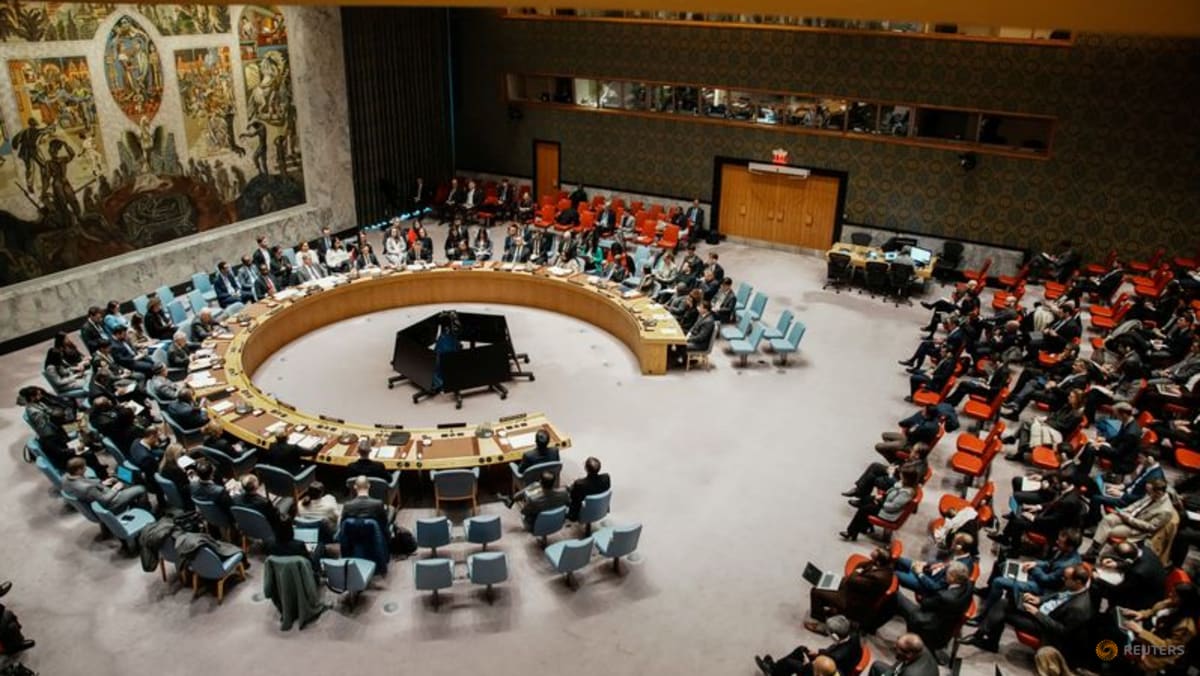
Yet China’s decision in the Mar 11 UNSC vote stands out against its record on Iran, where it had previously backed multiple rounds of UN sanctions as part of a coordinated international effort to curb Tehran’s nuclear programme.
Between 2006 and 2010, Beijing supported four sanctions resolutions on Iran, but these votes came within the framework of the P5+1. P5+1 refers to the five permanent members of the UNSC – China, France, Russia, Britain and the US – plus Germany.
Against this backdrop, analysts said China’s latest abstention was familiar in form, but more unusual in the Iran context – reflecting Beijing’s broader preference for resisting texts it sees as overly narrow in assigning blame, even as it contrasts with earlier support for UN sanctions on Tehran as part of a broader multilateral effort.
A THREE-WAY BALANCING ACT
Analysts pointed to three overlapping pressures that lie at the heart of China’s UNSC abstention on Mar 11.
They are China’s ties with Iran, its ties with Gulf states and its alignment with Russia – with which it shares a “no limits” strategic partnership – at the UN, where the two often aligned in opposition to Western-led initiatives.
“Rather than choosing between these, China is attempting to avoid alienating any of them. The abstention is a product of that balancing act, not a clear prioritisation,” said Burton.
Leoni of King’s College London voiced a similar view, while suggesting that some pressures weigh more heavily than others.
“I am sure that ties with Iran and the Gulf were more important in informing China’s decision, compared to alignment with Russia,” he said.
Read the full article here


