



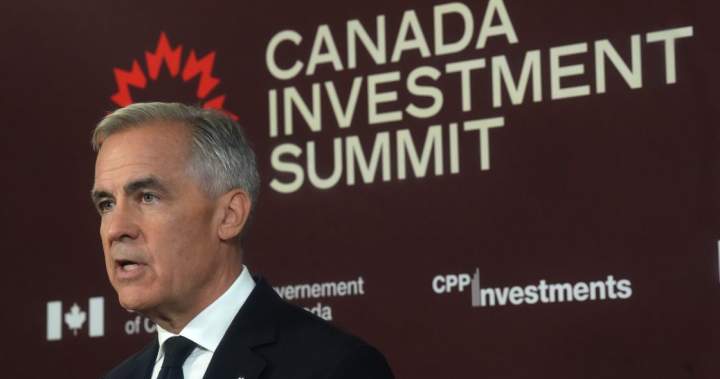
The Canada Pension Plan Investments Board (CPPIB) and Brookfield on Tuesday launched a $50 billion “Maple Fund” that they say will funnel capital towards critical infrastructure and strategic industries across Canada.
The announcement from the CPPIB, which manages the investments in the Canada Pension Plan, and investment management firm Brookfield was one of the main funding projects that came out from a recent two-day investment summit hosted by Carney and the premiers.
With the Canada Pension Plan playing a central role in many Canadians’ retirement planning, many may be wondering what this decision means for their retirements.
The Maple Fund will operate as an investing framework to provide funding for specific projects, and will include up to $25 billion each from the CPPIB and Brookfield over a five-year timespan.
The fund is focused on complex large-scale projects that each require significant upfront resources and development capabilities, and a minimum of $5 billion in capital funding, according to a press release.
Each project must also be individually approved by both partners in the fund, and the framework allows for either firm to bring in additional investors to partner on specific approved projects within the fund.
Although both CPPIB and Brookfield are providing an equal amount of long-term cash, or capital, the release says CPPIB will be involved in the fund’s operations by providing investing expertise, while Brookfield will also provide the development and management of the projects being funded.
The release did not mention specific projects or investments, but that those will be announced once they are finalized.


Get daily National news
Get daily Canada news delivered to your inbox so you’ll never miss the day’s top stories.
Connor Teskey, CEO of Brookfield Asset Management, in the release said, “we believe the Maple Fund can help drive a generational investment program to invest in critical infrastructure, industries and businesses that will support the growth of globally competitive Canadian businesses.”
The president and CEO of the CPPIB, John Graham, said in a release that these opportunities “offer compelling value.”
“CPP Investments has the capital, long-term investment horizon and expertise to pursue these opportunities, and the Maple Fund brings together our strengths with Brookfield’s strong origination and development capabilities to help move ambitious projects from opportunity to investment,” said Graham.
“The Maple Fund positions us well to meet this moment and move with speed on opportunities of unusual scale and complexity when they offer compelling value for the CPP Fund.”
Prime Minister Mark Carney’s government has been working since last year to pivot Canada’s economy away from relying on the United States amid tariffs and trade war uncertainty.
It’s been doing this mainly by proposing or starting new major projects of national interest with the aim of making Canada more attractive to a diverse and growing list of new international trading partners.
Most working Canadians’ are now indirect stakeholders in these projects by way of paying into the CPP Fund through regular work contributions for their retirements. The CPPIB then allocates that money towards investing opportunities to grow the fund, similar to a retirement savings portfolio.
Global News sent a request to CPP Investments asking about why the fund specifically offers value for average Canadians. A spokesperson deferred to Graham’s statement but did not provide further comment.
Andrew DiCapua, principal economist at the Canadian Chamber of Commerce says the idea of the Maple Fund is promising on a national level, but questions remain including how success is measured.
“The more Canadian assets that we can keep Canadian-owned is a great opportunity to advance sovereignty in the country and ensure that we benefit from that as Canadians, because, of course, pension funds are to the benefit of all Canadians and we maintain that sovereignty,” says DiCapua.
“How are we going to measure success and how are we going to actually execute and ensure that both business and government are working well together? And that remains to be seen because of course the work still needs to be done.“
Canadians who are employed or self-employed must make regular CPP contributions, which are usually deducted automatically from pay cheques.
The goal is to grow that money over the long term with strategic investments made by the CPPIB, and Canadians can withdraw their CPP earnings when it comes time to retire.
Most investments are long-term strategies, which means the total returns or growth on this $50 billion investment, and more specifically the $25 billion share from CPP, may not be seen for some time.
“The CPP exists for one reason and one reason only: it’s to maximize the return for whatever tolerable level of risk they’re willing to take on,” says economics professor Moshe Lander of Concordia University.
“The entire objective is: you make sure that there is the biggest pot of money available for us when we retire — that’s it. So, if they’re saying that ‘there’s compelling value here,’ is that just political phraseology to say that maybe we’re not pursuing the path of greatest return for a given level of risk?”
Like with any investment, there is a level of risk that these projects may not pay off or may not generate as much of a return as hoped, but the release states “each potential investment will be independently assessed and approved by CPP Investments and Brookfield against their respective requirements and through their established investment and governance processes.”
“CPP Investments may not be looking for the highest growth opportunities, but they are looking for predictable returns and where government and where industry can open the aperture and present those opportunities to the pension fund,” says DiCapua.
“The commitment to capital by the pension funds, including CPP investments, seems to signal that they see some opportunities that they can participate in, which is encouraging.”
According to the release, the CPPIB operates “at arm’s length from governments,” and as of June 30, 2026, the total value of its fund was C$863.6 billion. It adds that it manages the fund “in the best interest of the more than 22 million contributors and beneficiaries.”
Read the full article here


