



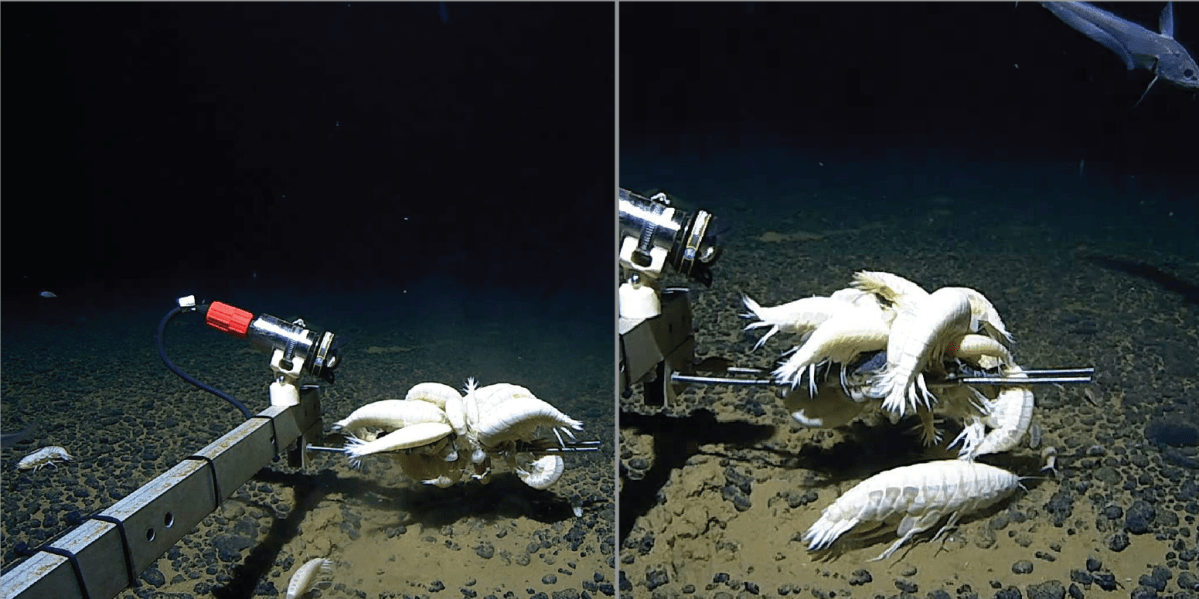
The world’s largest amphipod is not as rare as it was once believed to be, according to scientists.
Why It Matters
Scientists have long assumed the deep-sea Alicella gigantea was an uncommon survivor of the abyss.
But new genetic and expeditionary research published in Royal Society Open Science has found that this giant crustacean inhabits nearly 59 percent of the world’s ocean floor, overturning persistent assumptions about species scarcity and offering a fresh perspective on deep-sea biodiversity, adaptation, and the resilience of life in Earth’s extreme environments.
Newsweek reached out to the authors of the research via email for comment.
What To Know
Alicella gigantea, sometimes called the “supergiant amphipod,” can reach lengths of up to 34 centimeters (13.4 inches) and was first described in 1899.
For decades, infrequent sightings and sample limitations led scientists to believe that the species was rare or sparsely distributed in isolated pockets.
But now, a comprehensive global study led by Dr. Paige J. Maroni and colleagues at the University of Western Australia is challenging this long-held belief.
The researchers compiled 195 records across 75 locations and performed detailed genetic analyses.
Their findings indicate that A. gigantea is not only present but thriving in the abyssal (3,000–6,000 meters) and hadal (6,000–~11,000 meters) zones of the Pacific, Atlantic, and Indian Oceans.
Despite the animal’s enormous size and environmental reach, researchers found very low genetic differentiation among populations globally—suggesting a single species with a capacity for extreme dispersal, enabled by both evolutionary stability and geological factors such as shifting ocean currents and tectonic events over millions of years.
Modern sampling techniques—including baited deep-sea landers, high-definition video, and next-generation genetic sequencing—have been pivotal for revealing this cryptic abundance.
Large aggregations have even been observed on abyssal plains, challenging prior expectations of rarity based on collection bias rather than actual scarcity.
What People Are Saying
Dr. Paige J. Maroni, the lead author, said: “Historically, it has been sampled or observed infrequently relative to other deep-sea amphipods, which suggested low population densities.
“And, because it was not often found, little was known about the demography, genetic variation and population dynamics with only seven studies published on DNA sequence data.”
Dr. Maroni continued: “As exploration of the deep-sea increases to depths beyond most conventional sampling, there is an ever-growing body of evidence to show that the world’s largest deep-sea crustacean is far from rare.”
What Happens Next
Scientists emphasize that continued exploration and genetic studies will be necessary to fully document the life history, resilience, and possible cryptic diversity of Alicella gigantea and similar deep-sea organisms.
As commercial interest in deep-sea mining and exploration grows, understanding the genetic and ecological dynamics of such species is increasingly important for conservation policy, carbon cycling, and global biodiversity assessments.
Read the full article here


