



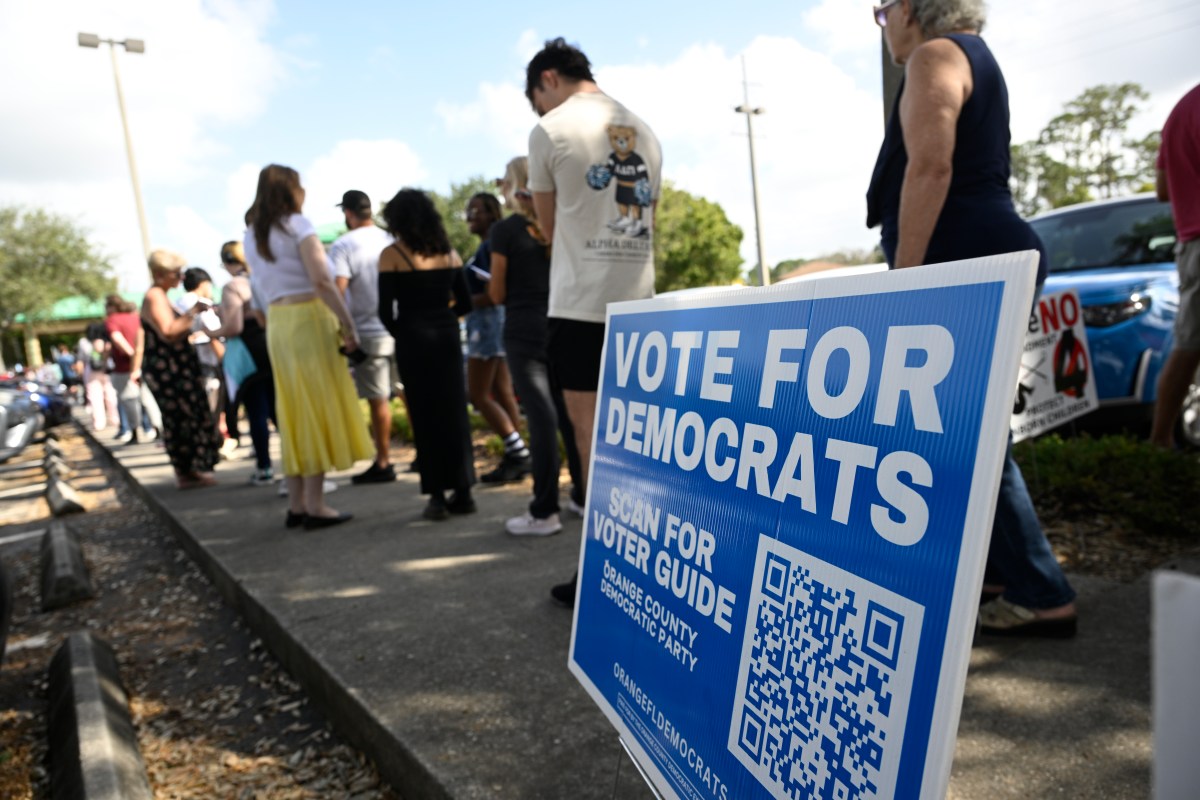
A new poll cited by Florida Politics finds Democrats leading the 2026 generic congressional ballot and running effectively tied in the state’s marquee races, driven by a sharp erosion of Republican support among independent voters.
The survey arrives as President Donald Trump posts a net negative statewide approval rating; a dynamic that pollsters say is pulling down GOP candidates across the ballot. Florida Democrats, candidates, and donors are the most immediately affected, as the data could reshape where the party invests ahead of the midterms.
Trump Is the Story
The poll’s most striking finding isn’t any individual race, but the president’s standing with the voters Republicans need most.
Conducted by South Florida-based EDGE Communications and MDW Communications, the survey polled 1,834 likely Florida voters between March 27 and April 3, with a 2-percentage-point margin of error. Trump’s net approval sits at -6 statewide and craters to -39 among unaffiliated voters, a group that makes up 22 percent of the poll’s anticipated turnout model.
He is underwater on every major issue tested: -4.9 on the economy, -12.7 on government spending, -13.6 on abortion, and -6.7 on foreign policy. Immigration enforcement, long a Republican strength in Florida, registers -2.7 statewide and -27.7 among independents.
His weakest number comes on the Jeffrey Epstein files, where he posts a net approval of -25.2.
“Trump is underwater on virtually every issue voters care about most,” pollsters wrote in their analysis.
Independent Voters Are Breaking Left
That Trump drag is translating directly into ballot movement. On the generic congressional ballot, Democrats lead 46 percent to 45 percent among likely voters. Among no-party-affiliated voters, the gap is far wider: Democrats lead 52 percent to 23 percent.
Christian Ulvert, founder and president of EDGE Communications, said the independent shift is unlike anything the firm has tracked in recent cycles. “NPA voters — the most coveted and hard-to-win bloc in any election — are breaking away from Republicans and moving toward Democrats in numbers we have not seen in decades,” he said.
The poll also flagged an internal GOP problem: Republican party loyalty has slipped below 90 percent, with Republican defection at 6.4 percent—far outpacing Democratic defection.
Every Top Race Is a Toss-Up
The competitive environment extends to Florida’s highest-profile 2026 contests. Republican Representative Byron Donalds and Democrat David Jolly are deadlocked at 41 percent each in a potential governor’s race, with 18.3 percent of voters still undecided. The Senate race between Democratic candidate Alex Vindman and Republican incumbent Ashley Moody stands at 42 percent to 43 percent.
In the attorney general’s race, Democrat José Javier Rodríguez leads Republican incumbent James Uthmeier 43 percent to 40 percent, a favorability gap of +3.4 to -8.6 that pollsters say could widen as the race develops.
The Economy Isn’t Saving Republicans Either
Affordability dominates voter concern, with nearly 70 percent ranking housing costs, property insurance, and property taxes among their top three issues. But Republicans are no longer the default beneficiary.
“The clear edge Republicans have held on economic issues in Florida since COVID has gone away as costs continue to skyrocket and both Washington and Tallahassee fail to act,” said Michael Worley, president and CEO of MDW Communications.
When asked to name their single most important issue, more voters chose corruption (21 percent) than any economic category, a direct challenge for the GOP in the current climate. Immigration ranked second at 13.8 percent.
A proposal backed by Republican Florida Governor Ron DeSantis to eliminate property taxes also underperformed. Initial support stood at 55.1 percent, below the 60 percent threshold required for passage on the Florida ballot. After voters were presented with tradeoffs including reduced funding for police, fire, parks, and roads, support dropped to 39.4 percent, a 21-point swing. Republican backing fell below 60 percent as well.
“The fact that voters are not on-board highlights yet another crack in the GOP’s brand,” said Martin Page, partner and COO at MDW Communications.
What Happens Next
With candidate fields still forming and nearly one-in-five voters undecided in the governor’s race, no outcome is settled.
Democrats must convert a favorable environment into statewide, funded, organized campaigns. Republicans face the more immediate problem: there is no clear path to shoring up independent voters as long as Trump’s approval continues to weigh on the ticket.
Read the full article here


