



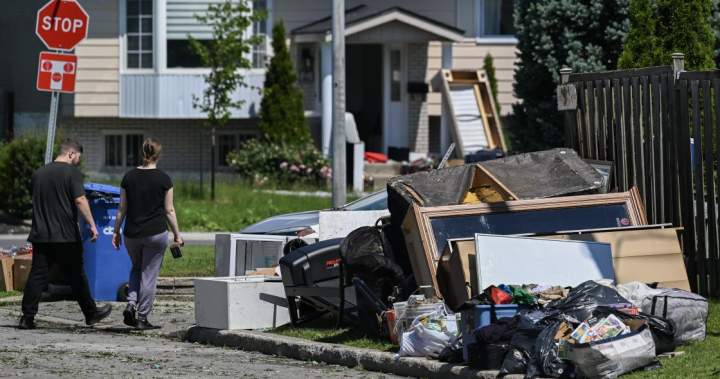
After significant rain led to flooding over the weekend in Montreal and Edmonton, insurance experts are urging Canadians across the country to check their insurance policies to make sure they have adequate coverage for extreme weather.
Most standard home insurance policies in Canada do not cover certain types of flood damage, which means many consumers could be left with a hefty bill to repair or replace their homes.
“Standard home insurance does not automatically include overland flood or sewer backup coverage. These coverages are optional and have to be added on at an additional cost to your standard home insurance,” says Rob de Pruis, national director of consumer and industry relations for the Insurance Bureau of Canada.
“You want to reach out to your insurance provider to make sure that you do have that coverage because that can literally help and save you thousands of dollars in the future if you do experience that damage.”
On Sunday in Montreal, as much as 150 mm fell within just a few hours, according to Environment Canada, which contributed to flash flooding that damaged homes, left vehicles submerged, thousands without power, and some areas being declared a state of emergency.
At the same time, Edmonton’s storm drain system is reportedly at capacity following an extreme amount of rainfall that also saw localized flooding, and the city is also under a state of emergency.
These and other weather events, including wildfires, have contributed to soaring insurance premiums in Canada, rising as much as 45 per cent in the past six years.
“We are seeing premiums rise due to extreme weather, and it really is a coast to coast issue. Significant events have hit pretty much every province across Canada,” says David Mayer, director of insurance and underwriting at rates.ca.
“It’s becoming a structural issue, which even these premium increases are not fully keeping up with, depending on the coverage that homeowners have in their policies.”
And these weather events are also costing insurance companies billions every year.


Get breaking National news
Get breaking Canada news delivered to your inbox as it happens so you won’t miss a trending story.
Statistics Canada says the years spanning 2020 to 2025 ranked among the top 10 most costly years for catastrophic event claims in Canada, with 2024 alone costing the most at $8.6 billion.
In 2024, flooding in Quebec and Ontario alone accounted for roughly $3.7 billion of those claims.
But not all insurance policies have kept pace with the frequency of these extreme flooding events.
One of the reasons this type of coverage isn’t included in many policies is because, unlike other types of extreme weather damage, these types of flooding events are relatively new for insurance companies.
“It’s the way these products were constructed many decades ago. Water damage was not as pervasive as a threat. When home insurance came into the mainstream in Canada, fire was really the biggest threat to a property,” says Mayer.
“Fire is still can be a pervasive threat, especially with respect to wildfire, but the big losses are really being driven by water damage.”
A June survey found that about a third of participants in Canada said they were hit by extreme weather within the last year.
“Nationally in home insurance, wind, hail, and wildfire are typically included in a standard policy. What surprises many Canadians is what’s not included. And that is overland flooding and sewer backup,” says Mayer.
“Those are typically optional add-ons, which come with an additional premium that needs to be attached to the policy.”
This means most Canadians who have not opted to add coverage for damage done by overland flooding and sewer back ups may be left to cover the repairs themselves.
“Homeowners really need to understand without the sewer backup and the overland water endorsements on their policies, they could be left with no claim even with a flooded basement or severe water damage,” says Mayer.
In some circumstances, homeowners may not even be able to get coverage depending on where they live.
“There’s some communities that are literally built on floodplains where these communities flood every single year,” says de Pruis.
“With some of the inherent risks, you don’t have to live by a lake or a river to be impacted by flood, either. We know that there’s many communities where the storm-water systems are just overwhelmed.”
Canadians may want to check their current policies to confirm if they have additional coverage for flood and water protection, and consider adding it if not.
Those who may find the extra premiums are too cost prohibitive or discover that they are denied coverage can still take preventative steps to minimize water damage.
Both Mayer and De Pruis suggest consulting with suitable experts where possible, and consider a few home upgrades that range in price. They add that all can help prevent thousands of dollars in damage in the event of extreme flooding.
The first is to ensure water flows away from one’s home. This includes keeping eavestroughs clear of debris, and redirecting and extending downspouts so water does not pool or run alongside foundations.
Next, home owners should consider backflow prevention valves and sump pumps in their basement.
These both prevent basement flooding, with a backflow preventer protecting the home from contaminated sewage backups, while the sump pump removes clean, natural groundwater from around the foundation.
De Pruis also encourages home owners to check the grading on their home to see if water naturally flows away from their foundations.
They should also monitor for consistent pooling after heavy rainfall and work with experts to determine how to make modifications where possible.
Mayer adds: “Even with some of these mitigation systems installed in the home, a significant and severe storm can still result in basement flooding.”
Read the full article here


