



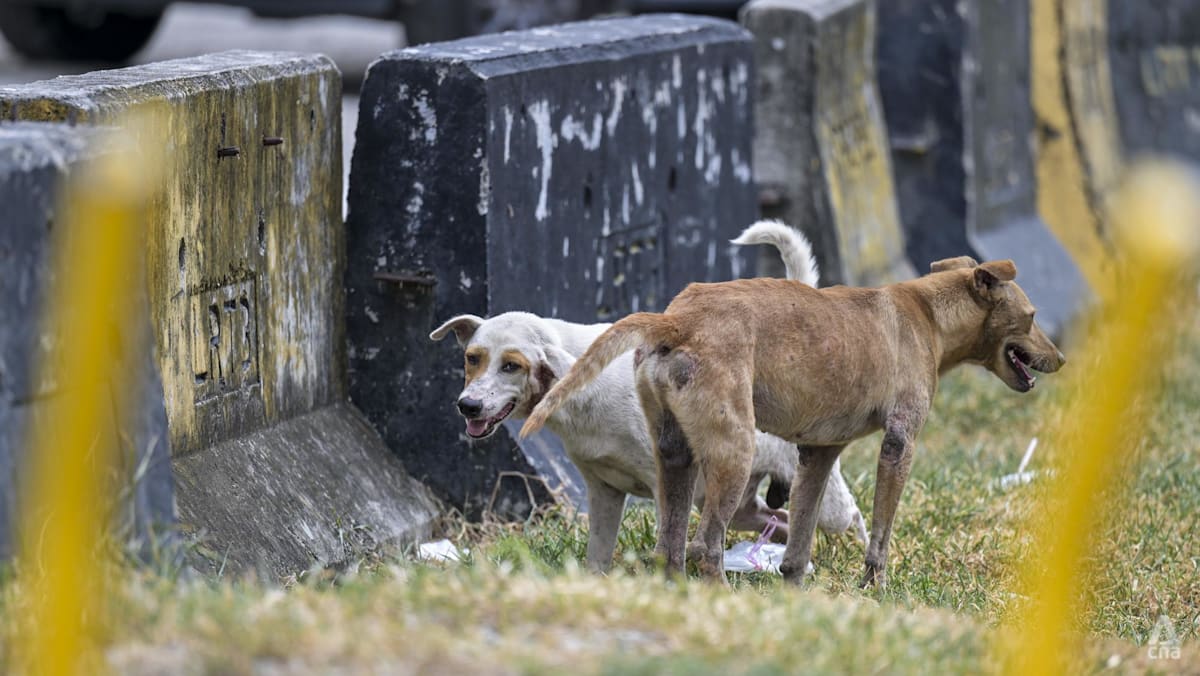
But for Wani Muthiah of the animal welfare NGO Malaysian Dogs Deserve Better (MDDB), involving untrained members of the public in municipal operations creates a recipe for disaster as they risk getting injured as well.
In the case of the Rocky incident for instance, the Klang town council had invited residents to join the operation. It was reported that there were 11 council members and about 50 residents involved in the operation that saw 12 dogs being caught.
The operation was carried out following repeated complaints from residents and students that they had been disturbed and chased by stray dogs in the area.
Wani warned that incentive-based programmes open the door to dangerous abuses, such as where some people would start stealing pets.
“Friendly community dogs that walk up to people or wait for food are easy targets, while mother dogs won’t run because they refuse to abandon their puppies,” she said.
CNA has contacted the Department of Veterinary Services and the Ministry of Housing and Local Government for their comment.
WHAT CAN BE DONE
The animal welfare groups CNA spoke to broadly agreed that sustained sterilisation programmes should form a central part of Malaysia’s approach, citing Penang’s model which is based on humane population management as an alternative to indiscriminate culling.
Choong Koon Yean of the Penang chapter of the International Aid for the Protection and Welfare of Animals told CNA that her organisation has a formal partnership with local authorities to implement an islandwide Trap-Neuter-Release/Rehome (TNR/R) programme.
She said that since the scheme began in March 2018, the Penang Island City Council has not killed stray dogs under the programme. They are humanely caught, neutered, vaccinated and either returned to their original territory or rehomed where appropriate.
Aggressive dogs that bite or chase people are never released back onto the streets, with these dogs rehabilitated where possible.
Choong said that 8,767 dogs have gone through Penang’s TNR/R programme, with 1,203 dogs rehomed.
Under the public-private partnership, the Penang Island City Council provides the facility including a pound and support for its maintenance and utilities, while the organisation undertook the programme’s operational work and raises funds required for its implementation
“The key principle is that neutering reduces reproduction while allowing stable, sterilised dogs to remain within their territories, gradually reducing the population over time,” she said.
While refusing to claim that Penang Island has “solved” the stray dog problem, Choong said that it has demonstrated that a sustained, systematic and humane population-management programme can produce measurable and lasting results.
She added that irresponsible pet ownership remains a primary driver of the crisis, noting that owners frequently let unneutered dogs roam freely or abandon them altogether when they are no longer wanted.
“They contribute directly to the stray dog population and increase the risk of conflicts between dogs and people. Irresponsible ownership is one of the root causes that must be addressed if we are serious about preventing future tragedies,” she said.
Read the full article here


