



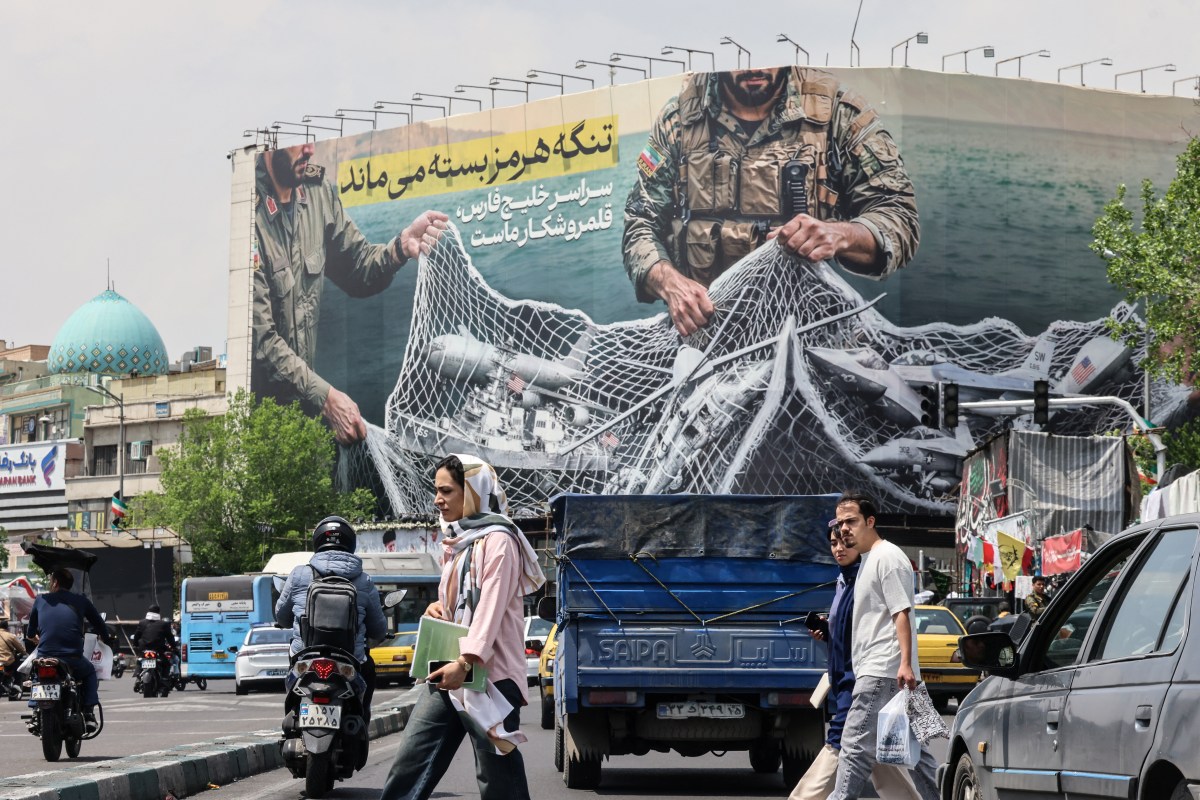
Washington is currently navigating a classic strategic trap, one that threatens to undermine years of regional stabilization efforts. Following President Donald Trump’s recent announcement on Truth Social, the U.S. has extended the ceasefire with Iran by a narrow margin with the possibility of more peace talks within the next “36 to 72 hours.”
Trump’s decision stems from a belief that internal Iranian divisions and political “fractures” might yield a unified proposal for peace. While Trump is displaying a commendable willingness to exhaust all diplomatic avenues, he is waiting for Iran to act like a rational country. This ignores the fundamental reality: the real ruling power in Iran is the Islamic Revolutionary Guard Corps (IRGC), which seeks to spread a radical Islamic revolution that began in 1979 throughout the Middle East.
By granting this window based on the hope of Iranian fragility, Washington is inadvertently providing the IRGC with the one strategic asset it needs most: time. While the White House waits for a “unified proposal” from a supposedly “fractured” leadership in Tehran, the reality on the ground tells a far more aggressive story. In the last 24 hours alone, Iranian forces opened fire on three vessels and seized two cargo ships in the Strait of Hormuz. This is not the behavior of a regime in chaos. This is a regime executing a deliberate, multilayered strategy of deception designed to paralyze Western decision-making.
Tehran’s current “political deadlock” is a tactical mask, not a structural failure. It is a page straight out of Sun Tzu’s ancient doctrine The Art of War: project disorganization to induce hesitation in your opponent. This is precisely what former Secretaries of State Henry Kissinger and George Shultz warned about in their critical assessment of the Obama Administration’s nuclear negotiations. Kissinger and Shultz argued that Iran successfully outmaneuvered the West by treating its mere willingness to negotiate as a major concession. While the world waited for a breakthrough, Tehran used the diplomatic cover to legitimize its nuclear infrastructure, strengthen its ballistic missile capability, and entrench its support for terrorist proxies like Hamas and Hezbollah.
This historical pattern confirms the warning Kissinger delivered to the Senate Armed Services Committee in 2015: the Iranian regime operates “beyond the control of national authorities.” We are witnessing the ultimate manifestation of the “Lebanese Model,” where the formal state apparatus is used to shield a revolutionary cause. As Tuesday’s collapse of peace talks in Pakistan demonstrates, the IRGC has now effectively sidelined the civilian presidency in Tehran to ensure that the military—not the diplomats—dictates the terms of engagement.
Washington’s hesitation is further compounded by a global vacuum of support. While the U.S. seeks an international consensus, Europe remains largely on the sidelines by clinging to the illusion that diplomacy can tame Iran despite it being a state driven by ideological expansionism. But as the IRGC tightens its grip on the Strait of Hormuz—a global artery through which 20 percent of the world’s oil flows—the cost of this collective inaction is rising. Just as Hezbollah holds Lebanon hostage while initiating coordinated escalations against Israel, the IRGC is now holding global trade hostage.
Trump correctly identifies that Iran is under immense pressure, but he must not allow diplomacy to act as a sort of release valve. Washington must stop chasing the diplomatic mirage of a “moderate” Tehran and start confronting the IRGC’s war machine directly. The current 120-hour window should be treated as a final warning. Strategic clarity now is the only way to ensure that the U.S. doesn’t find itself forced into a much larger conflict.
Bradley Martin is the executive director of the Near East Center for Strategic Studies. Follow him on Facebook and X @ByBradleyMartin
Dr. Liram Koblentz-Stenzler is a senior researcher at the International Institute for Counter-Terrorism (ICT) at Reichman University, Herzliya, and a visiting scholar at Brandeis University. Follow her on LinkedIn and X @koblentz_liram
The views expressed in this article are the writers’ own.
Read the full article here


