



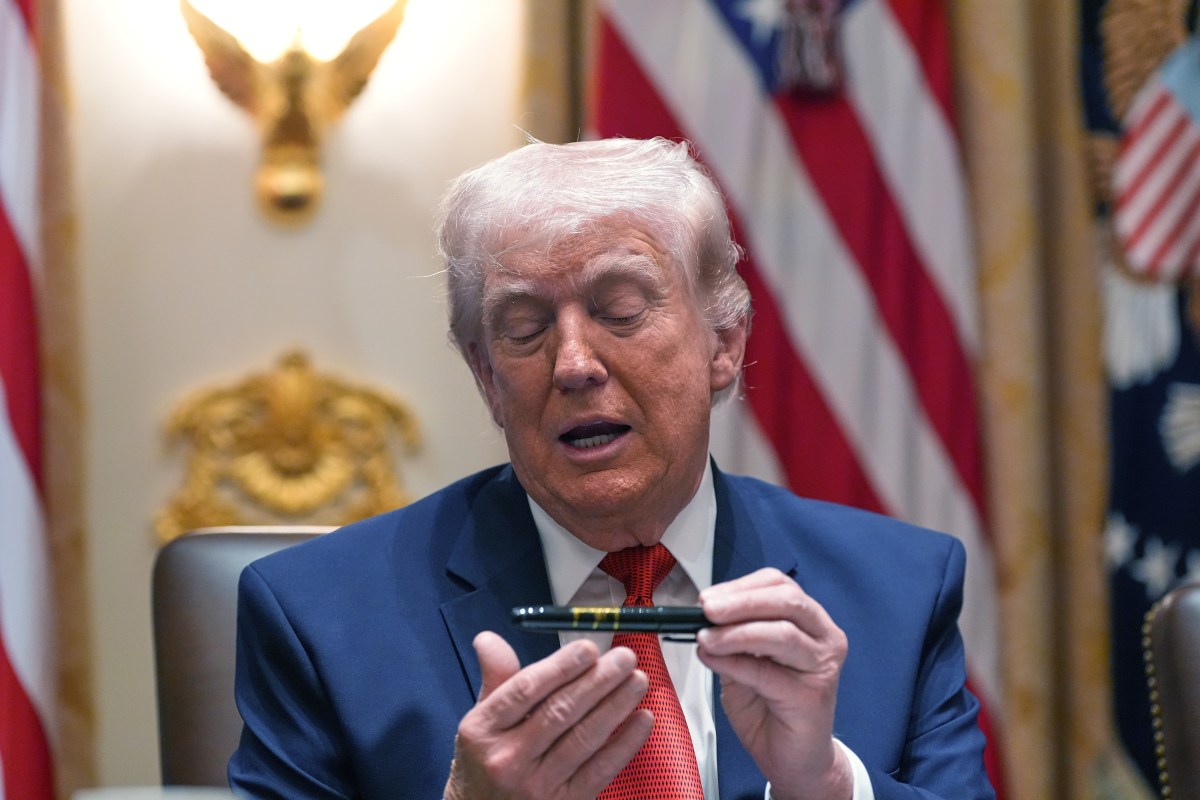
President Donald Trump used part of a Cabinet meeting Thursday to tell an extended story about his preferred writing instrument — a Sharpie marker — interjecting the anecdote amid briefings on the war in Iran, long security lines at major U.S. airports, rising oil prices and volatility in financial markets.
As senior officials discussed missile strikes, Iran’s uranium enrichment efforts and U.S. troops deployed in the region, Trump held up a black-and-gold Sharpie and launched into a winding explanation of how the marker became a fixture at the White House.
“See this pen right here?” Trump said at the start of what became a roughly five‑minute, intermittent monologue. “This pen is an interesting example.”
Sharpie Monologue Overshadows Policy Discussion
The Sharpie story was one of several lengthy asides Trump made during the meeting, moments that stood out given the gravity of the topics under discussion. Defense Secretary Pete Hegseth, special envoy Steve Witkoff, Vice President JD Vance and Secretary of State Marco Rubio had offered sobering remarks about military risks and geopolitical tensions before Trump shifted the focus.
Trump framed the anecdote as an illustration of his business instincts and his belief that the federal government can reduce costs through better decision‑making. He also used the moment to revisit his long‑standing criticism of what he describes as excessive spending on renovations to the Federal Reserve Building in Washington.
“We’ve gotta get our priorities straight,” Trump said.
From Expensive Pens to Markers
Trump said his story began when the White House stocked what he described as “beautiful” ballpoint pens that he claimed cost $1,000 each. He said the price became an issue during ceremonial bill signings, when presidents traditionally give pens used to sign legislation to lawmakers, aides and supporters.
“Sometimes you have 30, 40 people,” Trump said, adding that the cost of handing out the pens troubled him, particularly when recipients included children who, he said, did not understand the value of the gift.
Despite his reputation for opulence — including the $400 million White House ballroom he built after demolishing the East Wing — Trump said the practice conflicted with his desire to control spending.
“I love the government like I love myself, economically,” he said. “I want to save money.”
How the Sharpie Became a White House Fixture
Trump said he contacted a marker manufacturer about producing a custom pen bearing the White House logo in gold. He said he worried about giving the company too much publicity before identifying it as Sharpie, a brand he has long favored.
For decades, Trump has used Sharpies to sign autographs, mark up newspaper clippings and send handwritten notes in thick black ink. As president, he has continued using the markers to sign executive orders, proclamations and legislation.
Trump said the company agreed to produce the pens at no charge, though he insisted on paying $5 per marker. Online prices for standard Sharpies typically range from $1 to $2.
“The head of Sharpie gets a call. I don’t even know who the hell he is,” Trump said. “He said, ‘Is this really the president?’”
A Familiar Symbol at the White House
The episode marked the most attention Sharpies have received at the White House since the “Sharpiegate” controversy during Trump’s first term, when a modified weather map was displayed following Hurricane Dorian.
Sharpie’s parent company, Atlanta‑based Newell Brands, said in a statement that it had no information about the specific conversation Trump described. The company said Sharpies are used by current and former U.S. presidents, elected officials, celebrities, athletes and artists.
Trump described the anecdote as “a business story.”
“For $5, I get a much better pen than for $1,000, and I can hand them out,” he said. “And, honestly, they’ve become hot as a pistol.”
After finishing the story, Trump briefly praised his own storytelling before yielding the floor to Treasury Secretary Scott Bessent.
“Good luck, Scott,” Trump said as Cabinet members laughed.
“Well, sir,” Bessent replied, “as usual, you’re a tough act to follow.”
This article includes reporting by the Associated Press.
In a polarized era, the center is dismissed as bland. At Newsweek, ours is different: The Courageous Center—it’s not “both sides,” it’s sharp, challenging and alive with ideas. We follow facts, not factions. If that sounds like the kind of journalism you want to see thrive, we need you.
When you become a Newsweek Member, you support a mission to keep the center strong and vibrant. Members enjoy: Ad-free browsing, exclusive content and editor conversations. Help keep the center courageous. Join today.
Read the full article here


