



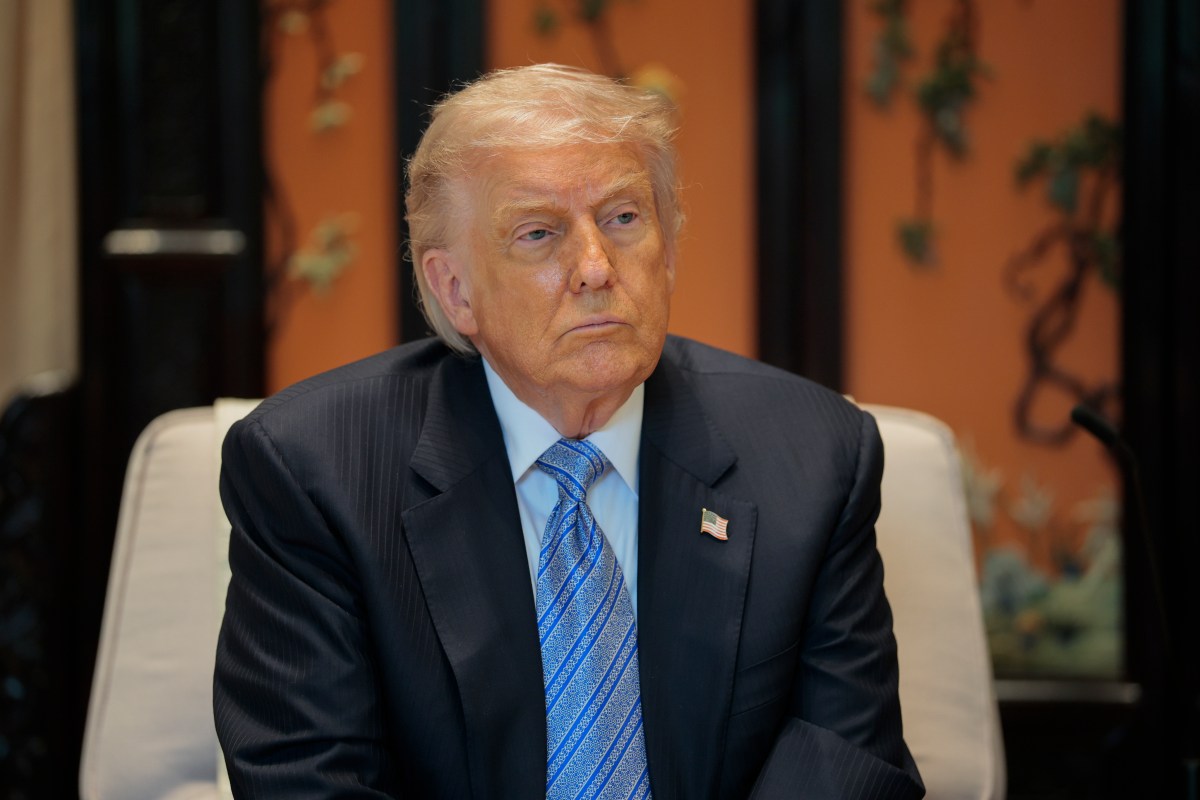
President Donald Trump is scheduled to see doctors for a medical checkup on Tuesday.
The news that Trump, who turns 80 next month and was the oldest person elected U.S. president, will see his doctors at the Walter Reed National Military Medical Center—the fourth visit with medical experts since returning to office last year—has put his health back in the spotlight.
The president has faced increasing scrutiny about his health since he returned to office in January last year, particularly because of photos showing bruised hands and swollen ankles.
And although his officials have repeatedly insisted that the president is in great health, some medical professionals have been skeptical of the official line.
Presidents have wide discretion over what health information they choose to release to the public—and despite questioning his predecessor Joe Biden’s physical and mental fitness, Trump has long chosen to keep basic facts about his own health shrouded in secrecy.
However, there is “absolutely no requirement” for presidents to have annual health exams or release the results to the public, Jacob Appel, a physician and professor at Mount Sinai Hospital in New York who has researched the medical histories of U.S. presidents told The Associated Press.
President Richard Nixon was the first modern president to publicize his annual medical exams, Appel said. Since then, the process has become more customary for U.S. presidents.
A look at Trump’s medical reports from his first and second terms shows how his health has been framed, what details have been provided and what has been left out.
January 2018: First Physical of First Term
Trump received his first medical checkup as president at Walter Reed on January 12, 2018 and the results provided were some of the most detailed of his two terms.
Dr. Ronny Jackson, his White House physician, said afterward that the examination “went exceptionally well” and he declared Trump in “excellent health.”
The examination had lasted several hours and measured things like Trump’s blood pressure, cholesterol, blood sugar, heart rate and weight.
Jackson reported the president weighed in at 239 pounds. Trump’s body mass index, or BMI, of 29.9 put him in the category of being overweight for his height. A BMI of 30 and over is considered obese.
His blood pressure was 122 over 74, and his total cholesterol was 223, which is higher than recommended and for which he was taking a low dose of the statin drug Crestor. Jackson said he would increase that dose in an effort to get Trump’s so-called “bad” cholesterol, or LDL level, from 143 to below 120.
Jackson also said Trump had received a perfect score on a surprise cognitive test that was administered. The test is designed to detect early signs of memory loss and other mild cognitive impairment.
February 2019: Annual Physical
Trump underwent an annual physical at Walter Reed on February 8, 2019.
The White House later released the results, revealing that Trump had gained enough weight to be officially considered obese. The results said he weighed 243 pounds and his body mass index was 30.4.
Despite that, Dr. Sean P. Conley, the president’s physician, said in a memo that Trump “remains in very good health overall.”
His resting heart rate was 70 beats a minute and his blood pressure reading was 118 over 80, well within the normal range. Conley said routine lab tests were performed and Trump’s liver, kidney and thyroid functions were all normal, as were his electrolytes and blood counts. An electrocardiogram, a test that measures electrical activity generated by the heart as it beats, remained unchanged from the previous year.
Trump’s total cholesterol was down to 196, but his LDL or “bad” cholesterol was slightly elevated at 122. Conley said he planned to increase the dosage of a statin drug to 40 milligrams a day to bring the president’s cholesterol reading down further.
November 2019: Medical Tests
Trump spent more than two hours at Walter Reed on November 16, 2019, for what the White House said were medical tests that were part of his annual physical.
That trip was omitted from his public schedule, breaking with White House’s protocol of giving advance public notice of them.
Then-White House Press Secretary Stephanie Grisham said the president had wanted to take advantage of a free weekend to start portions of his routine annual checkup early as he was “anticipating a very busy 2020.” She said the White House would not release results until all aspects of the physical were completed.
The White House released a statement from Conley that said it had been a “planned interim checkup” kept “off the record” because of scheduling uncertainties.
June 2020: Use of Malaria Drug Disclosed
The results of a physical Trump underwent in April 2020 revealed that the White House medical team had kept a close eye on Trump to watch for possible side effects from a two-week course of hydroxychloroquine, an anti-malaria drug, to prevent COVID-19.
“The President completed the regimen safely and without side effects,” Conley wrote in a report on Trump’s physical.
Trump was evaluated twice for the physical, first in November 2019 and then in April 2020.
Conley wrote in a report in June 2020 that Trump showed little change in basic health measurements from his 2019 physical.
The report said Trump’s weight came in a 244 pounds, putting him further into the obese range for adults of his height with a body mass index of 30.5.
He had a resting heart rate of 63 beats per minute and his blood pressure came in at 121 over 79.
His total cholesterol was 167 and the report said he was taking rosuvastatin to help lower his LDL and to raise his good cholesterol, or HDL
The report also said Trump was taking aspirin daily and finasteride, a drug to treat enlargement of the prostate and male pattern hair loss.
October 2020: COVID Hospitalization
Trump was hospitalized with COVID-19 in October 2020, weeks before the presidential election.
He tweeted on October 2 that he and the first lady had tested positive. Later that day, he went into the Walter Reed National Military Medical Center for monitoring, leaving three days later after receiving experimental treatments.
The White House provided frequent updates, but the changing, and at times, contradictory accounts about Trump’s condition created a credibility crisis at a crucial time.
The New York Times reported months later that Trump’s illness was more severe than his administration and doctors revealed at the time and that at one point, his oxygen levels were so low that it was feared he would need a ventilator. Trump’s former Chief of Staff Mark Meadows revealed in a book that Trump was far sicker than the White House had disclosed at the time.
April 2025: First Physical of Second Term
Trump underwent a physical exam at Walter Reed shortly after returning to office last year. The exam, which lasted about five hours, included blood work, cardiac testing, CT scans and ultrasounds.
The president also underwent neurological and cognitive screening, something he has repeatedly referred to as having passed with flying colors.
In a summary released by the White House, his physician, Navy Captain Sean Barbabella said Trump “exhibits excellent cognitive and physical health and is fully fit to execute the duties of Commander-in-Chief and Head of State.”
The results said Trump weighed 224 at the checkup and his BMI was down to 28.0, which dropped Trump to the category of overweight.
The report said that Trump’s joints and muscles “have a full range of motion, with normal blood flow and no swelling.”
It also noted that Trump previously had cataract surgery on both eyes, but gave no other details. The report also said that in July 2024, Trump had a colonoscopy that found a benign polyp and the condition called diverticulosis, a common condition in which the walls of the intestine weaken with age.
The summary said Trump again passed a Montreal Cognitive Assessment test. The test includes remembering a list of spoken words and listening to a list of random numbers and repeating them backward, among other questions.
July 2025: Diagnosis Disclosed
The White House announced in July last year that Trump underwent a medical checkup after noticing “mild swelling” in his lower legs.
White House press secretary Karoline Leavitt said tests by the White House medical unit showed that Trump has chronic venous insufficiency, a condition that occurs when little valves inside the veins that normally help move blood against gravity gradually lose the ability to work properly. The disclosure was notable given Trump has kept basic facts about his health secret, and Leavitt said the White House was disclosing details of the checkup to dispel rumors about Trump’s health following public speculation over visible swelling in the president’s legs and bruises on his hands. The results of his April physical did not include a finding of chronic venous insufficiency.
Leavitt also said that bruising on the back of Trump’s hands was “consistent” with irritation from his “frequent handshaking and the use of aspirin.”
October 2025: Follow-up Evaluation
Trump returned to Walter Reed in October for a medical exam, a move that raised questions about why there were two visits in one year.
The White House released a one-page summary from Barbabella saying it was a “scheduled follow-up evaluation” that found the president was in “exceptional health” without divulging many specific results. The summary said the evaluation included “advanced imaging, laboratory testing, and preventative health assessments conducted by a multidisciplinary team of specialists.” Trump got his yearly flu shot and a COVID-19 booster vaccine during the visit, it said.
Trump later told The Wall Street Journal that he underwent advanced imaging on his heart and abdomen in October. He said he regretted doing so because it raised questions about his health.
May 2026: Annual Physical
According to the White House’s announcement earlier in May, Tuesday’s visit is a routine checkup.
“President Donald J. Trump will visit Walter Reed National Military Medical Center on May 26 for his annual dental and medical evaluations, and to visit with the men and women of the military,” the statement said.
“This will include the President’s routine annual dental and medical assessments as part of his regular preventive health care.”
The visit will likely draw scrutiny, with supporters and critics watching what the White House will reveal afterward and in how much detail.
Read the full article here


