



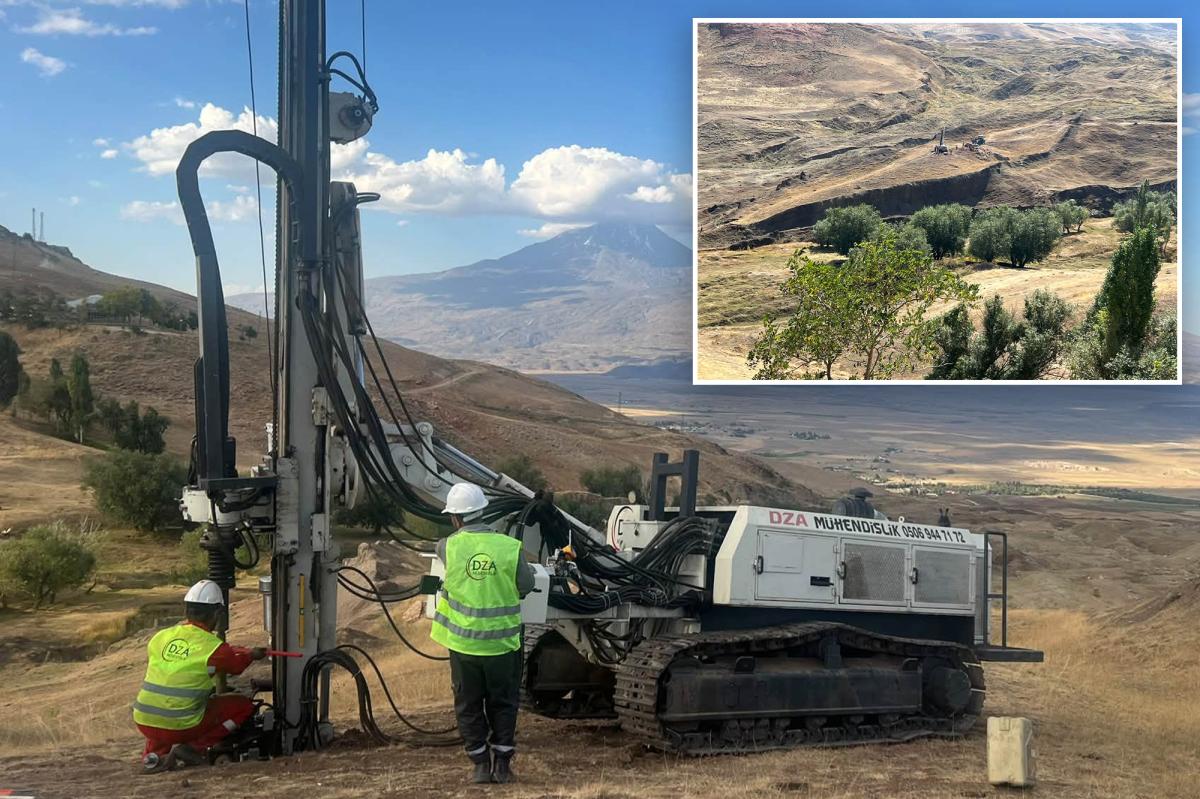
Researchers have begun drilling into a mysterious, boat-shaped formation in the mountains of eastern Turkey, hoping an underground robot will unearth the answer to one of biblical history’s biggest mysteries.
Members of the Noah’s Ark Scans expedition believe the Durupinar formation, located in eastern Turkey near Mount Ararat, could mark the final resting place of the vessel described in Genesis.
“Good morning from the outer rims of Noah’s ark,” the project’s marketing and fundraising director, divisive Christian activist Lauren Witzke, wrote in a Tuesday update.
“Core drilling has begun and the big bang evolutionists are already in damage control mode,” she continued.
Witzke said the expedition had Turkish government approval and oversight from local universities, with “some of the most brilliant minds in the world” taking part.
She made the sensational claim that, “When we are done, university curricula will need to be rewritten, and Darwinism will be dismantled.”
“This is the place where creation began anew,” she enthused.
Witzke is a controversial figure in American politics.
The former Senate candidate is a self-proclaimed “flat-earther,” has voiced support for the right-wing conspiracy theory QAnon, and once called the Covid vaccine a “satantic plot.”
But while Witzke handles publicity for the team, it includes bona fide archaeologists and geologists from around the world, such as Project Director Dr. Cenker Atila, from Turkey’s Sivas Cumhuriyet University.
A chequered history
A long line of researchers have visited the controversial “ark” over the years and drawn very different conclusions.
The Durupinar formation was officially discovered in 1959, when a Turkish Army captain captured it in an aerial photo while mapping the area.
Local researchers carried out surveying, digging and dynamiting, but couldn’t find any archaeological evidence and concluded that the formation was a natural anomaly.
Modern geologists agree, widely viewing the site as a boat-shaped ridge made of limestone and volcanic clay that was sculpted by erosion.
After that initial probe, the “ark” lay dormant until the 1980s, when American salvage expert David Fasold used ground-penetrating radar to examine the site and became convinced he was looking at the fossilized remains of a ship’s upper deck.
Fasold measured the length of the formation as 164 meters, close to the 300-cubit (157-meter) length of the ark quoted in the Bible.
There was also the matter of the “drogue stones”: large carved stones scattered northwest of the site — with holes cut through their upper ends — which he believed were ancient sea anchors, cut loose from the ark when the flood receded.
Skeptics argue the stones are simply ancient memorial markers or tombstones.
Years after his work at Durupinar, Fasold seemed to have a change of heart; publicly repudiating the ark theory as “absolute BS.”
But his Australian friend and biographer June Dawes maintained that he went to his grave believing he had found the ark.
What is the 2026 expedition doing?
In recent years the site has been probed with ground-penetrating radar again; this time by the Noah’s Ark Scans expedition, which claims it has “already mapped what looks like corridors and chambers under the surface, including one hallway that runs more than 250 feet.”
The next step would be to “drill narrow cores down into those spaces and send in Gopher, an underground robot built to go where a person cannot,” according to the group’s fundraising page.
Gopher has been equipped to collect high-resolution footage and soil samples under the surface.
It was designed by an Australian engineer: Dr Robert Ross from La Trobe University.
“The robot was basically repurposed based on a robot that I originally built for wildlife ecologists to explore wombat burrows (WomBot) and Armadillo Burrows in French Guiana (ArmaBot),” Dr Ross told news.com.au.
The Noah’s Ark Scans fundraiser said the project required USD$600,000 (A$843,000) to begin drilling.
As of Tuesday, it had only raised a small fraction of that; but drone footage shared by Witzke appeared to show that drilling had commenced.
The expedition is now racing against the onset of winter, which will freeze the ground and force researchers to stop operations until next year.
It could be a matter of time before Gopher settles the long-debated mystery of Durupinar for good.
Read the full article here


