



European Union officials have defended landmark digital rules on Wednesday, after the Trump administration went after what it described as a machine created to fuel censorship and imposed sanctions — including a visa ban — on a former EU Commissioner.
The European Commission said in a statement it “strongly condemns” the US decision, stressing that freedom of expression is “a fundamental right in Europe and a shared core value with the United States across the democratic world”.
Brussels insisted that the EU has a sovereign right to regulate its digital market in line with its values, adding that its rules are applied “fairly and without discrimination”.
The Commission said, if needed, it would “respond swiftly and decisively our regulatory autonomy against unjustified measures” from the US side.
Digital rules have become a point of tension between Washington and Brussels, both accusing each other of politicising what should be standard market rules for companies operating in the EU.
That friction was exacerbated after the US published a controversial national security strategy earlier this month, arguing that Europe faces the demise of civilisation unless it radically changes course.
In the document, the Trump administration said that Europe was drowning under illegal and excessive regulation and censorship.
The document was built on a premise laid out by US Vice President JD Vance at the start of the year, during a speech at the Munich Security Conference, in which he argued that internal rules posed the most significant risk to the EU.
He referred to EU Commissioners as “commissars” and argued that foreign interference is often used to censor content.
The EU denies that and insists that rules are applied fairly.
France pushes back against US over ‘coercion’
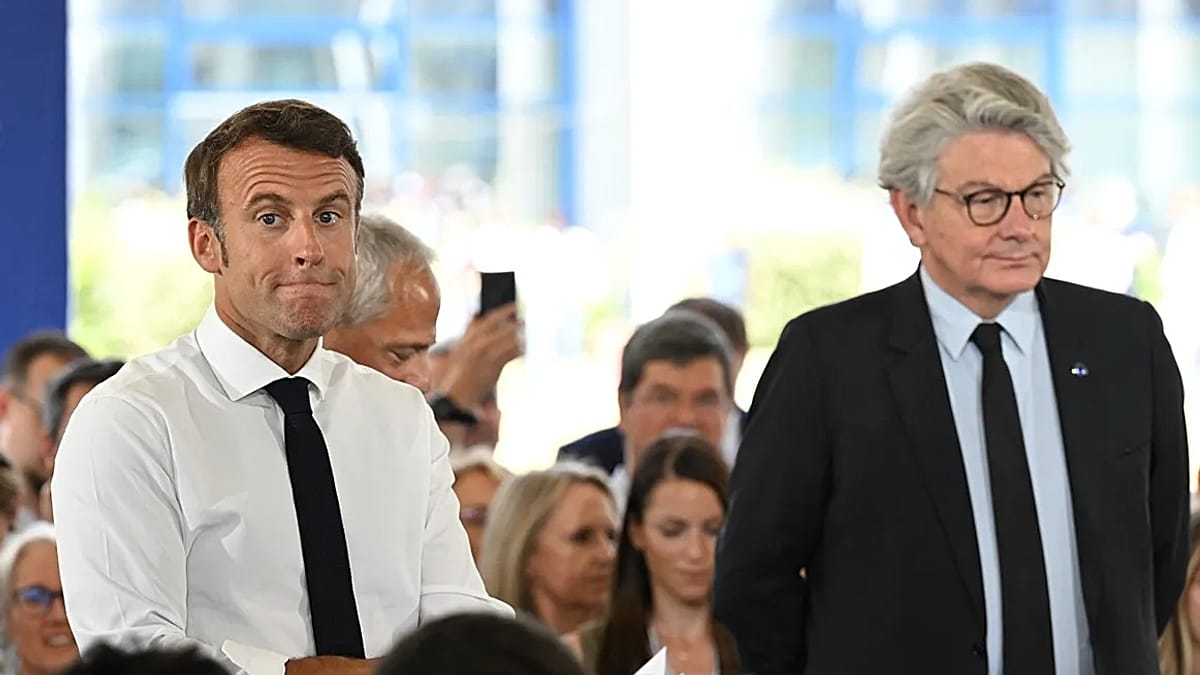
Meanwhile, French President Emmanuel Macron accused Washington of intimidation after the visa ban on Breton, the former European Commissioner appointed by Macron himself, saying it amounts to “coercion aimed at undermining European digital sovereignty”.
The French president, who has long campaigned for strategic autonomy, said that digital rules governing the EU market are decided by Europeans and Europeans alone.
Macron said he had spoken with Breton over the phone after his ban was announced and “thanked him for his significant contribution in the service of Europe.”
“We will stand firm against pressure and will protect Europeans,” the French president wrote in a post on X.
Breton, who served as European Commissioner for the Internal Market under Commission President Ursula von der Leyen, played a key role in drafting the Digital Services Act (DSA), which aims to hold social media and large online platforms accountable for the content they publish.
Under the DSA, digital companies can be fined up to 6% of their annual worldwide turnover for non-compliance, with specific penalties for various violations.
Fines and tariffs as leverage for both sides
Earlier this month, the European Commission slapped a €120 million fine on Elon Musk’s social media platform X, invoking the DSA for the first time.
The fine triggered a furious response from the tech billionaire, who called for the abolition of the EU.
While fines are not uncommon and multiple US governments have called out what they believe is a targeted effort to penalise innovation made in America, the Trump administration has been more aggressive in its tone and countermeasures.
Washington has indicated it would provide tariff relief only for key European sectors, such as steel and aluminium, if the EU agreed to ease the implementation of digital rules.
For the EU, the idea is a red line, as it would undermine its right to set policy independently of the US government.
After being hit by a wave of tariffs amounting to 15% on most European products over the summer, Brussels insisted the deal was the best of all options on the table as it would provide certainty for business with a single duty rate and reiterated policy independence was assured as digital rules had been left out of the negotiation.
With its latest actions, the Trump administration has suggested it may not be enough.
Read the full article here


