



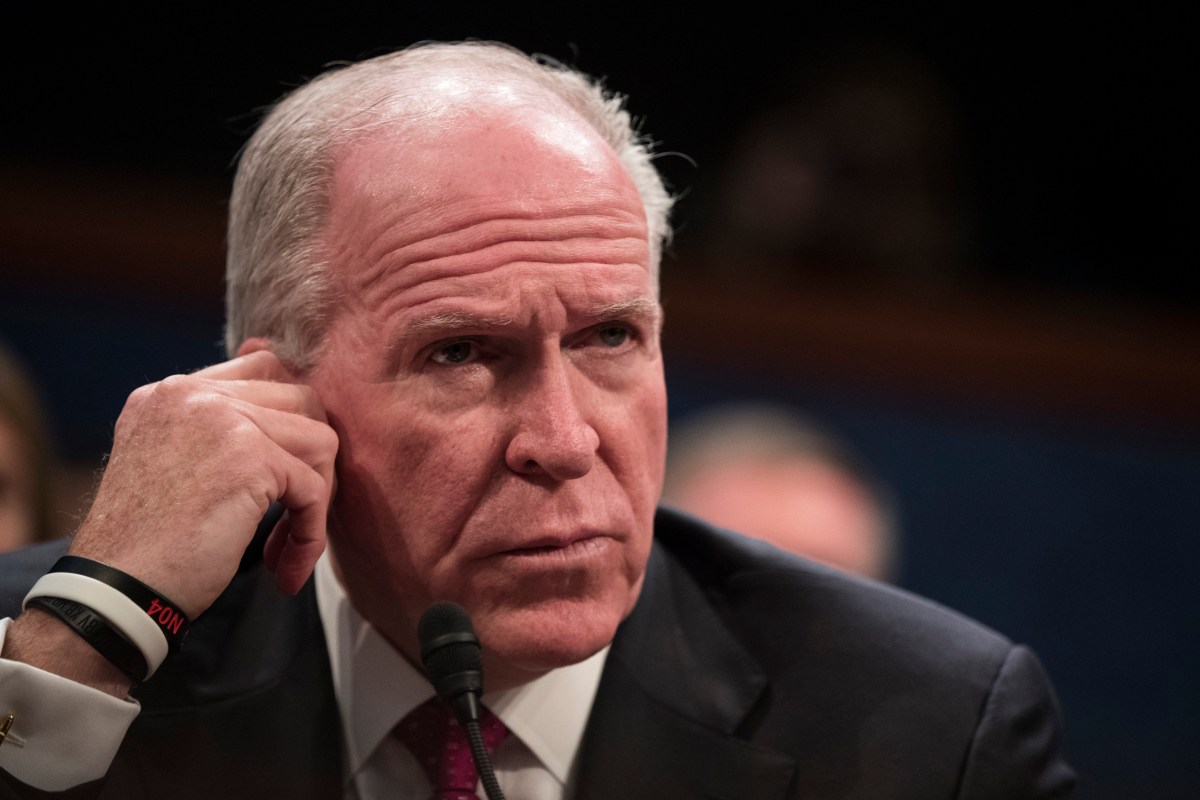
Former CIA Director John Brennan said President Donald Trump’s recent statements and actions related to the Iran war raise serious questions about his fitness to remain commander in chief, arguing that the Constitution’s 25th Amendment was designed for situations like this.
Brennan, appearing on MS Now, criticized Trump’s rhetoric on Iran and the war’s consequences. He warned that the president’s conduct—paired with his control over U.S. military and nuclear capabilities—represents a dangerous convergence of power and instability.
Calls to invoke the 25th Amendment against Trump have intensified following his threats toward Iran and comments suggesting the destruction of an entire civilization, setting off renewed debate over presidential authority and accountability during wartime.
Newsweek reached out to the White House on Saturday.
Why It Matters
The 25th Amendment was adopted to address presidential incapacity, but it has rarely been discussed in the context of a sitting president’s conduct during an active military conflict. Brennan’s argument reframes the amendment not as a tool of last‑resort succession planning, but as a safeguard against what he views as reckless command authority.
The debate has taken on added urgency as the U.S. confronts escalating regional instability in the Middle East, with Brennan citing reports of U.S. service members killed amid the fighting and diplomatic efforts underway to contain the conflict.
While Democrats have led many of the calls to invoke the amendment, some Republicans and conservative commentators have also raised concerns, contributing to an unusual cross‑party discussion about the limits of executive power in moments of crisis.
What to Know
Brennan served as CIA director from 2013 to 2017 under President Barack Obama, following more than 30 years in intelligence and national security roles, including as Obama’s chief counterterrorism adviser.
Brennan pointed to Trump’s comments on Tuesday threatening to eliminate “a whole civilization,” saying such language underscored the danger of unchecked executive power. “Allowing someone like this to continue to be the commander in chief and to control the tremendous capabilities of the U.S. military, including our nuclear weapons capability…we really are in very, very troubling times,” he said.
The former CIA director went further, saying that Trump “clearly is unhinged” and arguing that the 25th Amendment was effectively written with a leader like Trump in mind. Brennan warned that allowing such a president to continue as commander in chief posed extraordinary risks, particularly given Trump’s authority over nuclear weapons.
Brennan said it was especially troubling that Trump has continued to act with the backing of members of his party who, in Brennan’s view, have worked to excuse or rationalize his conduct rather than challenge it.
“The fact that he’s able to do that, and members of his party and his MAGA base continue to explain and apologize for and rationalize what he’s doing, is just so, so troubling,” Brennan said.
In recent days, a growing number of elected officials and political figures have publicly raised the possibility of invoking the 25th Amendment, citing concerns about President Trump’s conduct and rhetoric during the Iran conflict. Several Democratic lawmakers, including Representatives Shri Thanedar of Michigan and Ro Khanna of California, called on Vice President JD Vance and the Cabinet to act following Trump’s social media posts threatening large‑scale destruction in Iran. Senator Chris Murphy of Connecticut and Senator Ed Markey of Massachusetts made similar arguments in statements shared on social media and in television interviews this week, warning that the president’s language amounted to a national security risk.
Some Trump allies and conservative figures have echoed those concerns. Former Representative Marjorie Taylor Greene of Georgia, once a close Trump supporter, publicly called for invoking the 25th Amendment on April 5 in a post responding to the president’s Iran rhetoric. Other right‑leaning commentators, including media personality Alex Jones, have made similar arguments in broadcasts and online posts, saying the amendment exists as a constitutional safeguard when a president is viewed as unable to safely discharge the powers of the office.
Invoking the amendment remains procedurally and politically difficult. Under Section 4, the vice president and a majority of the cabinet would need to declare Trump unable to discharge the powers and duties of his office—a step that has never been completed against a sitting president.
Brennan, while sharply critical of Trump, expressed cautious optimism about the current diplomatic track, noting reports that Vance was bringing “some government professionals and experts” with him to the U.S.-Iran talks in Islamabad, Pakistan, this weekend aimed at de‑escalation.
What Happens Next
U.S. and Iranian officials are expected to continue talks in the coming days as they attempt to stabilize a fragile ceasefire and prevent further escalation of the conflict.
Domestically, pressure on the White House is likely to persist, with additional lawmakers expected to weigh in on whether the 25th Amendment should be formally considered. So far, there has been no indication that Vance or Trump’s cabinet intends to pursue that path, but the debate shows no signs of fading as the conflict—and scrutiny of presidential authority—continues.
In a polarized era, the center is dismissed as bland. At Newsweek, ours is different: The Courageous Center—it’s not “both sides,” it’s sharp, challenging and alive with ideas. We follow facts, not factions. If that sounds like the kind of journalism you want to see thrive, we need you.
When you become a Newsweek Member, you support a mission to keep the center strong and vibrant. Members enjoy: Ad-free browsing, exclusive content and editor conversations. Help keep the center courageous. Join today.
Read the full article here


