



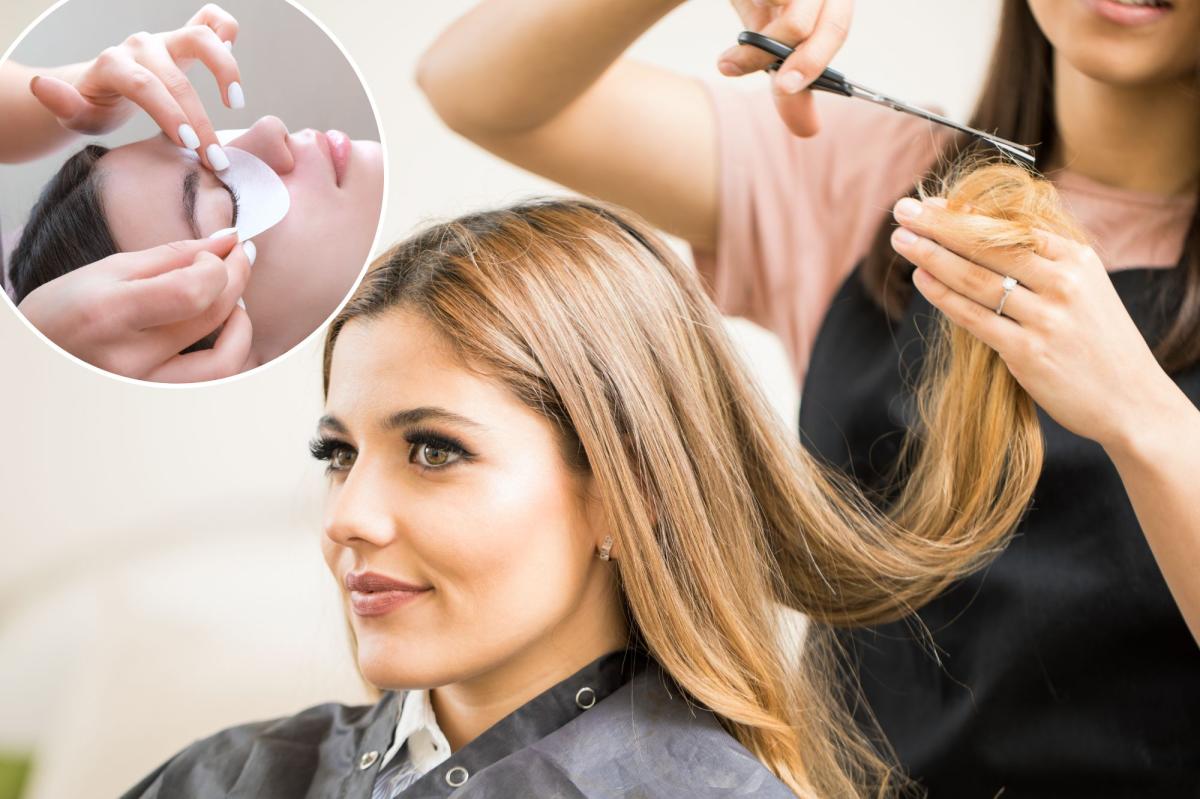
In 2026, money talks — but increasingly, so does a blowout, a brow tint, or a fresh set of lashes.
Across social media feeds and salon chairs nationwide, a very ancient idea is making a very 2026 comeback: bartering.
Only this time, it’s not barley for labor or tools in Mesopotamia — it’s eyelash extensions for manicures, tattoos for eyebrow shaping, and matcha for a quick trim.
Bartering — the direct exchange of goods or services without cash — is finding fresh life in the beauty industry, where cash-strapped consumers and busy pros are swapping skills instead of swiping cards.
Hannah M. Le, 28, of the Lower East Side and inventor of Buckle Scrunchies, says the swap economy didn’t exactly arrive with fanfare — it just kind of took over her social life.
“I first started using my products like currency for beauty services in 2024 when I moved to New York,” she told The Post.
What started as a quirky workaround has since evolved into a steady flow of beauty trades — not just in salons, but at brunches, events and beyond.
Financial coach AJ Schneider of Beyond The Green Coaching LLC says the resurgence of swapping isn’t happening in a vacuum — it’s happening in a squeeze.
And beauty services — which are repeatable, skill-based and highly personal — become prime barter material.
“The rise in beauty-service swapping is a reflection of economic pressure, inflation and the high cost of living — especially in cities like New York,” she told The Post.
And as everyday costs stack up — from rent to groceries to subscriptions — Schneider says consumers are quietly shifting toward a different kind of payment system altogether.
“So people are starting to rely on another currency — their time,” she added.
On social media, hairstylist Didi (@itsthecurlsforme) set off a wave of “Wait, that’s legal?” reactions after casually revealing just how far her trades go.
“I love a good bartering moment,” she told followers in a viral video, explaining that she once accepted “a boatload of eggs” in exchange for cutting the hair of a client’s son.
Her swap economy doesn’t stop there. One client, a professional nanny, watches her kids for a weekend in exchange for hair services.
Another trades a barista-made matcha for a quick trim. She’s even received ear piercings and family photo shoots in exchange for haircuts.
Meanwhile, nail tech and makeup artist Cass (@cassprostudios on TikTok) showed off her own barter deal in action, filming herself getting eyelash extensions before returning the favor with a manicure.
Her caption kept it simple — and telling: “Bring back bartering.”
In New Jersey, esthetician and brow artist Rosemary (@glowedbyrose) took things a step further, documenting a tattoo-for-brows exchange with another beauty pro.
Her caption: “Brows & lashes for ink sounds like a fair trade to me.”
The comments section under each video reads like a digital trading post, with users eagerly listing their own swaps — proof that in an era of inflation fatigue, the “something for something” model is resonating.
And the numbers help explain why.
The average cost of living in the US now sits at roughly $61,334 per year for a household, or about $5,100 a month — with single individuals averaging $4,716 monthly and families of four around $7,101.
Housing alone eats up roughly $1,800 monthly on average, making creative budgeting less trend and more survival strategy.
And for some New Yorkers, bartering isn’t just viral content — it’s lifestyle design.
For Buckle Scrunchies entrepreneur Le, the appeal isn’t about scoring “free” services, but about how differently people assign value to what they’re trading.
“For many of the people I meet, my products are the coolest thing in the world, and they value them so much more than I imagine.”
That mismatch, she says, is exactly what makes the system work.
“I might perceive the market value of their services way more than they do … vice versa applies.”
In other words, the real currency isn’t lashes or scrunchies — it’s perception.
And once that clicks, she says, the exchange stops feeling like a transaction and starts feeling like a relationship.
“In my experience, bartering has always been about relationship-building,” Le explained. “It’s being in a similar industry and having an unspoken, mutual understanding of ‘I got you.’”
Amanda Gabbard, an NYC-based makeup artist for over 20 years, added that even as the barter boom spreads from social media into everyday salon culture, it’s nothing new — just newly visible.
“Bartering has always existed in the beauty industry, but I’ve definitely seen it become more common recently,” she told The Post.
She added that the beauty industry is “especially hot on bartering in 2026” because, most notably for specialists who want to garner a bigger following online, exchanging services is “visual, relationship-driven and collaborative.”
“A lot of what we do naturally leads to partnerships, content creation and cross-promotion.”
However, Gabbard warned that if boundaries and expectations “aren’t clear,” someone can feel “undervalued.”
She stressed that as a makeup artist, “exposure is great, but it doesn’t replace fair compensation.”
Her advice to others in NYC’s cutthroat beauty industry: “Barter strategically, not habitually, as your expertise still has value.”
“Despite what people feel, we’ve been in a financial boom since COVID. People have had more money to spend, and easier access to debt or repayment plans, like buy now, pay later programs,” financial coach Schneider told The Post.
But that post-pandemic spending high, she warned, is fading fast.
“According to Experian, Americans have about $18.57 trillion in consumer debt.”
There’s another reality check, too: nothing is ever truly “free.”
“Bartering feels ‘free,’ but it still has a cost, your time, energy, labor, exposure and your business resources,” she warns.
And while swapping may feel like a shortcut around financial stress, Schneider says it can also mask it.
“Financial stability — budgeting, saving, investing, paying off debt, building wealth — requires delayed gratification, consistency and long-term thinking.”
Because in the end, she suggests, even in a barter boom, the bill always comes due — it just might be paid in lashes, not dollars.
Read the full article here


