



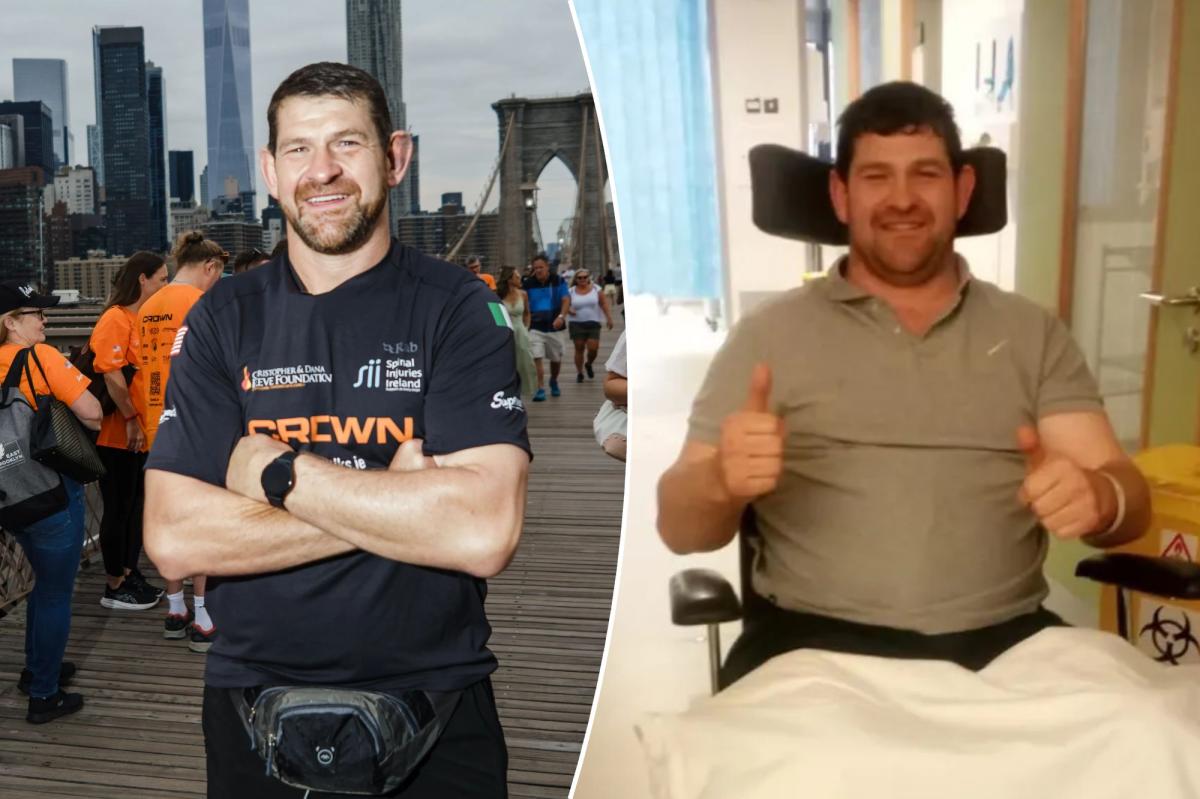
The odds have never meant much to Fergus Farrell.
In 2018, the Irishman was given a 5% chance of ever walking again after a workplace injury left him paralyzed from the ribcage down.
Nearly six years later, after a grueling recovery, he’s hitting the open road for a 3,000-mile trek across the US — entirely on foot.
“If anybody tells me I can’t do something, by God, I’ll do my damndest to do it,” Farrell, 46, told The Post. “It’s all about taking a small step at a time.”
And Farrell has already taken plenty. On the first anniversary of the accident, the Galway native walked across Ireland, ending his journey at the hospital he’d been told he’d likely never move his legs again.
In the years since, Farrell has rowed seven marathons, run four ultramarathons and even attempted to paddle across the Atlantic Ocean in 2022.
Now, the father of three is taking on his biggest feat yet: Six million steps from the Brooklyn Bridge to the Santa Monica Pier in just 75 days.
“When I walk across America, it’s to create awareness for people living with spinal cord injuries, but it’s also for my kids,” said Farrell, who kicked off his mission Saturday. “I want to show them that when you get up and work hard, you can do whatever you want.”
‘Very, very unlucky’
Farrell was overseeing his fleet of 35 buses on Oct. 26, 2018, when he bent down to lift a metal bench and felt a “massive explosion” in his back, dropping him to the ground in pain.
He soon realized he couldn’t feel his legs, and later learned that he had ruptured two discs in his back — one of which had nearly severed his spinal cord completely.
He was airlifted across Ireland to the National Spinal Unit in Dublin, where doctors operated immediately. But when he woke up, he said, “I still couldn’t connect to my feet.”
The pain was excruciating. Any feeling from the ribcage down was “completely gone.” Then the surgeon sat down beside him and put a hand on his shoulder.
“I’m sorry, Fergus, but you’ve been very, very unlucky,” Farrell recalled him saying.
The doctor then gave him a stark prognosis: “If you get moving within the next 72 hours, you have a 5% chance of getting some sort of strength back. However, if you don’t get movement after 72 hours, your stats go down to zero. You’ll be wheelchair-bound for life.”
Farrell fights back
For weeks, Farrell still couldn’t budge. Then, on the 21st day after the accident, came a breakthrough: a tiny twitch in his toe.
“That was a massive moment for me,” he said.
He was transferred to a rehabilitation hospital, where he spent months pushing his body to its limits, constantly in pain and using morphine to get a bit of sleep. But he began to improve: Little by little, movement returned.
“It was either live a life in pain and be myself, or live a life where I don’t know who I am.”
Fergus Farrell
Months after arriving, Farrell could shuffle on two feet, but his ability to walk remained limited. When medical staff sat him down to discuss being discharged, they expect him to use a wheelchair in public and have limited mobility at home, aided by grab rails.
“That’s bulls–t,” he remembers thinking.
“I said, ‘I’m walking out through those doors.’ I gave myself three weeks,” Farrell said. “During those three weeks, I broke myself, but I broke myself in a great way. I was there to do a job.”
Less than a month later, he left on his own two feet.
From rock bottom to redemption
Once he returned to Galway, though, he started to feel like a “prisoner” in his own home, restricted to a wheelchair and struggling to navigate the world. His marriage was unraveling, too.
“Have you ever heard that saying, “The empty mind is a dangerous mind?” he said. “When I got home, I was seeing all the negatives rather than the positives.”
He nearly ended his life, saved only by the grace of a “good friend.” He spent a week in a psychiatric ward.
“It was the best thing I ever did,” Farrell said. “I found out, for the first time at 39 years of age, who I was, not what I was.”
That person? One who excelled in the face of a challenge.
It was then that Farrell, who couldn’t walk more than 300 meters at the time, started training to walk 206 kilometers (128 miles) across Ireland on the first anniversary of his exit from the rehabilitation hospital. Around the same time, he started weaning himself off of morphine, which he’d become addicted to while managing the pain.
“I had to,” he said. “It was either live a life in pain and be myself, or live a life where I don’t know who I am.”
Next stop: America
Today, Farrell is an inspirational speaker, mental health advocate and devoted father. He’s taken on athletic challenges that would test even the fittest person — all while living with “24/7 nerve pain.”
“I still have a lot of disabilities. I don’t have any reaction skills. I have very poor balance,” he said.
But he no longer looks at Oct. 26, 2018, as the day his life fell apart.
“If you would have asked me two years after the accident what I thought of it, I would have told you it was one of the worst days of my life,” he said. “Now, if you ask me, it was the best day of my life, because I’m a lot better of a person than I ever was,” he continued. “I value everything I have rather than being envious of what I don’t.”
That outlook is fueling his biggest challenge yet.
For the past 18 months, he’s has been training for Fergus Walks, a cross-country trek aimed at raising awareness of spinal injuries and money for the Christopher & Dana Reeve Foundation and Spinal Injuries Ireland.
Farrell will cross 11 states, slogging through mountains, deserts, prairies and farmland while racking up roughly 80,000 steps a day. But the grueling miles aren’t what he’s most excited about — it’s the Americans he’ll meet along the way.
“Maybe they’ll come have a walk along the road with me,” he said. “I hope they do.”
A crew of volunteers will follow Farrell by car, keeping him supplied with food and water as he makes his way across the country. He’ll mostly bunk in hotels, though in more remote stretches, he’ll camp in a van.
By the time he reaches the West coast, he expects to have burned through eight pairs of shoes.
Farrell’s message to others is simple: “Anyone who’s fighting addiction, disability, whatever it may be, just take a small step at a time.”
“All those small steps add up,” he said. “The next thing you know, you’re in a place that you could have never imagined.”
Read the full article here


