



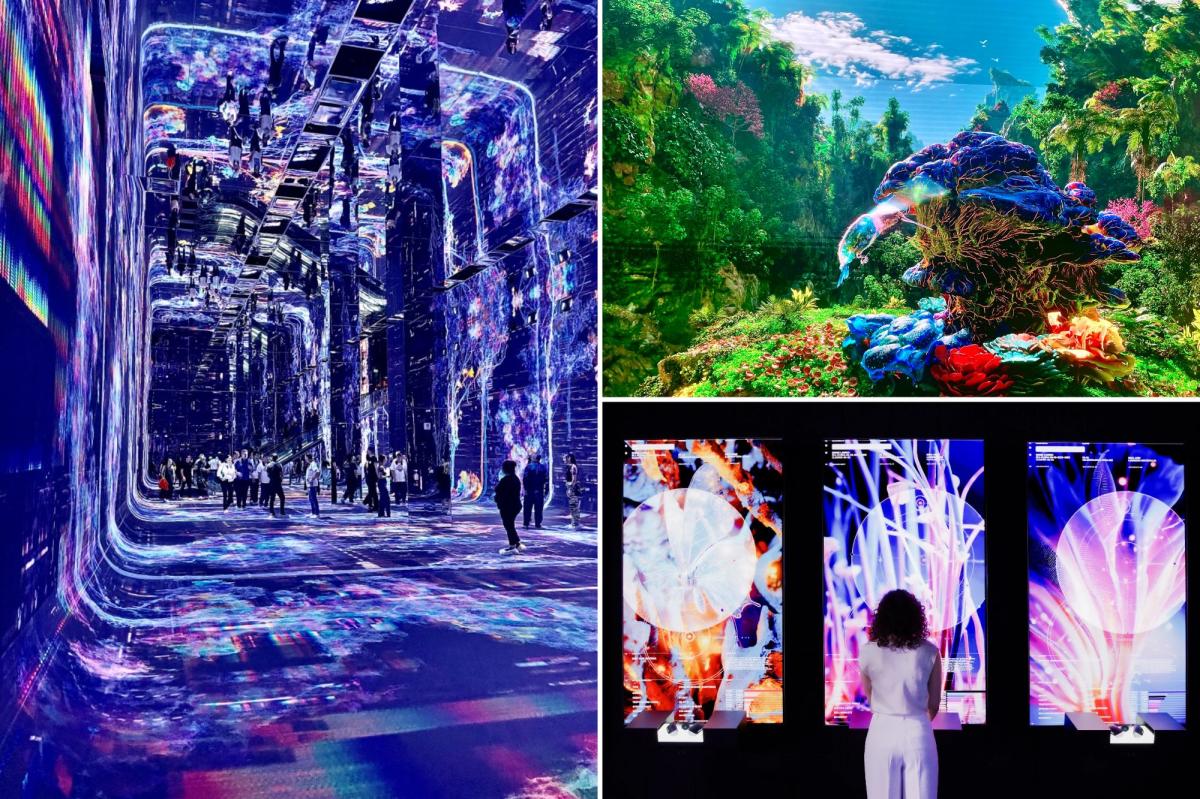
Everything is moving so fast in the rainforest, with life pulsing all around: in front, above, and below your feet.
The 360-degree cube takes the eye on a deep dive into exotic flora and fauna. Then comes an even deeper dive into the inner workings of trees, the sap pulsing through a usually invisible network.
The vibrant, ever-moving images inside the windowless cube are created by 1.2 billion data prompts live-fed from 16 rainforests across the globe. The ever-moving, gigantic images are accompanied by music — vast and engulfing — and smells, from floral to mossy to even electrical.
This is the wildly immersive Data Pavilion inside Dataland, billed as the world’s first Museum of AI Arts, opening in downtown Los Angeles on Saturday, June 20, inside The Grand LA complex.
Dataland debuts with “Machine Dreams: Rainforest,” a visceral, blow-your-mind immersion that goes far beyond data — certainly an art museum experience, but unlike few others.
The sensory splash, co-founded by artists Refik Anadol and Efsun Erkılıç, showcases four more reality-bending galleries to explore — like the classic “Alice in Wonderland” meets “Avatar” or the trippy, new horror film “Backrooms.”
Erkılıç watches, tears gathering on her cheeks, while recently venturing through Anadol’s Infinity Room, which zooms the eye and mind on a journey deep into the rainforest, a digital Shangri-La that displays the beauty of nature, as well as its fragilities.
It’s far from a flat tech experience. This is machine-created art with heart: an emotionally moving experience that feels alive and, in fact, intelligent.
But as you observe the art spread across the 25,000-square-foot “living museum” — an additional whopping 10,000 square feet of space houses the museum’s considerable tech — the art-slash-machine is observing and interacting with visitors via an optional wearable sensory wrist device issued at admission that captures intimate details like body heat and heart rate.
A separate scent-emitting device also releases odors along the way.
To create art splashed across a giant wall-to-wall screen, mirrored on a reflective ceiling and floor, the machine reacts to data transmitted in real time from the dozen-plus rainforests.
“We’re getting the data out of the tree,” Anadol told The Post, beaming.
Even he seemed amazed.
“We’re getting the humidity of the soil and the tree’s electromagnetic signals they send to each other,” he added. “It’s very complex.”
The stunning spectacle allows the viewer to “know about the trees and how they communicate with one another,” added Erkılıç.
Algorithms as art
Dataland emerges amid the controversies of AI-generated art, from writing to singing, especially its encroachment on copyright and personal rights.
“I’ve been a defender of artists’ copyright infringement for a long time as it relates to artists I’ve represented,” Jenn Singer, founder of Manhattan’s Jenn Singer Gallery, told The Post. “It was something that got me thinking about the ethical implications.”
After all, the data has to come from somewhere or someone.
It’s an issue about which Anadol is acutely aware. The world-renowned artist has been doing this for years, and, handled correctly, he thinks it’s time for algorithms to have a seat at the art table.
He is “ethically” accessing data compiled by Google, tech company Nvidia, and the Smithsonian in Washington, DC, in reciprocal partnerships.
“The model is open source. It’s free to the public,” explained Anadol, “meaning that even the institutions who shared the data with us, they can use that for their own purposes.”
Singer has nothing but praise for Anadol’s work.
“What’s interesting about Dataland and Refik’s work specifically is he’s gathering his data from natural sources — so, from nature,” she said. “He’s really mindful of the source and not infringing on copyrights.”
Veteran gallery founder Jeffrey Deitch, who showed Anadol’s Living Paintings exhibit in 2023, isn’t worried about AI in the arts.
“It is a tool that artists can use. And just because something is done with AI doesn’t mean it’s interesting. I’ve seen some terrible work made with AI,” he told The Post.
What about the inevitable deluge of AI art “slop”?
“There will be AI art slop,” lamented Singer. “Lots of slop.”
But is it really ‘art’?
At its root, though, remains a question: Is it even art?
The answer lies in part with the viewer; not everyone connects with the Mona Lisa, after all.
But another big question also comes to mind: Who actually is the artist — the machine or the human?
“Refik created the concept; he is the artist,” Deitch declared.
Undoubtedly, Anadol’s art is very moving in the way it connects the viewer to his chosen subject, nature. It goes beyond constantly moving and evolving, color-saturated images to illustrate the disappearance of flora and fauna species by the hundreds each year.
“I appreciate the concern with environmental issues and social issues. That gives much more depth to the work,” said Deitch. “We showed the work about the disappearing coral reefs, and the work raises awareness about these important issues.”
With that in mind, Erkılıç said it would be a dream to have famed naturalist David Attenborough, who recently turned 100, in the galleries and see the reaction of the machine.
“It would be so incredible,” she said.
Flex it through the gift shop
Of course, painting with data is a touchy subject.
Look no further than institutions like LA’s Hammer Museum and London’s Serpentine Galleries, which have exhibited Anadol’s work, as well as The Broad and the Los Angeles County Museum of Art: they all declined or did not respond to interview requests from The Post.
Perhaps shadows still exist from the sudden rise and staggeringly quick crash of the early 2020s NFT art trend, which brings to mind how to actually sell video and moving art, too.
Then how will this AI museum, packed with very expensive machines and systems, make money? Ticket sales are one way: Dataland, open Tuesday through Sunday, offers standard access tickets (from $49 to $79), priority access ($89 to $129), and annual memberships ($350 to $1,500).
“We also have the shop,” added Anadol with a mischievous smile.
And it’s no ordinary gift shop, of course: there are T-shirts, but they are individually designed using a visitor’s personal data detected by one’s wrist sensor.
That data can even be used to create a custom scent, bottled on the spot.
Then there’s Qualia, a rather sweet, contemplative robotic arm that will turn your data into physical art and paint “your portrait.”
Well, a portrait of your heart rate, at least.
Read the full article here


