



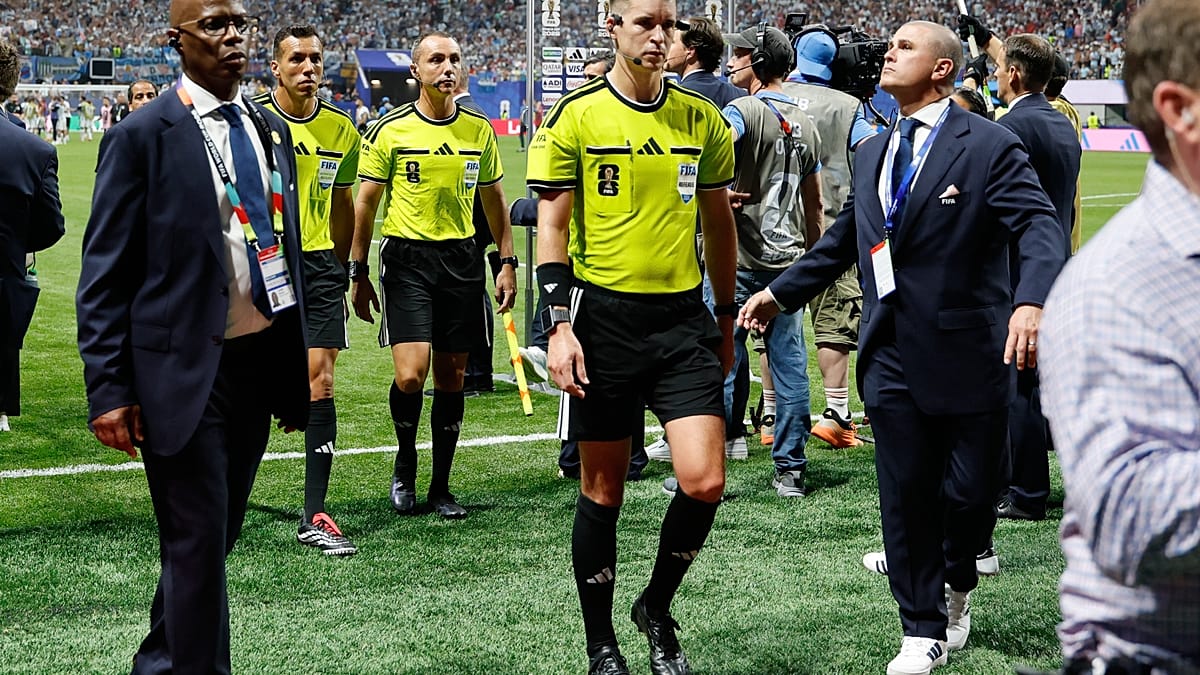
As the 2026 FIFA World Cup enters its final stage, controversies from earlier rounds are still stirring up misleading claims and false images online.
For example, Egypt’s elimination from the tournament on 7 July has triggered a wave of unsupported social media claims targeting French referee François Letexier.
It all began after Argentina won 3-2 against Egypt, in a match filled with controversial decisions which saw the former emerge victorious after initially falling two goals behind. Egypt’s Football Association filed a formal complaint with FIFA afterwards, accusing Letexier and his team of making “serious refereeing mistakes”.
Among the issues of contention were an Egyptian goal that was disallowed by the video assistant referee (VAR) after Egypt midfielder Marwan Attia was penalised for stepping on Lisandro Martinez’s foot, and a belief that Mohamed Salah was fouled in the Argentina penalty area, just before the South American country went 3-2 up.
Egypt called for Letexier to be excluded from the remainder of the tournament.
Criticism of the refereeing decisions developed into broader conspiracy theories online. Some users claimed, without evidence, that Letexier’s alleged Jewish background showed Israel had influenced the outcome of the match, whilst others used it as evidence that FIFA had manipulated the tournament in Argentina’s favour.
The Cube, Euronews’ fact-checking team, took a closer look at the allegations.
Wikipedia used as misinformation tool
Several posts on X were used to spread the claim that Letexier was born into an Orthodox Jewish family based on a screenshot of his Wikipedia page.
Taken together, these posts garnered thousands of views on X and TikTok, but they are based on unsupported evidence.
Wikipedia’s publicly available edit history shows that the phrase “François Letexier was born on 23 April 1989 in the Bédée commune of Brittany, northwestern France, into an Orthodox Jewish family” was added to his page on 8 July, in the early hours after the match between Argentina and Egypt.
The edit referenced an article from French magazine Le Point. The article in question focuses on Letexier’s refereeing career and rise through French football, and contains no reference to his religion, ethnicity or family background.
There is also no further reliable reporting that supports this claim about Letexier.
Other baseless edits were also made to his Wikipedia page following the match. The website’s revision history shows users inserted a claim that the referee had been “paid by Argentina and FIFA” and that the round-of-16 match against Egypt had been bought. Both edits were later removed.
The screenshots were taken and shared before the false claims were deleted, allowing them to spread quickly online and give them a veneer of credibility.
Aside from abusing Wikipedia, other social media users spread yet more unsupported claims about Lexetier.
One post, with more than two million views, claimed that “authorities investigated François Letexier’s bank account and discovered that in the last 24 hours he received a mysterious payment of more than $500,000″ before the match.”
These posts circulated on X in French, Spanish and English and provided no source for their claim.
The Cube also found no corresponding announcement from FIFA, French authorities or any established news organisation.
Another viral claim circulating on X said that Lexetier had been removed from the tournament following the complaint from the Egyptian Football Association.
FIFA confirmed it had received Egypt’s complaint, however there is currently no official announcement of an investigation into Letexier and his officiating team.
Speaking after the controversy, FIFA’s head of referees, Pierluigi Collina, defended the officials against bias allegations, explaining that “constructive discussion about decisions will always be part of football, but unfounded allegations have no place in our sport.”
“Nobody can question the integrity of the FIFA World Cup match officials,” he added.
The allegations against Letexier form part of a broader narrative and conspiracy theories online that FIFA is biased towards Argentina, amid claims that the football governing body does not apply its rules consistently.
It’s also part of a pattern of misinformation surrounding the World Cup: AI-generated images, fabricated videos, and false claims with racist overtones have spread widely online during the tournament, targeting teams and individual players after controversial matches.
Read the full article here


