



The 2026 FIFA World Cup is being touted as the biggest in the tournament’s history, with 48 teams competing in games held across three neighboring host nations.
But with less than a month to go until kickoff, the World Cup is generating headlines for all the wrong reasons. The latest centers on accusations that the tournament may be having a negative impact on host cities through the erasure of long-standing local art and cultural symbols.
Dallas ‘Whaling Wall’ Mural Destroyed
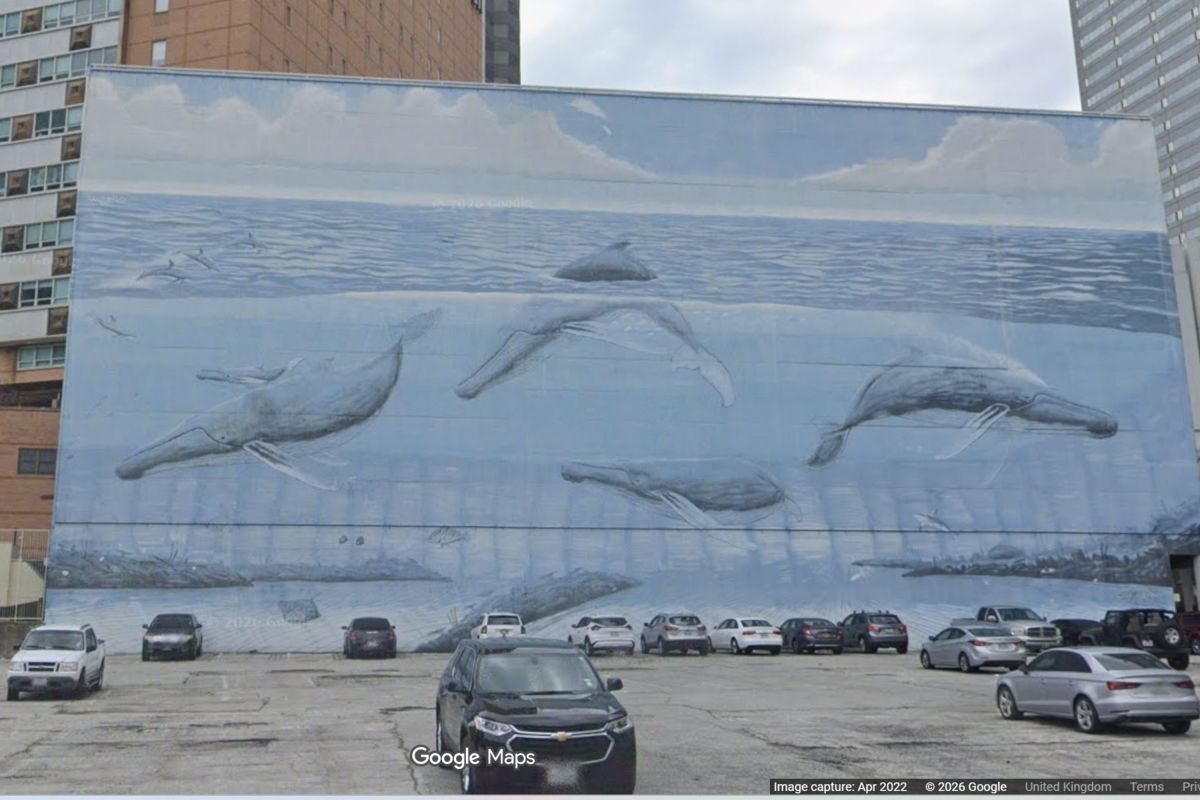
An eight-story mural in downtown Dallas, created by acclaimed marine artist Wyland, real name Robert Wyland, in 1999, has been almost entirely painted over to make way for a planned mural to mark the World Cup.
The 164-foot-long, 82-foot-high mural was located on the west-facing facade at 505 North Akard Street. It depicted a vividly realized array of ocean life, with dolphins swimming in and around coral reefs and life-sized humpback whales.
For a period in the 2010s, the mural was covered by advertisements. However, it reemerged during the pandemic, when the demand for outdoor advertising dropped.
Officially titled “Whaling Wall 82,” to many locals, it was known as the “Ocean Life” mural. Now little remains, save for the section of the mural depicting a cresting whale and some dolphins, which was painted on the northern corner of the building.
Newsweek has contacted the City of Dallas, Downtown Dallas, Inc, the community group behind the initiative and Wyland for comment. This is not the first time the FIFA World Cup has stood accused of leading to the erasure, marginalization, or reshaping the cultural and social fabric of host cities.
What Has Wyland Said About the Removal of the Dallas Mural?
Speaking to the Dallas Observer, Wyland said he had been sent photos by a Dallas local who asked whether he knew the mural was being painted over. He later shared one of those videos on his Instagram stories. Wyland said he was not aware of any plans to paint over the mural.
“We were pretty upset. We still are. This mural is iconic, and public art is for the community. This was a gift to the city of Dallas,” he said. “This is permanent. They’ve destroyed it.”
Wyland told the news source he is exploring the possibility of legal action against those responsible, citing the Visual Artists Rights Act of 1990, which protects artists against the demolition or modification of legally placed artwork.
“They need to be taken down a couple notches. How arrogant can you get?” Wyland said. “We just can’t let them get away with it.”
What Has FIFA said about the Dallas mural?
A North Texas FWC Organizing Committee spokesperson told Newsweek: “The mural currently being installed celebrates and builds excitement for the upcoming World Cup 2026. The project is being completed in partnership with the North Texas FWC Organizing Committee and Slate Asset Management, who owns the building.”
They also acknowledged the previous mural by Wyland and hinted at what the new work will offer.
“We recognize the cultural and historical significance of Robert Wyland’s Whaling Wall 82. With great respect for Wyland’s legacy, a portion of the original mural will remain preserved as a tribute to its lasting impact on the city,” they said.
“We look forward to unveiling a new piece that captures this current historical moment and reflects the energy, unity, and global spirit surrounding the World Cup 2026 this summer.”
Other countries around the world have seen similar effects of being a host city.
Brazil 2014
Ahead of the 2014 World Cup in Brazil—and in preparation for the 2016 Olympic Games—tens of thousands of residents were displaced from Rio de Janeiro’s favelas, informal settlements that long served as home to many of the city’s low‑income communities.
Authorities justified the evictions by arguing that the favelas needed to be cleared to make way for new infrastructure and large-scale redevelopment projects tied to the two sporting events. In the process, community murals, political graffiti, and painted streets—many of which had long reflected the city’s cultural identity—were destroyed.
The 2014 World Cup in Brazil also saw the Aldeia Maracanã, a historic 19th‑century Indigenous museum near the Maracanã Stadium, cleared of its occupants and earmarked for demolition as part of stadium expansion plans.
Only after sustained public protest did officials abandon proposals to convert the site into a parking facility and pledge to preserve it, though the original building was left in a state of disrepair.

Russia 2018
In 2018, a Soviet-era television tower that had stood in the middle of Yekaterinburg since 1983, left unfinished after the collapse of the Soviet Union, was demolished ahead of the World Cup in Russia. It came despite protests from some local residents who saw the brutalist structure as a symbol of the city’s history.
In other cities, such as Kaliningrad, banners were placed over the broken windows of disused facilities and buildings to improve the city’s image for visitors. On a broader scale, host cities like Kazan and Nizhny Novgorod were visually redesigned to better align with FIFA’s global image.
A year before the tournament began, President Vladimir Putin also signed a Presidential Decree that effectively banned all demonstrations and protests in host cities. This ban on freedom of expression extended to street art and political graffiti.
Qatar 2022
In the lead-up to the tournament, entire residential blocks housing predominantly migrant workers were cleared in central Doha. Thousands of these residents were ordered to leave, sometimes with only hours’ notice, as areas were prepared for visiting fans. Despite criticism, a Qatari government official said the evictions were unrelated to the World Cup and were “in line with ongoing comprehensive and long-term plans to re-organise areas of Doha.”
Historic areas like Souq Waqif—a restored traditional market central to Qatari heritage—were also renovated, decorated, and rebranded for the World Cup. A giant mural featuring the faces of thousands of migrant workers who helped construct the new Lusail Stadium built for the Qatar World Cup was also removed days before the tournament and covered by World Cup logos and slogans near the VIP stadium entrance. Though officials said the mural was only a temporary measure, the decision to remove the mural was one taken by Qatar’s Supreme Committee under FIFA’s image protocols.
Will the FIFA 2026 World Cup be a success?
Much is riding on this latest World Cup being a success.
FIFA President Gianni Infantino has made no secret of the fact that the tournament represents a crucial opportunity for the continued growth of soccer in the U.S., where 78 of the record 104 matches are due to take place.
When it comes to the bottom line, a joint study by FIFA and the World Trade Organization (WTO) published last March has forecast the tournament will generate $80.1 billion in gross economic impact, with $30.5 billion going to the U.S.
However, in more recent times, concerns over ticket pricing and travel issues have sparked predictions that the tournament could prove to be a colossal dud.
The resale prices of FIFA World Cup tickets appear to be in freefall, while host-city hotel owners and hospitality industry representatives have told Newsweek that bookings are running below forecasts.
With just 27 days to go, organizers face a battle to ensure the tournament lives up to the billing.
Read the full article here


