



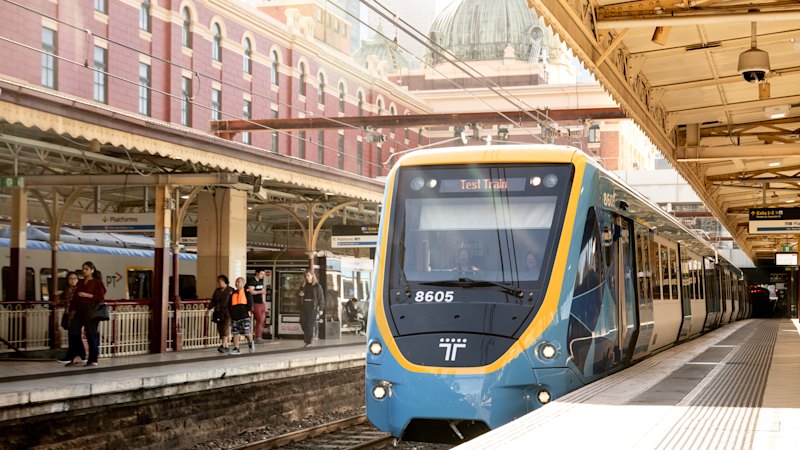
Metropolitan commuters will get a taste of the future when the new X’Trapolis 2.0 train operates it first passenger service on the Upfield line on Sunday.
The state government has made a $1.6 billion order for 50 X’Trapolis 2.0 trains to roll out on the Upfield, Cragieburn and Frankston lines over the next four years to replace the Comeng fleet – some of which are almost 40 years old, and recognised as the oldest and least reliable fleet.
The first X’Trapolis 2.0 passenger service will depart Flinders Street Station at 9.06am on Sunday and make the return journey from Upfield at 10.30am.
The Department of Transport and Planning’s head of rolling stock and ticketing, Ben Phyland, said the biggest difference for passengers would be comfort, accessibility and reliability.
“Really this is about getting the right type of train for the future: that’s more of a metropolitan style, fast on-and-off [service],” he said.
The new trains are larger, boasting 423 seats and accommodating 1225 passengers, compared with Comeng’s 420 seats and capacity of 1135 passengers.
Phyland said some trade-offs had been made in the new models. The seats have high backs to improve comfort and safety, but are squished closer together, meaning overall seating space is smaller.
But this change has made for a much wider aisle (80 centimetres versus 50 centimetres on the Comeng) so that two people can comfortably stand side-by-side, while letting a third passenger pass.
“There’s always feedback that you have a massive wide seat but can’t get down the aisle, so we’ve tried to find the right balance between those,” Phyland said.
The seats are also fixed to the side of the carriage rather than the floor, making more room under seats for bags or other belongings.
Similar to the High-Capacity Metro Trains (HCMTs) operating through the Metro Tunnel, the X’Trapolis 2.0s have large areas around the doors with fold-down seats, as well as 20 wheelchair spaces and “mixed-use” spaces for prams and bicycles.
Wider and faster doors should also speed up boarding times, improving on-time performance.
The X’trap’s doors open with the push of the button. Commuters will be glad to learn that a maddening feature on the Metro Tunnel’s HCMTs – an override that locks the doors for a few seconds if a passenger presses the button before it turns green – has been removed.
The train is one continuous set, so passengers can walk from end to end.
“I’ve seen a lot of feedback, particularly where there’s the two carriages, where at the rear train set people sometimes don’t feel safe because they can’t see who else is on the train,” Phyland said.
Clearer passenger information displays and audio announcements, as well as an air suspension system, would also make journeys easier and more comfortable, he said.
Comeng trains were commissioned in 1979 and built over seven years at Dandenong’s Commonwealth Engineering factory. All of Metro’s 570 carriages (190 three-car sets) were produced during this period. The 50 new X’Trapolis 2.0 trains will be assembled at Alstom’s factories in Ballarat and Dandenong, using a mix of imported and locally produced components.
Phyland said another major asset was that while Comengs experienced a fault that could impact services every 15,000 to 20,000 kilometres on average, the new trains should last closer to 70,000 kilometres.
“So it’s three times better with the modern trains” he said. “We can have more trains in service more often, and we don’t need as many spares. This will be much more reliable.”
Six more X’trap 2.0s have been built and are in the testing and commissioning phase in Newport, and a seventh is almost completed. The next four are under construction.
Last week, the state government announced a $673.6 million order of 25 additional train sets, bringing its total on order to 50 – enough to replace all remaining Comengs in service.
Phyland said it would be a gradual rollout, starting with a single train on Sundays for a number of weeks operating in addition to the usual timetable on the Upfield, Cragieburn and Frankston lines.
It will take a few months to build up confidence that the new trains can operate as a regular timetabled services.
The first 25 would probably enter service over the next 18 months, but it would probably take until about 2030 for all the Comengs to be replaced, Phyland said.
The new trains had 58 design changes based on feedback, including anti-train surfing exteriors and alterations to wheelchair fittings, hand holds and straps requested by accessibility advocates.
The Transport Department’s chief accessibility advocate, Tricia Malowney, said the seemingly small design changes would make a huge difference for people with disabilities, as well as elderly passengers and people pushing prams.
“It’s much easier to transverse and much easier to get on and off,” said Malowney, who uses a wheelchair. “I grew up on Comeng trains, and it’s no comparison.”
Public Transport Users Association spokesman Daniel Bowen said the modernisation of the fleet should deliver big improvements for passenger experience and network reliability.
“Once they’re finished, the entire fleet will be from this century at least, which is good,” he said. “It’s a big jump from 1980s trains to 2026 trains.”
Start the day with a summary of the day’s most important and interesting stories, analysis and insights. Sign up for our Morning Edition newsletter.


From our partners
Read the full article here


