



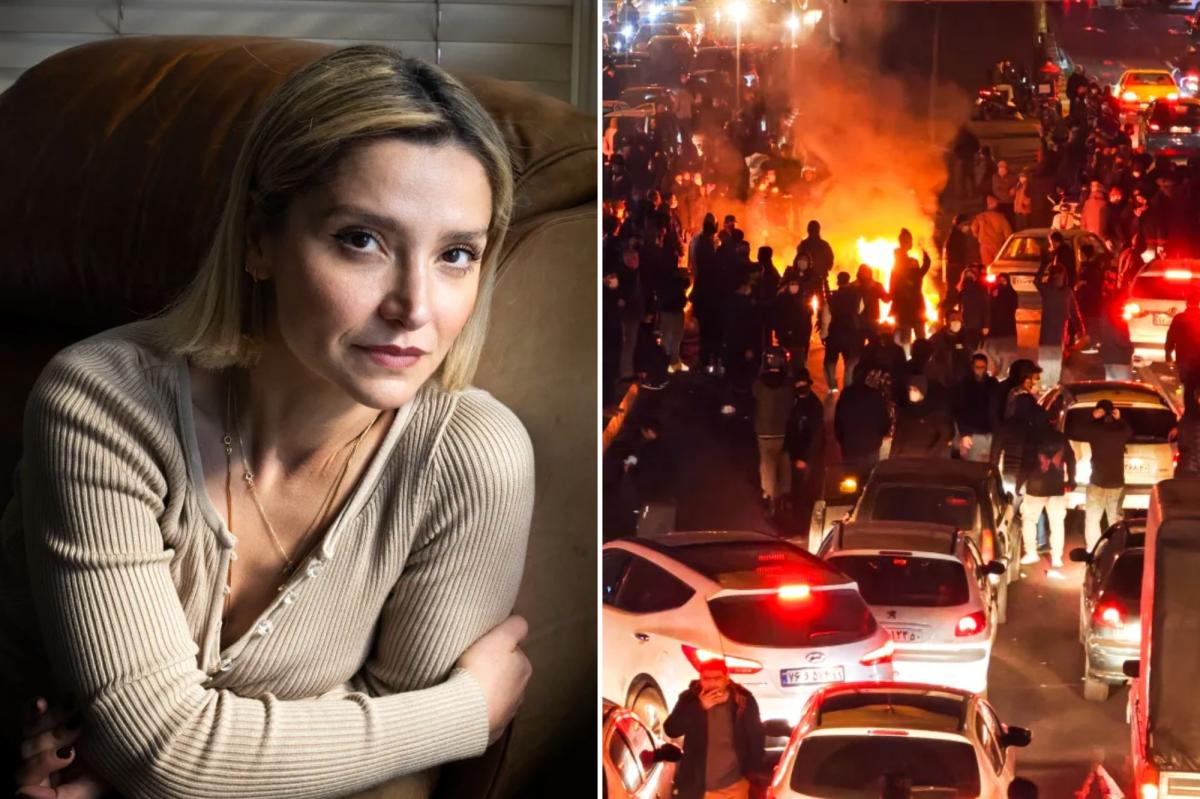
Last Saturday, a young shopkeeper in Tehran was dragged from his home at gunpoint by soldiers working for Iran’s Islamic Republic regime.
In front of his terrified parents, the 28-year-old was handcuffed and taken into custody, now facing possible execution. His crime: protesting his own government.
It’s one of many horrifying stories Tara Grammy has heard since the regime began brutally slaughtering its own citizens to quell a populist uprising last month.
Grammy — a Tehran-born, Los Angeles-based playwright and actress — has become one of the most prominent advocates for Iranians trapped in their country and a conduit for crucial information coming out about the brutality ordered by its leaders.
“It’s barbaric,” the 37-year-old declared of the Islamic Republic regime’s violent crackdown on protestors. “They are doing this to their own people.”
Over the last four years, Grammy has been contacted by desperate Iranians smuggling out information about the plight of their country, largely concealed because of the government’s strict censorship laws and internet restrictions.
“In September of 2022, I started getting messages from Iranians on Instagram,” the actress explained. “They would send me videos that they had just taken of regime guards shooting at protestors. I made a decision then to give my platform over to the people of Iran and anyone else who was scared of posting on their own social media.”
It changed the course of her career.
A voice for silenced Iranians
Becoming an activist wasn’t something Grammy initially envisioned.
She was born in Tehran in 1988, less than a decade after the country’s pro-Western monarchy was overthrown in the 1979 Revolution, replaced by the Islamic Republic regime.
“My mom decided to leave the country when I was 1 year old,” Grammy recalled. “She had taken me for a walk, and a whole group of regime guards with machetes suddenly appeared on the street, terrorizing pedestrians.”
Realizing it was no place to raise a girl, her mom spent years trying to obtain a visa. Finally, when Grammy was 6, she successfully filed paperwork to immigrate to Canada.
There, Grammy rose to prominence in her 20s after penning the acclaimed play “Mahmoud,” detailing with the lives of Iranian expats in Toronto.
She subsequently moved to Los Angeles, where she found fame as a comedian, creating popular sketches such as “Persian Makeover With Manijeh!” and the web series “My Immigrant Family.” She later hosted “Persia’s Got Talent.”
Grammy began sharing much of her work on Instagram, where she has racked up over 300,000 followers. As her fame grew, she started being contacted by desperate Iranians eager to share their stories about the country’s decline. She decided to post them on social media.
Many of Grammy’s sources were using VPNs to circumvent Iran’s heavily censored internet services and risked retribution if they were found criticizing the government.
“They’re fearful, but they’re brave — they’re very brave,” Grammy told The Post of her sources. “They know that the only way anything can change is if the world stops the regime.”
Grammy’s outspoken sharing of information has also made her a target — but she tries not to worry about her own safety.
“If I live in fear, then the regime has won,” she bluntly declared.
The uprising
For years, Grammy’s contacts in Iran have been sharing their economic anxieties.
“The middle class is practically dissolved in Iran at this point,” she explained. “People can’t afford to buy meat and pay their rent. The economy is now so bad that a lot of these people have nothing to live for anymore. So that’s when they’re like, ‘F–k it. I’ll risk my life for change.‘”
Middle-class, middle-aged Iranians were joined in their despair by young people, whose surreptitious social media use exposed them to influences beyond the Islamic Republic regime.
“They grew up with the internet and they know what the rest of the world looks like,” Grammy stated. “They know the lives that they could have.”
A currency collapse at the end of last year fueled protests that began on Dec. 29 and quickly morphed into a mass movement.
Millions of citizens took to the streets across all 31 of the country’s provinces, with nationwide demonstrations taking place on Jan. 8 and 9.
The Islamic Republic regime cut off all internet access, deployed the military and began brutally killing its own citizens to stop an overthrow of the government. Official reports estimate that 7,000 Iranians have been killed.
From Los Angeles, Grammy was glued to her phone, with her sources sharing stories of brutality that beggared belief.
Unspeakable violence
Desperate to deter the demonstrators, military personnel began shooting protestors with pellet guns. On Jan. 8 and 9, they used live ammunition to kill in cold blood, Grammy told The Post.
“They clearly got a shoot-to-kill order, because it seems all were shot between the eyes, in the neck or in the chest,” she stated.
The military didn’t discriminate, with the actress hearing from one source that a deaf and disabled man was shot dead after the military mistook his use of sign language for gestures that might incite protestors.
Meanwhile, in the city of Rasht, 150 miles north of Tehran, protestors fleeing bullets ran into a bazaar only for the military to set the stalls on fire.
Shockingly, several sources told the actress that members of the military entered hospitals and executed protestors who were being treated for injuries.
“In pictures that came out from the morgues, there were all these bodies with catheters and heart monitors still attached,” she told The Post. “So they [the military] had gone into hospitals and killed them point-blank. Executed. Hundreds, maybe even thousands of protesters.”
“That is evil,” she unequivocally added.
Several protestors were also killed in machete attacks, according to Grammy, with the military surrounding unarmed protestors in their vehicles before slaughtering them.
Meanwhile, both men and women were the subjects of heinous sexual violence.
“An acquaintance of mine had two kids who went out to protest, and they got away, but three of their friends [one male and two females] got captured,” Grammy told The Post. “These friends were taken somewhere — they don’t know where. For three days, they were tortured, stripped naked and raped by seven people. Then they were thrown at the end of a highway and had to find their way back home.”
The scale of the barbarism worked, with the Islamic Republic managing to tamp down the protests by Jan. 10.
Still, the savagery continued, with the military reportedly going door to door to get retribution on anyone whom they believed had demonstrated against the government.
“For the people that got away, they [the military] would find ways to mark them and follow them and go and find them in their homes and kill them,” Grammy said.
“There was a mother and her two daughters who got away from them. They heard a knock on their door, and they thought it was protesters coming in to try to find refuge, but it was the regime. I don’t know what part of the regime because there are so many offshoots of evil murderers now, but they just opened fire and killed all three of them in their house.”
‘Chehelom’
On the surface, life has returned to normal in Tehran and other large Iranian cities — but in the bazaars and behind closed doors, fear, paranoia and unspeakable grief loom large.
One of Grammy’s sources was shot in the eye with a pellet gun during a demonstration and currently has a gauze bandage over half her face. She’s terrified to leave her house lest the military identify her as a protester and kill her.
“The eyes were one of the places where they would aim with pellet guns, so they know that’s an injury from them — they mark people,” Grammy explained. “Now, when she leaves the house, she’s really scared.”
Others are in mourning — not just for the thousands dead, but for their country and what could have been had the Islamic Republic regime finally been toppled.
“There’s the heavy, heavy grief as all of the pictures of the deaths are coming out and more stories of people, how people were killed, why people were killed are coming out,” Grammy explained. “There are videos of their mothers dancing on their graves because they don’t want to mourn, because they know the Islamic Republic wants them to mourn. So these mothers are dancing on the graves of their children as a form of resistance. It’s just so heartbreaking.”
This past weekend marked 40 days since Jan. 8 and 9 — the deadliest days of the uprising.
Chehelom, meaning “fortieth” in Persian, is an important 40-day mourning ceremony in Iranian culture, serving as the final, major farewell ritual for a dead person before families return to the rhythms of daily life.
But, according to Grammy, the rhythm of daily life has been forever changed in Iran.
“People hate the regime more than ever now,” she stated. “If people didn’t hate them before, they do now.”
US intervention?
The Trump administration is currently pursuing a campaign to force Iran to permanently halt all uranium enrichment, dismantle its nuclear program and stop ballistic missile development.
A massive US military buildup in the Middle East suggests the US could be ready to launch a “sustained” bombing campaign on Iran in weeks — or even days — should Tehran continue refusing President Trump’s demands in ongoing negotiations.
Some of Grammy’s sources have told her they would welcome intervention by the Trump administration if it meant the end of the Islamic Republic regime.
“That is how desperate they are, how bad this regime is,” she told The Post. “They want this regime out.”
The future
Amid the ongoing anxiety and uncertainty, Grammy and other Iranian expatriates are trying to keep media attention on the country in the hopes that foreign governments finally intervene and the Islamic Republic regime will finally be overthrown.
On Saturday, Iran’s exiled crown princess Noor Pahlavi joined tens of thousands of demonstrators for a “Global Day of Action” in downtown Los Angeles. Other rallies took place in Munich and Toronto, where a reported 350,000 people turned out.
While the grief and disillusionment may be heavy, Grammy grew up hearing of “the utopia that was Iran before the revolution” and dreams of one day returning there.
“My son’s name is Deyer Azad‚ it translates to free homeland. That’s how much I care. That’s my child’s name. That’s how big this dream is for us,” she emotionally told The Post.
It’s a dream shared by millions of Iranians around the world.
“It’s like we’re holding hope, excitement and grief constantly. It’s just a cycle. It’s a constant cycle. I’m scared to hope, because the disappointment is so hard,” Grammy stated, before adding: “But you have to have hope, or what’s the point?”
Read the full article here


