In a secluded room deep within Samsung Display’s headquarters in South Korea, rows of whirring gray and black machines repeatedly fold, flex and stress test the company’s newest mobile displays. During a mid-June visit, I was among the first people outside the company to step inside the high-security lab and see how Samsung pushes its foldable screens to their limits before they reach consumers.
On Tuesday, Samsung unveiled Flex Titanium, a new display technology for its upcoming Galaxy foldable phones including the Z Fold 8. It combines a titanium-alloy film with a titanium plate to create a thinner, more durable display structure designed to better withstand drops and other impacts — an important consideration for foldable phones that can cost thousands of dollars.
Samsung Display designs and manufactures screens for Samsung Electronics as well as competitors including Apple, and has become one of the industry’s leading developers of flexible and advanced display technology. Beyond commercial products, the company regularly showcases futuristic display concepts for phones, tablets and other devices.
Watch this: I Went Inside Samsung’s Secret Display Lab and Saw Its Wildest Phone Concepts
As Samsung makes its foldable phones thinner — last year’s Galaxy Z Fold 7 measures an impressively slim 4.2mm when open — the company is looking for ways to scale back various components to maintain a sleek profile. Samsung says it spent about three years developing Flex Titanium technology while examining customer feedback across seven generations of its foldable phones.
“We have to understand user behavior and various display challenges like dropping or pressure with a large object or a tiny object,” Samsung executive vice president Byung Duk Yang said in an interview. “Because of that, we have developed a very comprehensive and sophisticated evaluation method to understand user behavior in the real world.”
These are the machines that fold Samsung’s displays hundreds of thousands of times to ensure durability.
Testing the endurance of foldable displays
As we navigated the maze-like, pristine white hallways snaking below Samsung Display’s headquarters in Korea, about 20 miles from Seoul, our guide touted the exclusivity of what we’d be seeing. No one outside the company — not even the employee’s mom and dad — had been here, she said as she led us into the testing lab.
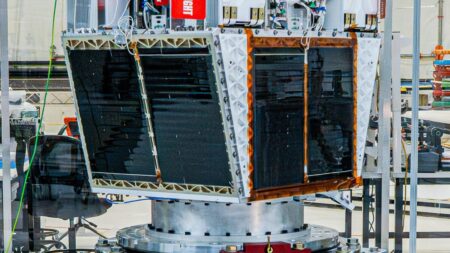
In this secluded room, which only engineers enter, equipment runs around the clock, folding and unfolding display panels to ensure they can pass 500,000 folding tests. Once the metal latch is closed, the Z Fold 8 panels (there are four inside right now) are subjected to extreme temperatures ranging from -20 degrees to 60 degrees Celsius (or -4 degrees to 140 degrees Fahrenheit). It’s not just the displays that are tested for durability. The hinges that power the folding mechanism also need to withstand repeated stress.
Outside the machine, a monitor shows what’s happening inside from eight different camera angles. The footage, which is also being recorded, can detect issues such as the display lifting off the device frame. Currently, the display panels being tested are off, but the machine can evaluate how operational displays respond to extreme conditions, too.
The machine to my left tests a display’s image quality. You can slide open the panels to peer inside via the small windows.
Down another long hallway (I feel like I’m in an episode of Severance at this point), we enter a lab for examining the display’s image quality, including brightness and color. After placing a display in the center of the machine and closing what looks like a miniature garage door with sliders on the windows for peering in, the testing begins.
A series of bright lights beams down on the panel, and the machine measures how much light is reflected — the less, the better. That’s for a few reasons: The display’s colors appear deeper, less reflection makes it easier to see the screen under bright lighting and you’re less likely to just be staring at your reflection when you look down at your phone. It takes about three minutes to test one panel.
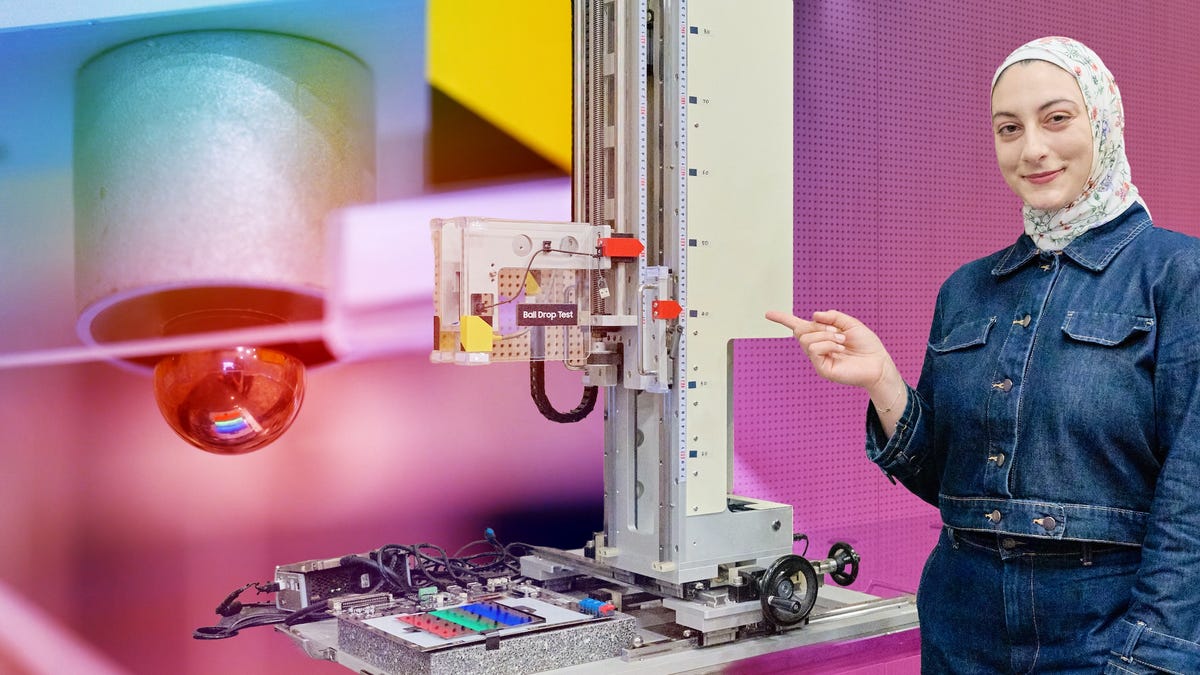
The ball drop test ensures a display can effectively absorb and distribute pressure from a small, heavy metal ball.
Another test I saw appeared rather simple compared to these more deeply technical mechanics, but it’s equally important for ensuring a display’s durability. A towering 220-pound machine propped on a counter holds a marble-sized metal ball weighing around 21 grams. An arm-like structure drops the ball from a height of 30 centimeters onto the display three times to ensure it won’t crack. In our demo, we pushed the limits to higher drops from 40 and 50 centimeters, and the display effectively absorbed and distributed the pressure to avoid damage.
This marble-sized ball is small but mighty. It’s dropped onto a display panel to test if it cracks.
Making a “better display”
Samsung’s new Flex Titanium is all about bolstering durabily without adding bulk. Compared to polymer film, titanium-alloy film has 20 times greater mechanical stiffness, the company says, meaning it better retains its shape. This component sits below the OLED panel and is less than one-third the thickness of a human hair. Below that is the titanium plate, which Samsung says can provide more stable support when the phone is unfolded without compromising flexibility.
Last year’s Z Fold 7 also used a titanium plate, but the display structure was made up of multiple polymer-based support layers. Samsung has now consolidated those layers into a single titanium-alloy film, reducing the thickness of the display module while maintaining strength, flexibility and long-term durability, the company says.
The layers of Samsung’s Flex Titanium display.
See also: Beyond the Galaxy Z Fold: Samsung’s Future Phone Concepts That Roll, Slide and Expand
Notably, the upgraded display also has a reduced crease — a growing focal point in the world of foldable phones. Samsung Display showed off a creaseless foldable concept screen at CES earlier this year. The company is reportedly working with Apple to develop a creaseless screen for a foldable iPhone, which could make its debut this fall. What I saw at Samsung Display in June still had a minimal crease, although it’s much less apparent than the Z Fold 7’s.
At CES 2026, Samsung Display showed off a concept for a creaseless screen.
Samsung is slated to share more about Flex Titanium and upcoming Galaxy foldable devices, including the Z Fold 8, during its summer Unpacked event on July 22. These advancements look to be a step toward mitigating many of the durability and aesthetic compromises that have long characterized foldable phones — though the work is far from done.
“Years ago, Samsung created this foldable category,” Yang said. “And the foldable display and the structure we developed became the standard. So we feel some responsibility for this market; we have to make a better display.”
Read the full article here