



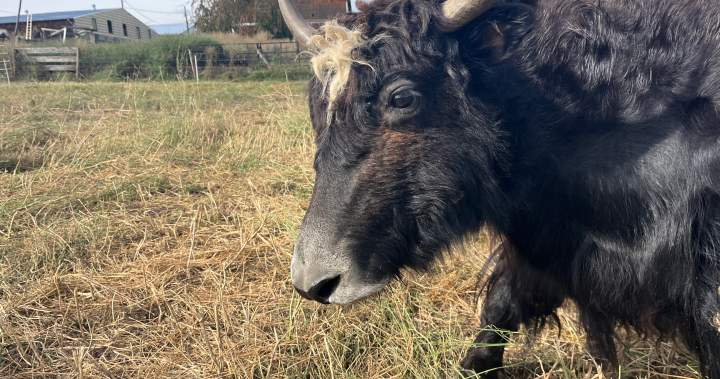
For Jamie Kamps, yaks have traditionally been raised for one main purpose: meat.
Kamps, who operates Black Yak Cattle Co., has about 30 Tibetan yaks on her farm close to Salmon Arm. The herd is primarily raised for grass-finished meat, while cows and calves can also be raised for their wool and fibre.
Kamps estimates there are only about 1,000 yaks in Canada, making them a relatively uncommon livestock animal.
But one of her younger yaks, Toro, could have a different future. To one day carry a rider.
Yaks have traditionally been used in parts of Central Asia to carry people and heavy loads. Their thick coats also help them withstand cold conditions, with their winter coats growing longer and providing insulation in low temperatures.
Kamps describes the roughly one-and-a-half-year-old Toro as a “chill dude” who is calm, tolerant and easy to handle. She says that temperament has her looking beyond the traditional meat market and toward training some of her animals to become riding or pack yaks.


Get daily National news
Get daily Canada news delivered to your inbox so you’ll never miss the day’s top stories.
“So our hope is that as we raise them from calves to be well handled, that you can continue training them and then they would have a purpose aside from just being butchered,” Kamps said.
Toro is already being trained, and Kamps says he could potentially carry a rider at around two years old. She says yaks can also be trained to pull a sleigh or carry loads.
The animals’ build makes them suited to riding, according to Kamps. She says their hump works well with a western saddle and that they can be less “flighty” than horses.
For Kamps, the idea is about giving some of her animals another purpose.
“Well, we found that the stock we’re producing have such a nice temperament and such great trainability that if they can be utilised for something outside the meat market, people enjoy them, they’ll have a good life as a pleasure animal, not just a meat animal.”
Kamps says the long-term goal is to build up a group of mature, well-trained animals that could be sold for packing and other recreational uses.
She also hopes to eventually use some of the mature animals for petting zoos and similar experiences, but only once they are old enough, trained and ready to safely interact with the public.
For now, that means waiting for the animals to grow and continuing their training. Toro is just one of the first yaks Kamps hopes can help demonstrate what these animals can do beyond the meat market.
Read the full article here


