



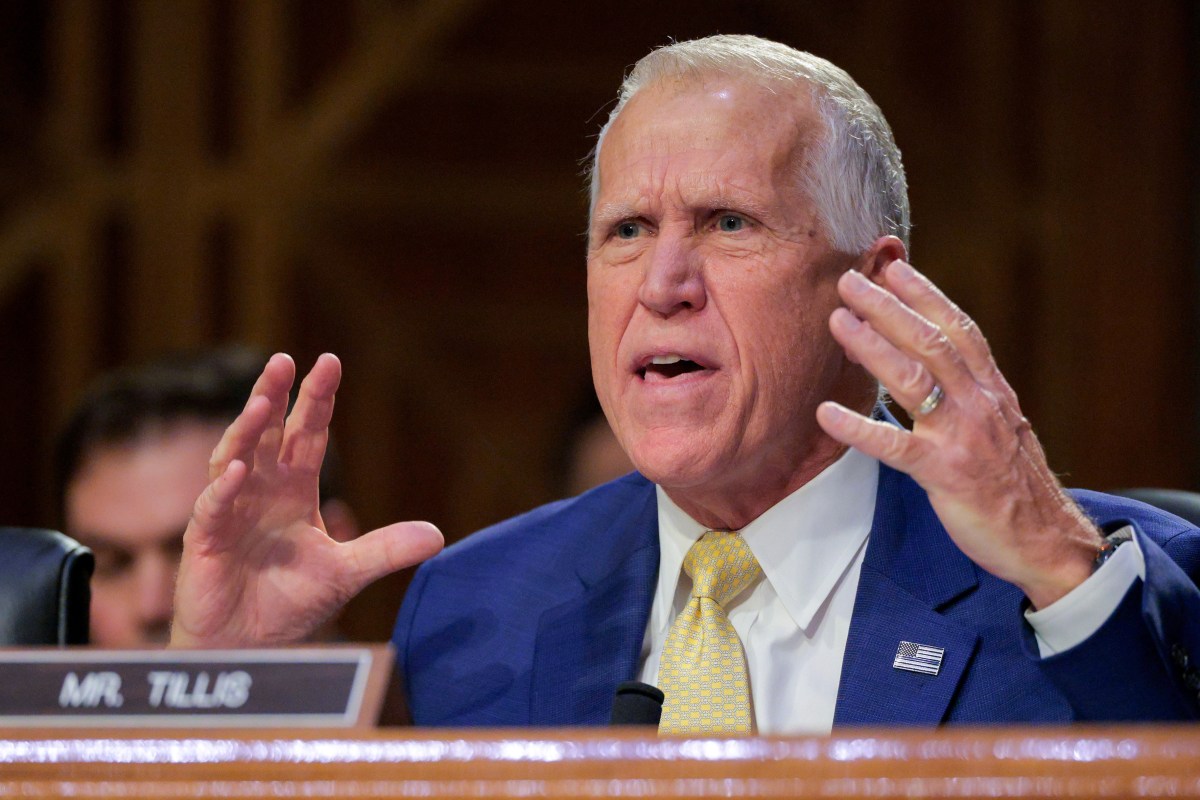
A senior Republican senator on Sunday sharply criticized the Department of Justice’s (DOJ) prosecution of former FBI Director James Comey, breaking with the Trump administration and raising fresh questions about whether the case amounts to political retaliation.
Senator Thom Tillis of North Carolina, who is not running for reelection this year, said he does not support what he called a “vindictive prosecution” of Comey, even as he reiterated harsh criticism of the former FBI chief. Tillis made the remarks during an appearance on CNN’s State of the Union, pushing back against the administration’s handling of the case.
Newsweek reached out to the White House on Sunday.
Why It Matters
Tillis’ comments mark one of the most prominent instances of a Republican lawmaker publicly distancing himself from the Trump administration’s legal strategy against one of the president’s longtime adversaries. As a senior GOP senator, Tillis’ intervention underscores unease within parts of the president’s own party about the appearance of politicized prosecutions.
The case against Comey has become a flashpoint in a broader debate over whether the DOJ is being used to target President Donald Trump’s critics. The president has repeatedly argued his opponents have weaponized the legal system against him, while critics say the administration is now doing the same in return.
What to Know
Comey was indicted by a federal grand jury last week over a 2025 Instagram post showing seashells arranged to spell “86 47.” He appeared in court on Wednesday. Prosecutors argue a reasonable person familiar with the circumstances would interpret the post as a serious expression of intent to harm Trump, the 47th president.
Trump wrote on Truth Social on Thursday: “86′ is a mob term for ‘kill him.’ They say 86 him! 86 47 means ‘kill President Trump.’ James Comey, who is a Dirty Cop, one of the worst, knows this full well! EIGHT MILES OUT, SIX FEET DOWN! Didn’t he also lie to the FBI about this??? I think so!”
Comey has denied any intent to threaten violence, saying he deleted the Instagram post after learning some people associated the phrase with harm and that violence “never occurred” to him.
Tillis said Sunday he considers Comey “the biggest disappointment” of his Senate career and regrets voting to confirm him as FBI director. But, he added, “that alone would not allow me to support what I think, on its face, is some sort of a vindictive prosecution.”
He also questioned whether the slang term “86” can reasonably be interpreted as a call for violence, noting its common use in the restaurant industry to mean removing an item or refusing service. “If this whole case is based on a picture in the sand of a North Carolina beach, it again makes no sense to me,” Tillis added.
The Trump administration has strongly defended the case. On NBC News’ Meet the Press on Sunday, acting Attorney General Todd Blanche rejected the notion Comey was charged solely because of the Instagram image. “Rest assured that it’s not just the Instagram post that leads somebody to get indicted,” he told moderator Kristen Welker, stressing the investigation spanned roughly 11 months.
Blanche said career prosecutors and investigators were involved and the decision to bring charges was ultimately made by a grand jury, not political appointees. “This is not just about a single Instagram post,” Blanche said. “This is about a body of evidence that the grand jury collected.”
Blanche also addressed skepticism stemming from an earlier Comey indictment that was dismissed by a federal judge last November. He emphasized the dismissal was not based on the facts of the case but on procedural grounds related to the appointment of a U.S. attorney. “There was no final finding on the facts or anything like that,” Blanche said, noting the earlier case remains on appeal.
The acting attorney general pushed back on suggestions Trump’s past public calls to prosecute Comey and other critics undermine confidence in the DOJ’s independence. Blanche said investigations are driven by evidence gathered over time, not by political statements, and details of the Comey case will ultimately be tested in open court.
Meanwhile, Tillis has also clashed with the Trump administration in recent weeks over a DOJ investigation into Federal Reserve Chair Jerome Powell, which the North Carolina senator warned was a threat to the central bank’s independence. Tillis used his leverage on the Senate Banking Committee to block consideration of Trump’s nominee to succeed Powell until the DOJ dropped the probe, arguing that criminal scrutiny of a sitting Fed chair risked politicizing monetary policy. The department later announced it was ending its investigation, shifting the matter to the Federal Reserve’s inspector general, a move Tillis welcomed as an appropriate resolution.
What Happens Next
Comey is expected to appear in federal court in the coming weeks for further proceedings, including an arraignment and the filing of pretrial motions. His attorneys have indicated they plan to seek dismissal of the charges, arguing the case violates the First Amendment and lacks evidence of intent.
The DOJ has said it will eventually present its full body of evidence at trial. Blanche said on Meet the Press a public proceeding would allow Americans to see exactly what investigators relied upon, adding the case will now move forward through the judicial process rather than being litigated in the media.
In a polarized era, the center is dismissed as bland. At Newsweek, ours is different: The Courageous Center—it’s not “both sides,” it’s sharp, challenging and alive with ideas. We follow facts, not factions. If that sounds like the kind of journalism you want to see thrive, we need you.
When you become a Newsweek Member, you support a mission to keep the center strong and vibrant. Members enjoy: Ad-free browsing, exclusive content and editor conversations. Help keep the center courageous. Join today.
Read the full article here


