



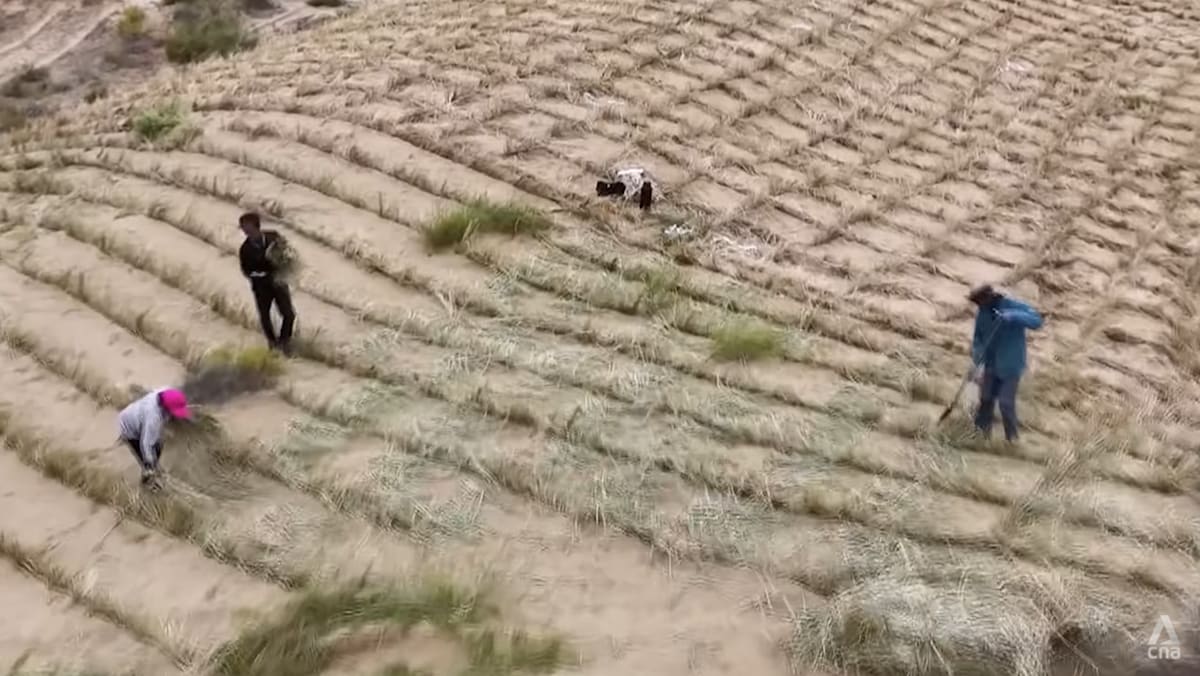
“Only people who are extremely resilient can do this kind of work,” Zhao said.
“Every spring, we face strong winds and frequent sandstorms. Sometimes we have to live deep in the desert, with no electricity or water. We have to truck water in ourselves.”
Many workers left after a short time, but Zhao stayed. He later brought his parents to join him and began recruiting labourers from his hometown, as well as from Yunnan and Sichuan.
“The locals wouldn’t do it as they make a living from herding, so I saw an opportunity and brought over more than a dozen people,” he said.
Zhao is now a contractor bidding on shelterbelt projects. At peak periods, he supervises teams of up to 1,000 workers, with daily wages ranging from about US$30 to US$60 depending on output.
He also documents his work on the popular Chinese short-video sharing platform Douyin, where encouragement from viewers has helped sustain his motivation.
“Planting trees is a self-healing process. You plant something and watch it grow … In recent years, that kind of (desert) weather has almost disappeared. The environment is clearly improving,” Zhao pointed out.
SCIENCE BEHIND SURVIVAL
In the early years of the Shelterbelt programme, large-scale planting was carried out rapidly, but survival rates were low. In some areas, only 30 per cent of saplings survived the harsh and arid conditions.
Scientific research proved critical to improving outcomes.
Wang Haibing, an assistant professor at Inner Mongolia Agricultural University, said early failures highlighted the destructive impact of wind erosion.
“After spring plowing, when the crops have grown to this height, if a sandstorm hits – just a single one – at least a third of the farmland will have its seedlings completely destroyed, beaten into mud and sand,” he noted.
Read the full article here


