



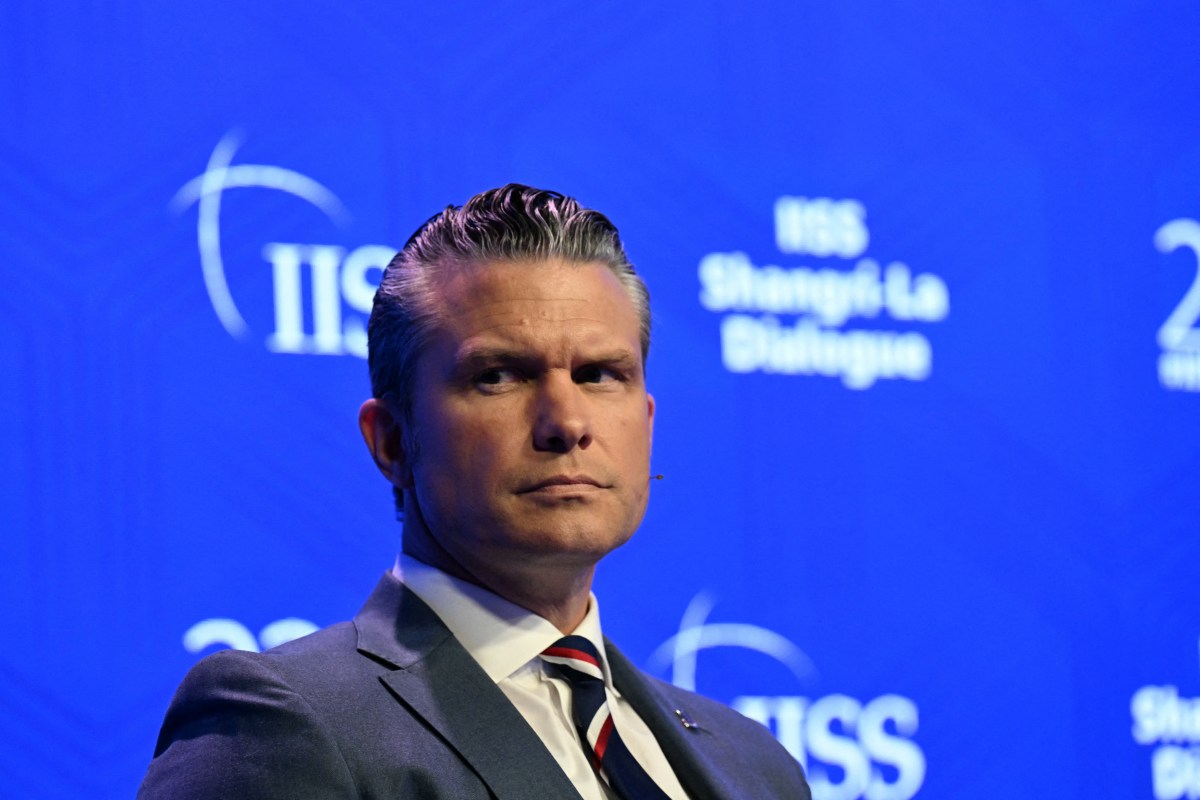
Defense Secretary Pete Hegseth’s demand that Asian allies and partners boost defense spending appeared to make U.S. support increasingly conditional in a region that has long relied on a balance of power underwritten by American military might.
The Pentagon chief called on U.S. allies and partners in the Asia-Pacific to commit to spending 3.5 percent of GDP on security.
Countries that demonstrate a commitment to a U.S.-led regional defense efforts would be moved “to the front of the line,” Hegseth said during a speech Saturday at the Shangri-La Dialogue, a defense summit hosted annually in Singapore by the International Institute for Strategic Studies.
That means “expedited arms sales, deep industrial-base collaboration, expanded intelligence sharing—the list goes on,” he said. “The benefits are many,” Hegseth said. Yet those that do not “carry their own weight for our collective defense” would be treated less favorably, he warned.
Newsweek reached out to the White House by email outside of office hours for comment.
Why It Matters
The remarks suggest a more conditional approach to U.S. security commitments in the Indo-Pacific, a region where American military power has long served as a key deterrent against China.
The push comes amid rising tensions across the Indo-Pacific. China has rapidly increased military spending and intensified pressure in territorial disputes with Japan and the Philippines, while also expanding its military footprint across the region.
U.S. Support Linked to Spending Commitments
Hegseth’s comments echoed President Donald Trump’s longstanding complaints that the United States bears a disproportionate share of the burden for collective defense.
Trump has successfully pushed NATO members to endorse a new goal of spending 5 percent of GDP on defense by 2027.
The threshold set out by Hegseth would be a significant increase for most regional allies. None of Washington’s major partners in Asia currently meet the 3.5 percent benchmark.
Singapore and South Korea come closest, spending roughly 2.8 to 3 percent and 2.8 percent of GDP, respectively. Japan is approaching 2 percent under its ongoing defense push, while Australia spends about 2 percent.
Philippines Cited as Example of Burden Sharing
Hegseth pointed to the U.S. treaty ally as a successful example of burden sharing, citing Manila’s deepening defense ties with Washington and its hosting this year of the largest-ever Balikatan joint military exercises.
Yet despite a roughly 12 percent increase in defense spending last year, Manila’s military budget remains well under the 3.5 percent target.
“It is especially difficult for agricultural economies to reach compared to more industrial nations with an established military-industrial structure,” Philippine Defense Secretary Gilberto Teodoro told reporters on the sidelines of the Shangri-La Dialogue.
“But for an archipelago of 7,600 islands where you still have to invest in your basic infrastructure for connectivity, education, health care, it is very difficult to hit.”
Malaysia Raises Economic Constraints
The figure is equally unrealistic for Malaysia, a country economically bound to Beijing, but with close security ties to Washington.
“We recognize that the United States is a very important partner and plays a very strategic role in creating a balance in the Indo-Pacific region,” Malaysian Defense Minister Mohamed Khaled Nordin said during a roundtable discussion at the Shangri-La Dialogue on Sunday.
“But they must also understand that every country faces different circumstances, priorities, as well as constraints.”
He added that sharply increasing defense spending could come at the expense of development in other sectors, with potential knock-on effects for stability.
Read the full article here


