



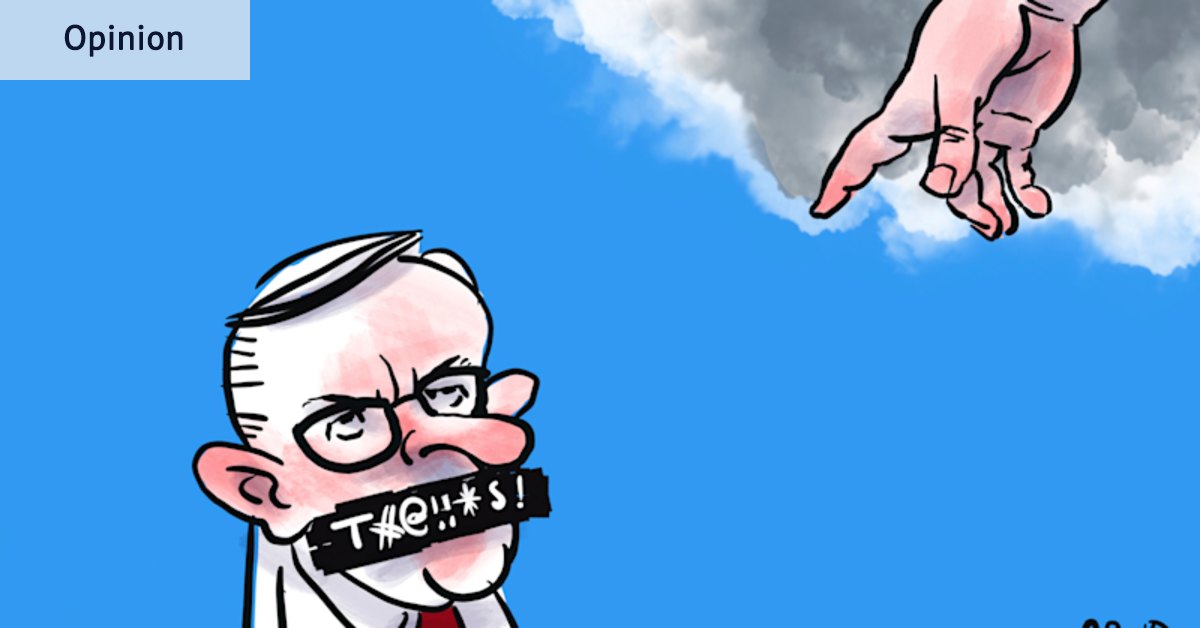
If ever the theory of evolution had an antithesis, it must be found in political language. Where evolution selects for genes that make a species stronger and better adapted to its environment, pollie-speak deliberately weakens etymological DNA in an attempt to change the political environment.
The prime minister rolled out not one but three language “evolutions” this week. Equity, resilience and social cohesion have been pounded in the mortar of current concerns to create a balm that Anthony Albanese’s consulting linguisticians hope will smooth a cracked and hoary budget.
The three terms had already been through the political wringer ahead of this week. I keep a compact version of the Longer Oxford English Dictionary (more or less a family heirloom) on hand as a doorstop, occasional terrine press and bulwark against misleading bastardisations of the English language. Equity, according to its minuscule type, once meant “the quality of being equal or fair, fairness, impartiality; evenhanded dealing”. Those meanings have been superseded.
Equity is now used as a distinguisher from equality. Equality refers to everyone having the same opportunities to get ahead. Equity, by contrast, now means that everyone should have the same starting point. Somehow the glorious diversity of humanity, in which people are blessed with different talents and abilities, is to be levelled. Luck and misfortune, the accident of birth that places some children into loving families and others into desperate circumstances, are to be overridden.
The foresight of previous generations in creating stability and building wealth is a sin, which must be punished through expropriation. Since the advantages conferred by nature, chance and enterprise are unequally distributed, equity, in its new sense, is punitive. Since it’s pretty much impossible to give everyone the same starting point, it takes a scythe to those with too much good fortune.
It’s no accident that Albanese has repeatedly framed the coming federal budget as one of “intergenerational equity”. The treasurer is expected to announce measures that will increase the taxes paid by older Australians who have accumulated assets. There’s a strong political rationale for it: young Australians, perceiving that it’s harder to get ahead than it was for previous generations, feel the system is rigged against them. Politicians have been keen to teach them that their struggles are the fault of older, wealthier generations accessing tax reductions that were put in place when the economy was going gangbusters.
That’s politically safer than admitting successive governments have screwed up the prosperity engine. As James Massola observed on Friday, “Labor’s calculation is that there isn’t a lot of sympathy for Baby Boomers out there”. But if the changes are grandfathered – that is, if people who have already arranged their affairs to benefit from negative gearing and the capital gains tax discount are left unaffected – the losers of the reform won’t be the Boomers. They’ll be younger Australians who’d hoped to build wealth in similar ways.
Resilience is another word that has received recent political enhancement. In the olden days – around 2020 – it meant the ability to withstand and recover from disruption, illness or crisis. Now it has morphed to mean government buying support from the business community through the “Future Made In Australia” program. I won’t recap here the many hilariously poor “investments” this scheme has already racked up. Suffice to say that, when the government refers to them collectively as resilience, it is changing the meaning of the word from an innate quality to something politically directed.
The meanings of equity and resilience have been on a “journey” for some time now. But this week, a surprising new usage entered the chat. The original draft provided to journalists of a speech the prime minister was due to deliver at the Chamber of Minerals and Energy of Western Australia used the term “social cohesion” in the context of intergenerational equity and resilience. “Resilience is about social cohesion,” the draft read, “and giving people that sense of ownership over the economy.”
It was an odd term to use in this way the day before the scheduled release of the interim report of the Royal Commission on Antisemitism and Social Cohesion. As I’ve previously observed in these pages, since October 7, 2023, when Hamas fighters killed 1200 civilians in Israel, and some communities celebrated the attack, “social cohesion” has been co-opted as a euphemism for problems with integration. The government created a program of “Community Funding to Support Social Cohesion Initiatives” aimed to “support communities [affected by the Hamas-Israel conflict]” and “deliver community programs to support Australian Palestinian and Muslim youth”.
The inclusion of the phrase in the title of the royal commission was a clear nod to its established current purpose of talking around the issue of Islamist extremism.
Bringing a loaded term into a trifecta of imprecision creates a new angle. People who are worried about social cohesion in its post-October 7 sense are enlisted in concern over its intergenerational equity sense. This creates a new logic to deal with age-old bugbears.
For instance, school funding. In February, in a speech about values and patriotism, Julian Hill, Labor’s assistant minister for citizenship and multicultural affairs, suggested that the growth in faith-based schools could stand in the way of social cohesion. “It is increasingly possible,” he said, “to grow up in Australia from prep to year 12 without ever really mixing outside your faith or even ethnic group.”
Faith-based schools are, of course, also private schools – even if many are low-fee. Labor-aligned groups, including the Labor-appointed NSW Education Secretary Murat Dizdar, have questioned whether private schools should exist at all. Dizdar and others of similar mindset would like to see them abolished in the name of equity.
To apply the full suite of new vocabulary, public schools are also more resilient – that is, they’re fully paid for by the government. Which shows how this new messaging mish-mash might be used to mount an argument for something previously considered politically unpalatable.
It’s politically safer to change the meanings of words than sell a new program. If you ever want to know which way a politician is headed, the clue is in the outrages they inflict upon the language.
Parnell Palme McGuinness is an insights and advocacy strategist. She has done work for the Liberal Party and the German Greens and is a senior fellow at the Centre for Independent Studies.
Get a weekly wrap of views that will challenge, champion and inform your own. Sign up for our Opinion newsletter.


From our partners
Read the full article here


