



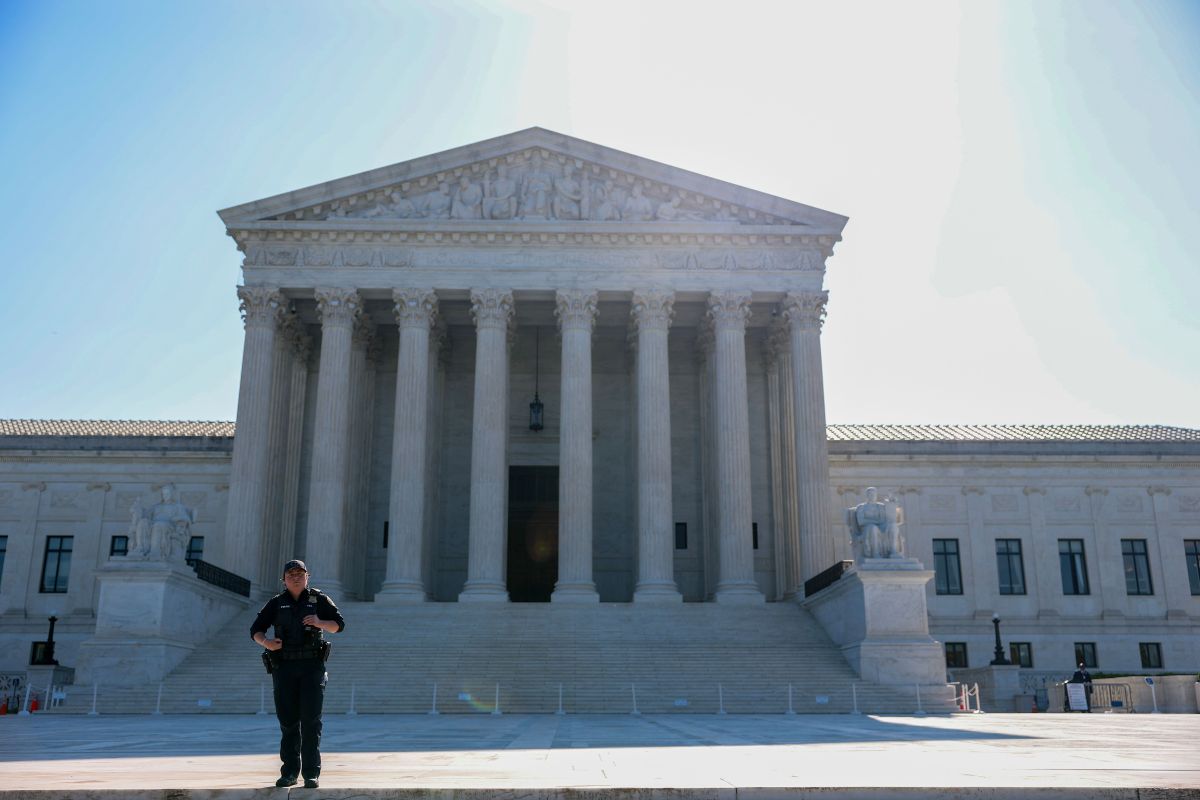
In a 6-3 decision on Wednesday, the Supreme Court weakened four decades of voting rights law, potentially giving Republicans a powerful tool to reshape congressional maps and improve their standing in the midterms and beyond.
The ruling in Louisiana v. Callais strikes down Louisiana’s congressional map and rewrites the legal test for proving racial discrimination in redistricting. It opens the door for Republican-controlled states to redraw maps in ways that were previously illegal, potentially flipping as many as 19 Democratic-held seats by 2028.
The court’s conservative majority found that Louisiana violated the Equal Protection Clause by creating a second majority-Black congressional district to comply with Section 2 of the Voting Rights Act. Justice Samuel Alito, writing for the majority, said the state could not justify using race in redistricting without showing that Section 2 explicitly required it.
“Allowing race to play any part in government decision-making represents a departure from the constitutional rule that applies in almost every other context,” Alito wrote.
For the 2026 midterms, the impact is limited by timing. For 2028 and beyond, the door is open.
Florida moved instantly. As the decision was announced Wednesday morning, the Republican-controlled legislature was already debating a new congressional map drafted by the office of GOP Governor Ron DeSantis. Within hours, the House passed it 83-28 along party lines, followed by a 21-17 Senate vote, with three Republicans opposing. The map now heads to DeSantis and could give Republicans up to four additional seats, shifting the delegation from 20-8 to 24-4.
The response in other Republican-led states was just as swift, if not yet as concrete. In Tennessee, Senator Marsha Blackburn, a Republican running for governor, called on her party to redraw the state’s lone Democratic district centered in Memphis. “I’ve vowed to keep Tennessee a red state,” Blackburn said, pledging to “do everything I can to make this map a reality.”
Even so, structural constraints limit how far states can go before the next election cycle. Louisiana’s May 16 primary is days away, with early voting beginning Saturday. In Georgia and Alabama, early voting has already begun. In North Carolina, Mississippi and Texas, primaries have already been held. Filing deadlines have passed in most states.
“Most states are already locked in. The filing deadlines have passed or are passing. You would need an extremely fast legislative process and very late primary dates to redraw maps before 2026. That is not the case in most places,” Michael McNulty, policy director at Issue One, told Newsweek. The organization has modeled redistricting scenarios nationwide.
How the New Standard Works
The practical effect of the ruling is that Republican-controlled states can now pursue aggressive redistricting with a built-in legal shield. The High Court changed Section 2 such that it now requires litigants to show a redistricting plan was designed to discriminate against racial minorities, rather than simply proving the plan leads to effective discrimination. Lawmakers can now claim their maps are drawn for partisan advantage rather than racial disadvantage—a distinction that is often impossible to prove in court.
“Litigants have to provide proof that a state was intentionally trying to afford racial minority voters less opportunity because of their race,” Wilfred Codrington, a Cardozo Law School professor, told Newsweek. “Because lawmakers could pass discriminatory maps unintentionally, or just disclaim any racially discriminatory motive, in either case it is going to be nearly impossible to succeed on a Section 2 claim.”
This reverts the standard to one Congress changed more than four decades ago because proving intent was so difficult. “Louisiana might create six white Republican districts and zero districts represented by Black people, notwithstanding the fact that they represent about one-third of the state’s population,” Codrington told Newsweek. “Lawmakers might just say we are discriminating against you as Democrats who happen to be Black.”

James Blumstein, a Vanderbilt constitutional law scholar who filed an amicus brief in the case, framed the immediate consequence: “Partisanship can control. Districts that favor minorities are not protected if the reason for a gerrymander is partisanship, not racial disadvantage. States have a good bit of flexibility to redraw districts that disfavor Democrats, so long as the basis is partisan advantage, not racial disadvantage.”
In Alabama, where federal judges imposed a map with two majority-Black districts through 2030, Senator Tommy Tuberville urged the state attorney general to file a motion to vacate that injunction “the moment” the Supreme Court ruled.
While the near-term window is narrow, the political implications extend much further. The Trump administration quickly framed the decision as a major victory. White House spokeswoman Abigail Jackson told Newsweek it was a “complete and total victory for American voters” and praised the court for ending what she called “the unconstitutional abuse of the Voting Rights Act.”
Open Doors for 2028 and Beyond
Legal experts say the more consequential changes lie in how difficult it will now be to challenge maps in court. Rick Hasen, a UCLA law professor, told Newsweek that Alito’s opinion makes it significantly harder to prove intentional discrimination. “When a state says it is drawing maps to help Republicans or Democrats, that will be a defense to a claim that it was done to benefit majority white voters,” he said.
“It is hard to overstate what an earthquake this will be for American politics,” Hasen added.
That concern is echoed by voting rights advocates who see the decision reshaping incentives for mapmakers. “We are much more concerned about the impact on 2028 and beyond, which would let politicians pick their voters instead of voters picking them,” McNulty told Newsweek.
McNulty’s organization, Issue One, estimates that from 12 to 18 majority-minority districts across the South could be at risk of gerrymandering in 2028 and beyond, spanning Alabama, Florida, Georgia, Louisiana, Mississippi, Missouri, North Carolina, South Carolina, Tennessee and Texas. “The more significant risk is that this ruling accelerates another round of aggressive redistricting heading into 2028 and beyond, when states have more time and fewer procedural constraints to redraw maps,” McNulty told Newsweek.

Republicans, however, framed the decision as a corrective to what they see as years of overreach in voting rights enforcement. “For decades the left has spent hundreds of millions of dollars seeking to divide Americans along racial lines in a cynical pursuit of partisan power masquerading as civil rights enforcement,” Adam Kincaid, executive director of the National Republican Redistricting Trust, said in a statement.
“Today’s decision rebukes that divisive and unconstitutional effort,” he added.
States with unified Republican control, including Alabama, Georgia, Louisiana, Mississippi, North Carolina and Texas, are positioned to act in 2027 and 2028. In Texas, where the Supreme Court already allowed contested maps to be used pending Callais, a weakened Section 2 could end remaining challenges. Lawmakers could reduce the number of minority-influence districts and eliminate several seats represented by members of the Congressional Black and Hispanic Caucuses.
Estimates of potential gains vary. Fair Fight Action and Black Voters Matter say the ruling could help Republicans flip as many as 19 majority-minority seats now held by Democrats. An NPR analysis found that expanded gerrymandering could lead to white candidates winning 15 House seats currently represented by Black members of Congress. The New York Times estimates that as many as 12 Democratic districts could be redrawn into Republican ones.
Democrats Counter, But Face Harder Math
Some Democratic leaders signaled they would respond in kind. States like California, Virginia, Colorado and Washington have shifted redistricting to bipartisan commissions through constitutional changes. After President Donald Trump began pushing mid-decade redistricting, Democratic leaders adjusted their strategy.
Virginia voters on Tuesday approved a Democratic redistricting plan that could give the party up to four additional seats. Democrats also passed a ballot measure to override California’s independent redistricting commission and create more safe Democratic districts.
Even with those efforts, the underlying math remains uneven. Republicans control more states with larger populations and simpler redistricting processes, giving them more room to take advantage of the Callais decision. Codrington noted that because racial minorities make up a large part of the Democratic Party base, that party would face greater intraparty pushback were it to try to redistrict for partisan gain in ways that would eliminate opportunity districts for minorities.
“This is an all-hands-on-deck moment. Democrats must build more durable state legislative majorities and break out of superminorities so governors can push back against GOP gerrymanders,” said Democratic Legislative Campaign Committee President Heather Williams.
Civil rights groups responded with alarm. Janai Nelson, president of the NAACP Legal Defense and Educational Fund, who argued the case, said the ruling was “just as harmful and even more deceptive” than striking down Section 2 outright.
“It is a day of loss of any remnant of credibility for this Supreme Court to rise above partisan politics,” Nelson said.
Read the full article here


