



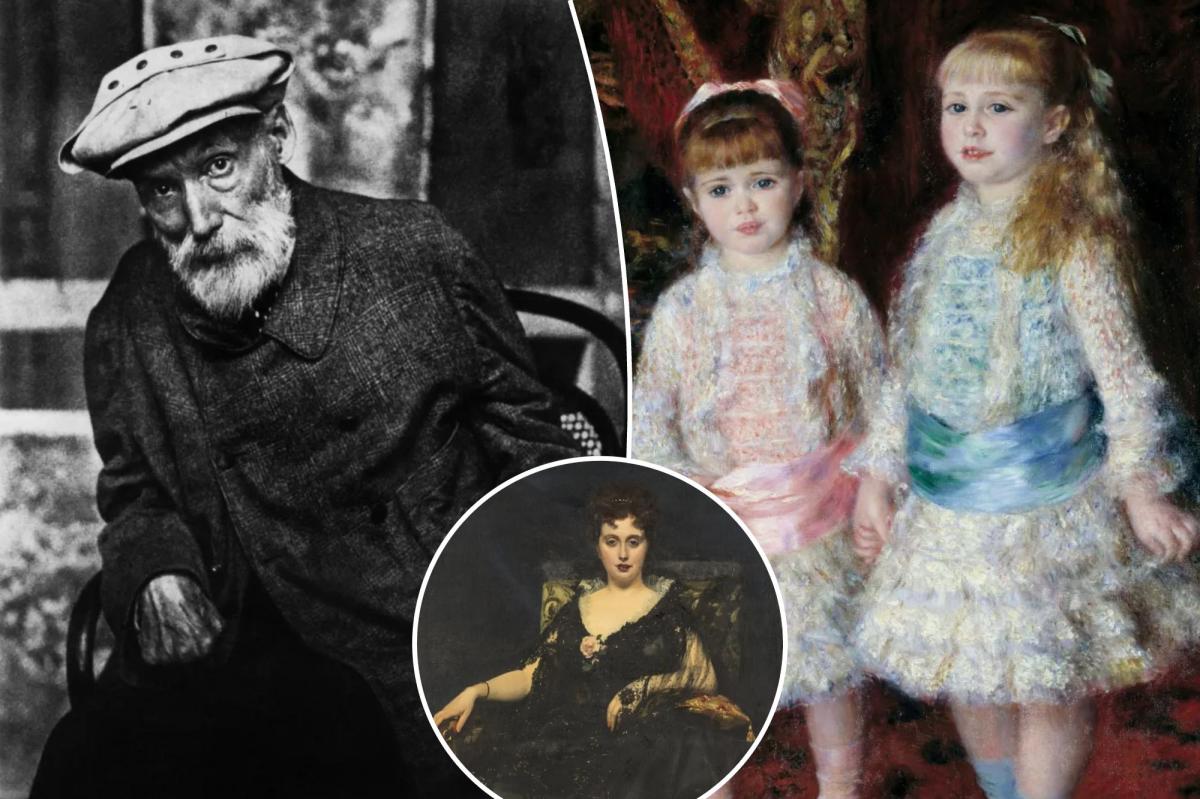
Two adorable little girls dressed in frilly white — the elder wearing a blue sash, the younger sporting a pink one — are captured by the painter Pierre-Auguste Renoir in a moment of innocence nearly 150 years ago.
In the 1881 Impressionist masterpiece “Pink and Blue,” familiar from innumerable postcards, jigsaw puzzles, and art prints, the two cherubic figures are holding hands, their hair tied back by silk ribbons, their eyes looking out at the world with gentle trust.
There is no hint that Elisabeth, the blonde, then 6, and Alice, the brunette, 4, will be carried forward by time into turmoil, hardship, and unimagined brutality.
As Catherine Ostler recounts in her fascinating new book, “The Renoir Girls: A Hidden History of Art, War & Betrayal,” the pair began life as the cherished youngest daughters of Louis and Louise Cahen d’Anvers, a wealthy couple who lived on the fashionable Avenue Montaigne in Belle Époque Paris.
It was a brilliant era of galloping scientific and technological progress, and a remarkable flowering in the fine arts.
The girls’ mother, Louise, was a well-known society beauty who dressed in haute couture, hosted a salon for artists and writers, and conducted a long affair with art patron Charles Ephrussi, believed to be an inspiration for Charles Swann in Marcel Proust’s “In Search of Lost Time.”
Ephrussi persuaded Louise to have her children’s portraits done by Renoir, then an up-and-comer in the Impressionist movement, which was radically overturning the rigid rules of academic painting. Renoir first visited the Cahen d’Anvers townhouse in 1880 to paint his older sister, Irène. In this striking picture — known now as “Little Irène” — the girl’s cascade of red-gold hair, doll-like features, and creamy skin are set off vibrantly against a green background of tangled leaves. The next year, the artist painted the two younger daughters.
For some reason, this second painting, although praised lavishly by others, did not meet the approval of the girls’ father, Louis Cahen d’Anvers, who dragged his feet in paying Renoir. Did the image of little Alice, in particular, make him unhappy? Did he suspect she was not his daughter, but Ephrussi’s?
This is the first mystery in a story full of them. Relying on gossip, supposition, contemporary writing, and family memories — plus a deep dive into French and English archives — Ostler pieces together what happened to the two girls in the decades after the portrait was completed. A final, thunder-clap revelation is the capstone of her absorbing account.
Ostler’s interest was first sparked 15 years ago, when she ran across a reference to the Renoir double portrait in Edmund De Waal’s “The Hare with Amber Eyes,” a bestselling memoir about his family, the Ephrussis. De Waal also mentioned that Elisabeth died after being deported to Auschwitz.
“This hooked my heart, maybe because at the time I had two daughters just about the same age as Elisabeth and Alice,” Ostler told The Post. “When I embarked on this work, I only had a beginning — the painting — and an ending — the older girl’s murder. The mystery would be what came between.”
Ostler devotes the first half of the book to describing the glittering world in which the girls came of age. The Cahen d’Anvers were bankers, and alongside other rich Jewish families like the Rothschilds and the Ephrussis, they had joined the Parisian elite, called in colloquial French le gratin after the crispy, tasty top of baked macaroni or potato dishes.
While Paris society at the close of the 19th century thrummed with beauty and sophistication, French politics of the time were fractious. The Third Republic, newly established in the wake of the nation’s humiliating 1871 defeat in the Franco-Prussian War, struggled for legitimacy. “There were those that wanted a republic,” Ostler told The Post. “And others who wanted a monarchy, but even the monarchists were split between various factions.” Instability fueled xenophobia and antisemitism.
Jews had been granted full rights as citizens after the French Revolution, and families such as the Cahen d’Anvers had left places elsewhere in Europe to come to Paris. Most felt themselves quickly assimilated. But suspicion and resentment against Jews flared once a French army captain of Jewish descent, Alfred Dreyfus, was convicted on treason charges in 1894. Although fresh evidence exonerating Dreyfus rapidly came to light, France split into two fiercely opposed camps, Dreyfusards and anti-Dreyfusards.
Proust later described how Jews in high society lost status as a result of the Dreyfus affair, and conversions to Christianity, once rare, increased sharply. Elisabeth Cahen d’Anvers chose to become a Catholic in 1895. The tender care she received from nuns after a riding accident landed her in the hospital may have prompted this. But she had also fallen in love with Comte Jean de Forceville, a Catholic aristocrat from Picardy, whom she later married.
Alice was taken by her mother to Egypt for the winter season in 1897, where she met one of the British Army’s rising stars, Charles Townshend. Most likely, Townshend first had an affair with Louise before turning his attentions to her daughter, 21. Townshend and Alice were wed a year later in a Church of England ceremony at the family chateau outside Paris. (He enjoyed a fine army career until April 1916, when he oversaw the humiliating surrender of the British garrison at Kut, south of Bagdad, to the Ottoman Army.)
Once she was married, Alice lived mostly in England, but was in France as the Germans advanced in May 1940, and resolved to spirit her grandson and granddaughter out of the country. Alice’s daughter Audrey, married to a Belgian count, chose to stay behind and work for the Resistance. Alice, then 64, found herself cowering in a ditch for two nights with the two children and her lady’s maid as the Luftwaffe flew overhead. The group reached Bordeaux just ahead of the Nazis and boarded an overcrowded freighter bound for Britain. (Alice’s grandson, Arnaud de Borchgrave, was the longtime Newsweek journalist who died in 2015.)
Meanwhile, Elisabeth, who had divorced two husbands and lost another love in World War I, retreated from Paris after the German occupation. Crippled by rheumatoid arthritis, she could barely walk — a Gentile couple cared for her in a cottage in the village of Juigné-sur-Sarthe, 150 miles west of Paris. Elisabeth considered herself a French Catholic and had no inkling that the rabidly antisemitic village mayor — likely channeling a grievance against the Cahen d’Anvers family from decades before — would inform the Gestapo of her whereabouts. She was arrested and sent to Drancy, a collection point for Jews outside Paris, in winter 1944. Aged 69, infirm Elisabeth, the little girl who once wore the blue sash, was transported east to her death in March.
And what of Renoir’s “Pink and Blue”? Most fortuitously, in summer 1939, the painting was included in a collection of French art organized by a Louvre curator and sent on a tour of the Americas.
At the tour’s end, the dual portrait — which had been sold in 1909 by the Cahen d’Anvers family to the Bernheims, gallerists in Paris — was stashed in a fine-art storage facility on New York’s Second Avenue and 61st Street, until, in 1951, it was sold to the Brazilian plutocrat Francisco de Assis Chateaubriand Bandeira de Melo.
Today, Elisabeth and Alice’s portrait hangs in the São Paulo Museum of Art — a poignant relic of opulent, brittle Belle Époque Paris.
Read the full article here


