



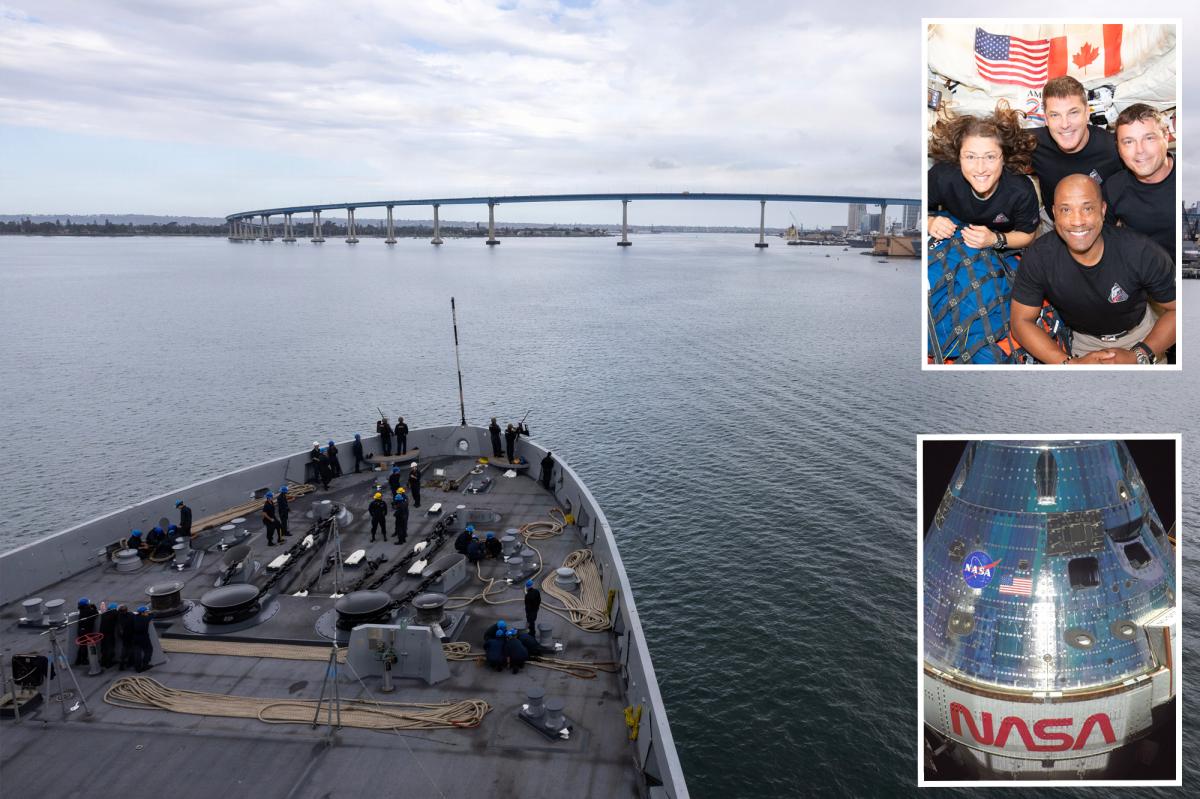
California residents will have a golden opportunity to witness history when NASA’s Artemis II splashes down on Friday off the San Diego coast.
For those who live in southern California or want to travel to see it, the historic moment is expected to happen at 5:07 p.m. on Friday April 10, when the crew of the 10-day moon mission returns to earth.
The Orion capsule is expected to splash down into the Pacific Ocean, somewhere between 50-70 miles offshore, between Catalina Island and San Clemente Island.
As of Wednesday, the crew had already begun their trip back, after soaring farther from earth than any other humans have ever before.
Francisco Contreras, an Oceanside resident and board member for the San Diego Astronomy Association, said, if people in San Diego County want to get a chance to catch some of the history, the best bet is to “head to the coast.”
“Because it’s so high up and so far away, you should be able to see it from the coast; you don’t have to get close to San Clemente, I don’t think,” Contreras told CBS 8 News.
“As long as you can have a clear view northwest, that would be your best chances to see it.”
There will also be a watch party held at the San Diego Air and Space Museum, with fun activities for the kids.
San Diego being a huge Navy town plays into the recovery of the capsule, with both Coronado’s Naval Air Station North Island and Naval Base San Diego involved in the efforts.
A Navy helicopter squadron based out of Naval Air Station North Island will track the capsule as it streaks through Earth’s atmosphere, then it will pick up the four astronauts and deliver them to the ship for evaluation, the Navy said in a statement.
Meanwhile, the San Diego-based USS John P. Murtha will be ready front and center to recover the astronauts after their spacecraft hits the Pacific Ocean.
In a statement, the Navy said the ship has “unique advantages” that will help with recovering the Orion capsule and gathering “critical data to help ensure it’s ready to recover the astronauts and capsule during future Artemis missions.”
“We’ve been working on this with NASA for about 12 years, working up to this day,” Captain Neil Krueger, from Naval Base San Diego, told the outlet.
“They come in really fast, they have parachutes that deploy, so by the time they splash down in the water, they’re only going about 20 miles per hour.”
“We have mobile dive teams to open the capsule, get them onto a floating raft, helicopters will take them to the ship and get medical care,” Krueger said, noting that the capsule will then be recovered and towed back to the naval ship.
Krueger said when the ship returns to shore on Saturday morning, people could get a chance to catch a glimpse of history.
While the excitement for the astronauts return is palpable, the most dangerous part of the mission is ahead for the crew as the shield of the Orion capsule will be tested when it plunges through the Earth’s atmosphere being scorched by temperatures of 5,000 degrees Fahrenheit.
The crew’s survival through that inferno will depend on the capsule’s heat shield, a 16.5-foot-wide dome on the bottom of the spacecraft designed to slough away at controlled rates as they plummet 25,000 mph back to Earth.
The uncrewed Artemis I shield in 2022 was left with giant poke marks and cracks, so adjustments were made to the coating on the shield, which will be officially field tested on Friday.
NASA later determined that the shield’s coating material had been applied too densely and made adjustments for Artemis II to be applied lighter as to allow hot gases to release upon the dangerous reentry.
The crew were ultimately given the go-ahead to take off, because reports noted that the Artemis I cabin temperature would have been safe for astronauts, despite the shield cracking and ripping apart.
As if the crew needed one more thing to worry about, NASA will be keeping an eye on the forecast in San Diego, as there’s now a possibility of rain and possible thunderstorms on Friday, according to local weather forecasts.
But at this point, the weather is expected to cooperate with recovery efforts.
Read the full article here


