



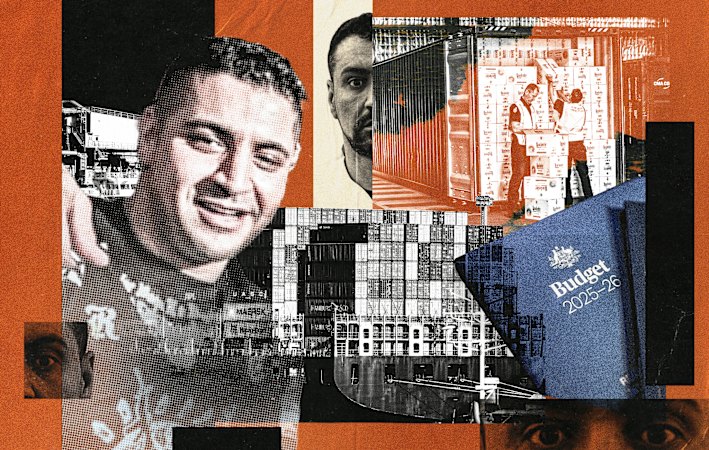
The plan was to “break” the customs search facility, to jam it up with so many shipping containers that the Australian Border Force would be too busy to detect all the other illicit goods flowing through the port.
It was the early 2020s and the Haddara crime family were the top dogs in Melbourne’s illicit tobacco game, controlling international smuggling routes, a network of retail shops and even a profit share in one of the world’s largest manufacturers of illicit tobacco.
The nation’s ports had become an open book to them from sheer practice.
Authorities have no idea how many containers of tobacco – and who knows what other contraband – slipped into the country during that period, like water flowing around a rock.
It was just another crack in the border wall that would soon become a flood. Black market tobacco was filling shops in Melbourne, Sydney, Brisbane and Perth.
The ABF already knew they had a major problem with illicit tobacco.
Taskforces had been launched, with hundreds of millions of dollars being spent “cracking down” on the illicit tobacco black market across the country.
And yet today, Australia is one of the world’s most lucrative markets for illicit tobacco.
It feeds a multibillion-dollar black market that has been injected with so much dirty money that transnational organised crime syndicates have gone to war to control it – leading to a nationwide campaign of more than 200 firebombings, a score of shootings, rampant extortion, the death of an innocent woman and even spawned a terror attack.
This is the story of how law enforcement and state and federal governments allowed a well-intentioned health measure designed to stop smoking – raising taxes – create a black market that has now become a national security problem.
And it was entirely predictable.
A custom-made market
“There has been a clear regulatory failure by all levels of government going back a number of years to enforce laws governing illicit tobacco, in particular those governing retailing and distribution.
“Yet very little effective enforcement action appears to have been taken. This undermines confidence in the rule of law and provides free-rein to organised criminals,” a report from the Black Economy Taskforce found.
This could be a spot-on assessment of the current state of play in Australia’s illicit tobacco market – except it was written in 2017 not 2026.
There have been six separate federal and state parliamentary inquiries into the illicit tobacco market since 2015, including one – the second for the Australian parliament – that is currently underway.
Add to that at least 10 specialist anti-tobacco state and federal law enforcement taskforces, including the creation of a dedicated Illicit Tobacco and E-cigarette Commissioner.
All of them have been essentially undertaken to combat a simple problem – the unintended consequences of skyrocketing taxes on cigarettes.
Forcing up the cost of smoking was originally intended as a health measure that would also deliver a massive win in public health and a financial windfall for the government – and both were highly successful.
Smoking rates fell to record lows and the Commonwealth received billions in taxes, making tobacco one of its biggest revenue raisers. At its peak in 2019-20, tobacco excise revenue accounted for $16.3 billion.
But, as every government inquiry has shown, there have been multiple warnings about the unintended consequence of steeply raising tobacco taxes – the lure it presented to organised crime.
Sir Ronnie Flanagan, former chief inspector of constabulary for the United Kingdom, testified before a 2016 Australian parliamentary inquiry that the connection between price rises and criminal activity was “self-evident”.
“I think everyone accepts that there should be properly calibrated annual increases in revenue, but the shock ad hoc increases over and above the calibrated increases, I think, do have the real risk of bringing about the effect of driving people into the illegal tobacco market.”
In March 2017, a single cigarette attracted a tax of $0.61 and a “cheap” packet of cigarettes cost about $18.
Fast-forward nearly a decade, and the tax per cigarette is $1.52 and packets are now $37 to $55.
The result?
The tobacco market is now deeply infiltrated by organised crime, with up to 60 per cent of all cigarettes sold in Australia coming from black market sources, according to the Illicit Tobacco and E-Cigarette Commissioner.
These operations can provide packs of cigarettes for $12 to $25.
Dr James Martin, associate professor in criminology at Deakin University, said the tipping point was around 2018, after the government had been implementing a series of tax rises of 12.5 per cent each year since 2013.
“We saw this coming a long time ago. I basically argued at the time that it wasn’t going to work – and that these taxes would backfire, and you’d end up with a massive black market and that it would create more problems than it solved,” he said.
“Supply finds a way around whatever obstacles are there with it when there’s sufficient demand.”
Illicit tobacco is now the second most valuable illegal commodity after drugs. It is worth up to $8.5 billion a year to organised crime, including the sale of illicit vapes since 2024.
It’s a lesson that Australian political authorities are still struggling to understand or accept.
At a press conference last year, Minister of Health Mark Butler said Australia was a victim of criminal gangs capitalising on a worldwide glut in cigarette production.
“The explosion in illicit tobacco was … a product of significant oversupply in the world, dumping of this product on every single country around the world by these gangs that are controlling this traffic.”
But this simply isn’t right.
Multiple law enforcement, intelligence and industry sources have described Australia’s taxation policy as creating the “investment capital” for the massive growth in organised crime related to the illicit tobacco market.
“Australia is flooded with illicit cigarettes because Australian criminals are ordering them from the factories where they are made in Dubai, Cambodia and China,” a criminal intelligence source said.
“Bottom line: nicotine addicts will buy f—ing cigarettes. The money that can be made means all the well-intentioned health policies in the world won’t stop the flow if the taxes are so high that fortunes can be made.”
One container of Manchester brand cigarettes bought for $250,000 in Dubai can be sold in illicit shops in Australia for $7 million to $10 million, according to underworld sources.
And crime gangs need only one in 30 containers to make it through the ports to turn a profit, according to the Australian Criminal Intelligence Commission.
As The Age has previously revealed, the now top-selling cigarette in Australia – the illicit brand Manchester United Kingdom – is part owned by the transnational organised crime syndicate run by Kazem “Kaz” Hamad.
More than 4.4 billion Manchester cigarettes were shipped to Asia and onward to Australia in 2023 to 2025, flooding the market with cheap tobacco.
The federal government remains steadfast in its refusal to consider a change in excise, with Butler equating it to “raising the white flag” to organised crime.

The illicit cigarettes commissioner Amber Shuhyta – a new federal oversight role created in 2024 as the illicit market exploded in size and violence – told The Age there “isn’t clear evidence that changing excise would reduce the illicit tobacco market”.
“In the case of excise, entering into a price competition with the illicit market could lead to adverse health outcomes, and undo successive generations of government policy to drive down smoking rates.
“Changing the excise rate would not necessarily deter criminal involvement, for instance, surplus cheap illicit supply means illicit trade can always be cheaper whilst still remaining highly profitable.”
Australia has now found itself in a catch-22.
Former deputy chief medical officer Dr Nick Coatsworth has called the effects of the excise a “disastrous public health policy”.
Yet, many public health experts argue that dropping the excise will only further worsen smoking as a health problem.
That has left Australian law enforcement to try to stop the flow at the border – a policy which has been failing for more than a decade.
Stop, seize, repeat
In 2013, a federal and state law enforcement investigation on Melbourne’s waterfront known as Operation Peacham/Farlax intercepted 80 million cigarettes and hundreds of tonnes of tobacco worth more than $67 million.
It was then the biggest seizure in Australian history – and the tentacles of the Haddara crime family were all over it, according to court documents and police intelligence.
The Haddaras were rapidly becoming the main operators in Victoria’s illicit tobacco market, smuggling in cigarettes from Dubai and China and then distributing to a network of shops that would sell them under the counter to the public.

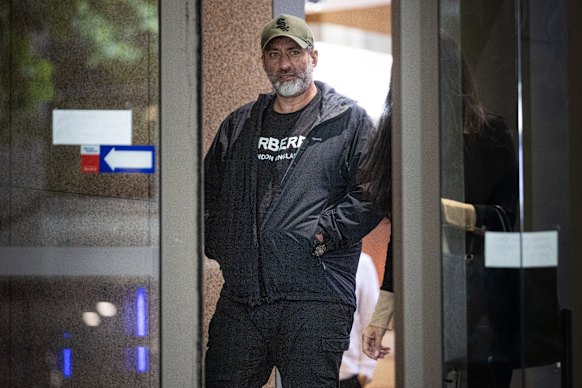
The bust was heralded as a massive success by Australian law enforcement at the time.
Those in the know on the inside were less confident.
“Industry analysts noted that these seizures did have a temporary impact on the flow of illicit tobacco to the marketplace, however the illicit supply soon returned to previous levels once the investigation had been completed,” former ABF commander-turned-private consultant Rohan Pike wrote in a submission to the 2016 parliamentary inquiry into tobacco.
At the time in 2013, border authorities were seizing about 200 million cigarettes a year.
By 2021, nearly 600 million cigarettes were seized. Still, it was a cause for triumphalism.
“This increase in illicit tobacco detection rates highlight just how committed the ABF is to disrupting and dismantling the tobacco black market, and the dangerous criminal syndicates who operate it,” then-assistant minister for Customs Jason Wood said.
“Australia has one of the strongest regulatory regimes for tobacco in the world, and the high rate of detections by the ABF show the effectiveness of this approach.”
It was so successful that just two years later, in 2023, more than 1.77 billion illicit cigarettes were seized. In 2025, it was 2.5 billion.
Law enforcement and industry sources, who cannot be identified publicly, said ABF and the government had become committed to a failing methodology focused on “seizing” their way out of the problem for lack of a politically palatable alternative.
Even as late as September 2025, the ABF was trumping its impact after seizing 30 million cigarettes and 400,000 vapes worth $74 million in an operation in Queensland.
“In less than a week, the ABF has put a significant dent in two major illicit tobacco networks,” ABF acting Assistant Commissioner James Copeman announced to the media.
Yet shipping manifests for the illicit Manchester brand obtained by The Age shows that at almost that same time – in a single month – more than 500 million illicit cigarettes were being loaded on ships in Dubai to be sent towards Australia.
Meanwhile, the Hamad syndicate had also created a lucrative new partnership with a China-based criminal that saw Australia flooded with illegal vapes.
This obsession about seizure numbers fundamentally misread the nature of how illicit markets work, according to Deakin University’s James Martin.
“Black markets are adaptable. You can damage individual players but you can’t damage the market as a whole when it gets beyond a certain scale,” Martin said.
“Once it’s big, which is clearly the case in Australia, you can count on the fact that there’ll be more suppliers entering the market and that makes it nearly impossible to disrupt supply.”
The ABF weren’t in the dark. They knew from at least 2020 that their methods were not working.
“By then it had already gotten too big. The tax had risen to a point where it made economic sense for the syndicates to keep expanding and [smoking] had become normalised in the community as well,” said a former senior law enforcement source with direct knowledge of the system.
“ABF realised they were not having an impact. That they were not going to seize their way out of the problem. Those big numbers were not really an indication of success.
“What impact is there from seizing 10 million sticks? It’s just merely numbers. That’s really more speaking to the sheer size of the market than some kind of successful outcome.”
The result?
“We’ve handed over billions of dollars to organised crime,” the source said.

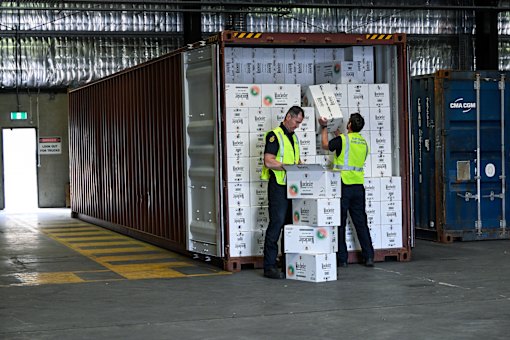
This was the outcome despite federal government spending half a billion dollars on enforcement measures since 2015 directly on combatting illicit tobacco – above and beyond the regular budgets of the ABF, ACIC and Australian Federal Police.
ITEC commissioner Shuhyta told The Age that “enforcement serves as an effective disruption tool”.
“Comprehensive effort should focus on the Australian border, in conjunction with law enforcement efforts at the federal and state and territory level, public health measures, and working closely with international partners to disrupt the supply chain.”
But even as enforcement is continually publicly pushed as a way out of the worsening morass, border authorities were being hobbled by under-investment in an ageing cargo system and lacklustre intelligence capabilities.
The reality is that the ABF has a very low “strike rate” at detecting illicit tobacco shipments, sources say.
Officers only checked about 1 per cent of containers in 2023, and those searches were overwhelmingly based on intelligence, rather than being random checks. That figure is down from 5 per cent more than 20 years ago.
The vast majority of intelligence is provided through tip-offs by the tobacco industry and international law enforcement agencies.
There was also always a litany of other more serious and politically sensitive issues that had to take priority – terrorism, people smuggling, illegal fishing, drugs, firearms.
This despite the known connections between tobacco smuggling and how the money it reaped was ploughed back into more serious organised crime.
The operation of Australia’s sea cargo system itself had also become deeply problematic.
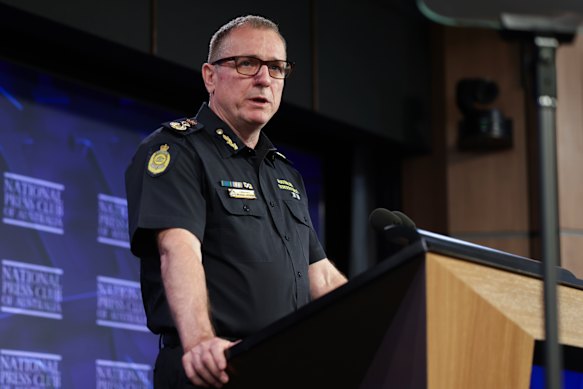
When former ABF commissioner Michael Outram was retiring in October 2024, he delivered a pointed critique during an address at the National Press Club.
While only mentioning tobacco once, the speech got right to the heart of how federal law enforcement – and the governments that have funded it – opened the door for the flood of illicit tobacco that has led to the rampant criminality and violence of today.
“At the time of the Sydney Olympics, our border was highly regarded globally. The Integrated Cargo System or ICS, which handles Australia’s import and export transactions, was about to be introduced as a world-leading single window system,” Outram told the National Press Club.
“In 2007, a few years after ICS was introduced, Australia was ranked 23rd in the World Bank Trading Across Border index and just over a decade later we’d slipped to 106th.”
Outram declined to comment when contacted for this article.
But other sources familiar with ABF operations describe a litany of problems that have gone uncorrected for decades.
“We’ve still got paper-based systems for incoming passengers and incoming sea cargo, which is a massive problem. We have people going through pieces of paper like it’s 1950,” one source said.
“The fact that we’re still using X-ray machines in this day and age. Great, they were awesome in 1994.”
The price tag on bringing the system up to state-of-the-art would cost billions.
Meet the new boss
This was the state of affairs on the morning of March 24, 2023 – the day the “tobacco war” began.
Apart from budget announcements that the federal government was drawing an ever declining chunk of revenue from excise taxes (the federal budget is facing a $67 billion shortfall in tobacco excise in the decade to 2028-29), the widespread availability of illicit tobacco was practically invisible to the public – unless you were a smoker.
Hundreds, if not thousands, of specialty tobacco shops had opened up and illicit brands like Manchester and Double Happiness were readily available at cut-rate prices.
So profitable had it become, that competition was seeing new players push into the market – bikie gangs, Middle Eastern and Asian organised crime start-ups, even punters looking to make a fast buck off a quick shipment.
In February 2023, the reigning powers in the Haddara crime family called a meeting to set ground rules about prices, supply and who got a piece of the trade.
Kaz Hamad, who was on the cusp of being released from an eight-year prison sentence for heroin trafficking, demanded a seat at the table and was refused.
What came next was chaos. Dozens of firebombings, shootings and murders.
This is what brought the sheer moneyed power of the illicit tobacco market to public attention – and brought the chickens home to roost for the government and law enforcement.
State police forces were now confronted with a street war over something that had been festering for years without concerted attention by the federal government.
Hamad waged a two-year war to gain control of the illicit tobacco market, forming a cartel in early 2025 known as “The Commission”.
In late 2025, AFP Commissioner Krissy Barrett declared Hamad was a threat to Australia’s national security as a result of his suspected involvement in illicit tobacco industry, alleged links to serious violence and suspected involvement in the firebombing of the Adass Israel synagogue in December 2024 on behalf of the Iranian government.
But the so-called “tobacco war” would be ended by the same person who started it – Hamad.
With the Haddaras beaten into submission, the Hamad syndicate seized control of its operations and expanded it dramatically.
The AFP has said Hamad runs a nationwide operation, with a presence in five states and one territory. The cartel is strongest in Victoria, New South Wales, Queensland and Western Australia.
Hamad was arrested in January in his native country of Iraq, in circumstances that remain a mystery.
But it’s not clear how any of this has affected the supply of illicit tobacco, which is still widely available despite his arrest and a “licensing crackdown” promised by the Victorian government on February 1. (NSW toughened its laws last year and has shut down more than 50 shops suspected of selling illicit tobacco or vapes, and seized more than 1.6 million illicit cigarettes.)
“Seizures are not a success metric, they’re a symptom of a market that’s out of control. What matters is the size of the illicit market,” the former federal law enforcement official said. “Until we see criminals losing market share, not stock, we can’t claim progress.”
In fact, the black market recently got even more profitable for the syndicates.
At the start of March, the federal government pushed ahead with its latest scheduled rise in the excise tax, taking it to $1.52 per cigarette.
In the wake of Hamad’s arrest, the “tobacco war” has also restarted as old rivals and new players compete again for a slice of the market. There have already been more than a dozen firebombings in Victoria, New South Wales, Western Australia and Queensland, as well as at least two shootings tied to the violence in Melbourne.
Meanwhile, the Australian parliament is now accepting submissions as part of its current “Inquiry into the Illegal Tobacco Crisis in Australia”.
Perhaps the sixth time is the charm.
Start the day with a summary of the day’s most important and interesting stories, analysis and insights. Sign up for our Morning Edition newsletter.
Read the full article here


