



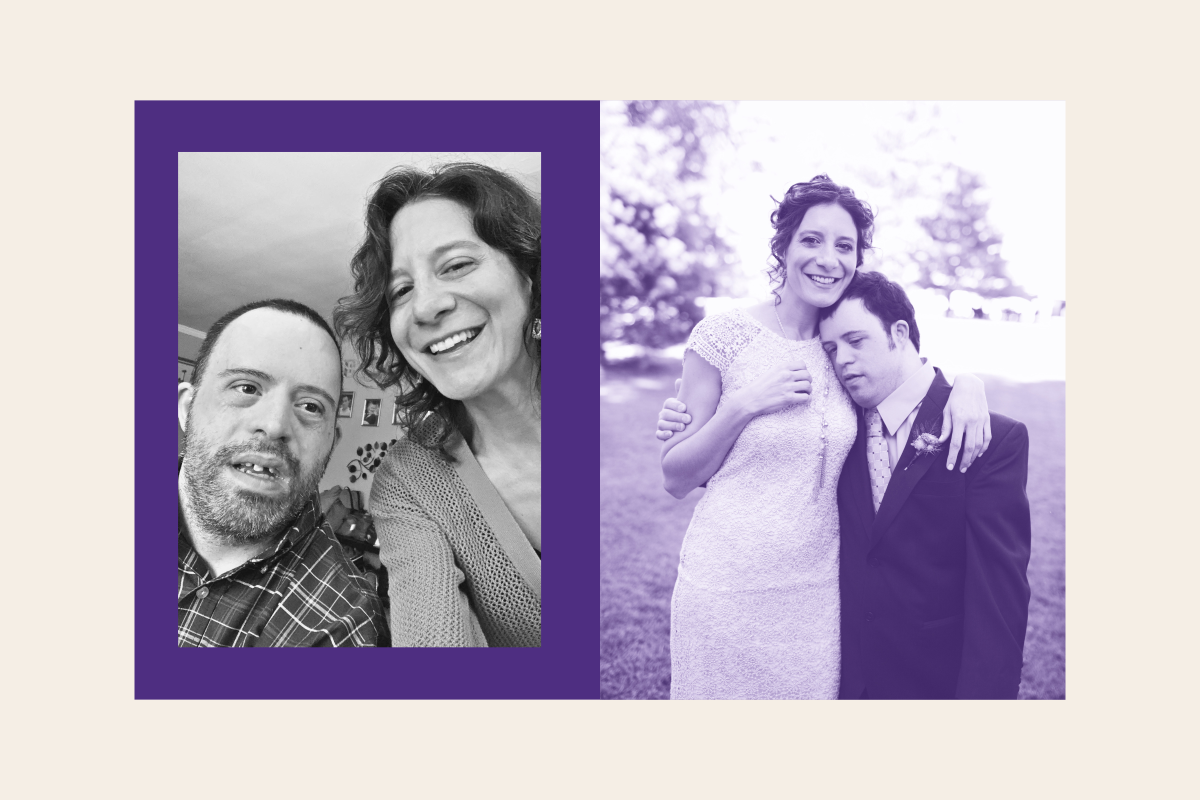
A blue breathing tube emerged from my brother’s mouth like a tentacle. My school-age son played with a toy like it at home. There, it drove me crazy, but here, in the hospital, it kept my 45-year-old brother, Adam, alive.
My mother had died years earlier, and what that experience had taught me was that when a family member is on the edge of death, you don’t leave anything unsaid. But with my brother, it was different. I couldn’t explain to him my biggest fear—that I had never truly known him.
Adam was three years younger than me, born in 1979. On the day of his birth, my mother’s cousin remembers calling the hospital and hearing my mom sob. “He has Down Syndrome,” she said.
My parents were initially afraid of what life might hold for my brother, but he grew up in the ’80s, amid a growing push for inclusion for people with developmental disabilities. Adam lived at home and attended public school. While he never learned to read, he swam, skied and memorized the entire score of Les Misérables. He greeted people he knew well with a sniff on the head and a declaration of pizza or hot dogs—his two favorite foods.
But his inner world, what could I say of that? He expressed basic emotions like joy, sadness and anger, but was unable to talk in depth about his feelings. If you asked Adam how he was doing, he would shrug and forgo any follow-up with a shake of his head. He didn’t appear to hold grudges or have regrets. When he got frustrated, he said, “Let’s start again,” as if it were possible to wipe the slate clean with a few words.
But I didn’t want to start again. I wanted to go someplace new with my brother, discover something about him that I’d never learned before.
When I was a child, I used to camp outside his door, hoping to learn his innermost secrets. From my stakeouts, I initially got excited when I heard Adam talking to his Big Bird doll. I was finally going to learn his secrets! Then, I realized that he was repeating conversations he’d had with my parents. They ranged from mundane topics (“What’s for supper?”) to heartbreaking renderings of his bigger life battles (“Time for chemotherapy, Adam!”).
When our mother died in our 20s, Adam added a new conversation to his repertoire. He would “call” my mother by turning his hand into a phone. “Ma?” he would say, speaking into his pinky. Then, “I miss you.” While I found this gesture sweet, I highly doubted my brother was communing with my mother. And even if he was, these “calls” never lasted very long. Adam might tell her he missed her a few times before hanging up.
In our 20s, Adam and I both moved away, he into a small home with other adults who had Down syndrome, and I to New York City. When I came back to the Hudson Valley, I would visit, and we developed a routine. I greeted him with a nickname I made up for him, goosey bugaloo. He laughed, raising his eyebrows up and down like Groucho Marx. We sang “Master of the House” and “On My Own” from Les Miz. At least once we would kiss each other on the head.
“What am I, Adam?” I would ask him.
“Hot dogs,” he would say, grinning.
I always loved seeing my brother, but it often felt as if we were two characters performing the same scene. This stood in comparison to my life, where I was moving (yet again) into a new apartment, discovering a latent passion for creative writing, falling in love with a woman, and having a child. We talk about relationships in terms of change, as growing or deepening or fracturing, but my relationship with my brother remained static. At times, I found that sameness disappointing, enough that I took it for granted, assuming that Adam would always be there to play his part.
Then, in 2020, Adam developed dementia, not uncommon for people with Down syndrome. After we emerged from the COVID lockdown, my father and I visited Adam. My dad suggested we go for a walk in the backyard since the weather was getting warmer. As we descended a small slope, Adam leaned heavily on both our arms.
“Isn’t this nice, Adam?” I asked. He didn’t answer.
That’s when I realized he hadn’t yet said my name. I held back tears as we completed our lap.
As Adam’s dementia worsened, he stopped speaking altogether. I still called him goosey bugaloo, but he stared back at me blankly. I’d once resented my part, but now I couldn’t help playing it, hoping it would revive him. After every visit, I lamented all the times I skipped a visit, convinced I had something more important to do than replay our routine.
A few months after Adam turned 45, I got a call from my father: Adam was hospitalized with aspiration pneumonia. He’d been having trouble swallowing for some time as a result of the dementia. In the hospital, the breathing tube went in, then out, then in again. The medical team drained fluid from his lungs. He was fed through a nasogastric tube.
My father, sister and I discussed Adam’s options one night after a visit. Even if Adam were able to leave the hospital, what would his life look like? Would he ever speak again? Leave the house? Be able to eat? As a family, we once joked about Adam being a human vacuum cleaner when it came to food. Would he want a life without hot dogs or pizza?
Trying to imagine what my brother might want in this situation instigated my old fear. Not only had I never known him, but now I never would.
I said this out loud, and my father disagreed. “Of course we know Adam,” he said. “Most people think about relationships as transactional, but Adam never did. He treats everyone the same and gives love without expecting anything in return.”
My father’s words made me question how I’d been thinking about my relationship with my brother. I’d been so focused on verbal communication, on wanting to know my brother in the way that I knew my closest friends and family, that I neglected to see the relationship we actually had.
Adam never got better. He died in January 2025. My father asked if I would write the obituary. While I was initially reticent—I’d once botched the eulogy for my mother—thinking about his life in both broad strokes and deep specificity was a gift. There might not be many upsides to grief, but one was reexamining what my relationship with my brother meant to me.
Disability advocates have long argued that our society privileges certain forms of love, intimacy and care, but it wasn’t until my brother’s dementia and illness stripped away the illusion that our relationship would evolve that I was able to see this. I understand now that I devalued aspects of him that didn’t fit with my idea of how an adult relationship should progress. I also failed to appreciate what Adam did give me—a ritual-based connection and unconditional acceptance. How many people do you have in your life that always greet you the same way? Who seemingly don’t judge you, but always welcome you just as you are? Who can wipe the slate clean and “start again” when things get tough?
A year after Adam’s death, I put my hand up to my ear like he used to do to talk to my mother.
“Hi goosey bugaloo,” I said into my pinky.
I could see him in that moment. The way he smiled each time I called him by his nickname. How he belted Eponine’s solo. His head on my shoulder.
My brother wasn’t here, and yet, for a moment, I felt certain of our connection. I saw him—and our relationship—for what it was.
Alyson Pomerantz is a writer from Poughkeepsie, New York, working on a memoir about coming out after her mother’s death. She has been published in The New York Times Magazine, Huffington Post, Out Magazine, Longreads and Business Insider.
All views expressed in this article are the author’s own.
Do you have a personal essay you want to share with Newsweek? Send your story to MyTurn@newsweek.com.
Read the full article here


