



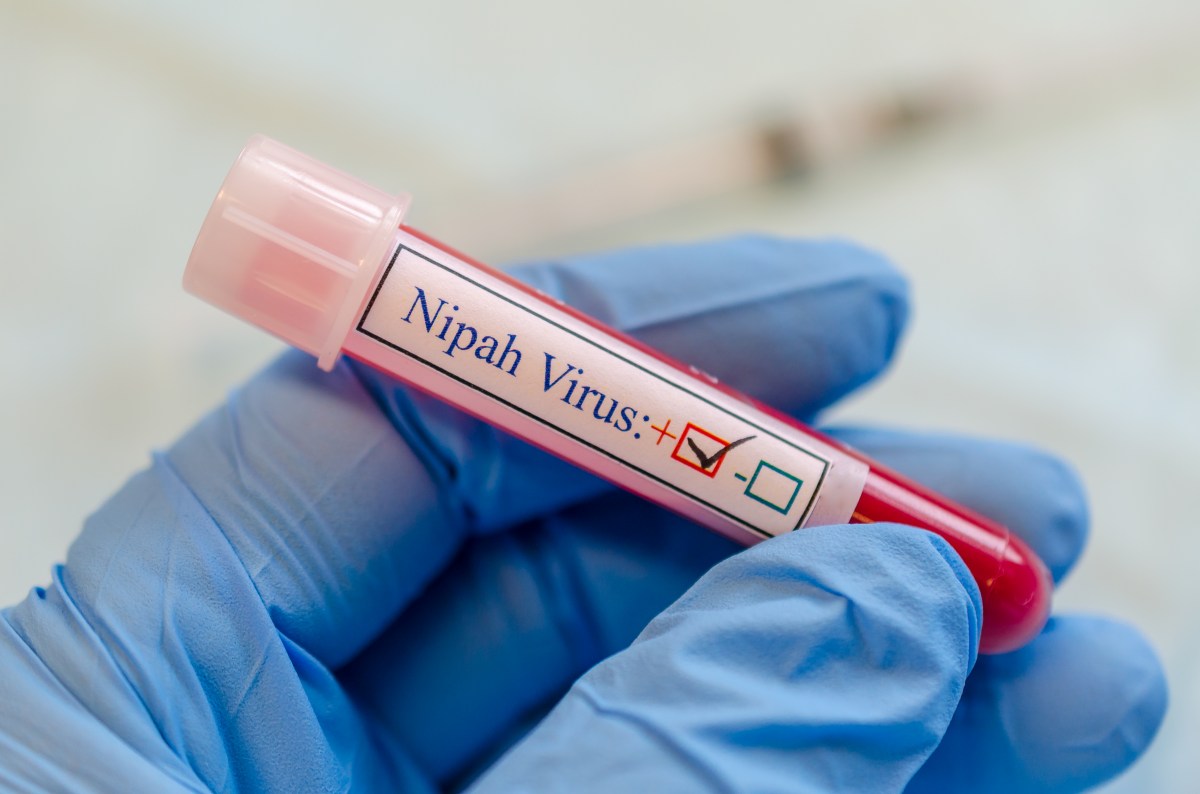
India is battling an outbreak of Nipah Virus in its eastern state of West Bengal that has seen five people confirmed infected and nearly 100 people placed in quarantine.
The outbreak is reported to have begun in a private hospital in the city of Barasat, with three of the patients being medical professionals treating patients in the facility.
Patients have been transferred to an infectious diseases hospital in the east of the state capital of Kolkata.
Nipah (Henipavirus nipahense)—which was first recorded in 1998—is a serious and frequently fatal zoonotic virus, which is carried by fruit bats and can infect animals (often pigs) and humans.
At present, there are no specific treatments for Nipah, nor is there a vaccine against the disease. The infection has never been recorded in the U.S.
What Are the Symptoms of Nipah Virus Infection?
The initial symptoms of Nipah virus infection typically include a cough, difficulty breathing, fever, headache and a sore throat.
Symptoms typically develop within four to 14 days of people being infected with the virus, although longer incubation periods have been recorded in previous outbreaks. Once manifest, symptoms usually last for three to 14 days.
As the infection develops, some patients may also develop a serious complication known as encephalitis—an inflammation of the brain.
This can result in additional symptoms including confusion, drowsiness and seizures, with patients often falling into a coma within 24 to 48 hours.
Nipah virus has a very high mortality rate, with the WHO reporting that it is estimated that between 40 and 75 percent of cases may result in death.
How Is Nipah Virus Treated?
According to the U.K. Health Security agency, there is no proven individual treatment for Nipah virus infection—nor is there a vaccine against it.
However, evidence of infection can be revealed by laboratory testing by health care professionals both in sick and recovered patients.
Patients who have contracted the infection are typically prescribed rest and hydration, as well as treatments to combat individual symptoms.
Several experimental therapies—based around monoclonal antibodies, fusion inhibitors and novel antivirals—are presently in development or undergoing initial clinical trials.
How Does Nipah Virus Spread?
Nipah virus is carried by megabats of the genus Pteropus—which are more commonly known as “fruit bats” or “flying foxes.”
As their common name might suggest, these nocturnal creatures subsist primarily on fruit as well as other plant matter.
They are known to serve as the reservoirs of several other fatal diseases including Australian bat lyssavirus (which presents rather like rabies) and Hendra virus.
People can contract Nipah virus from direct contact with infected bats, or other animals—pigs being the usual intermediary candidate.
The virus can also be contracted by consuming food or drinks (e.g. fruit or raw date palm sap) soiled by infected animals, or by coming into contact with the bodily fluids of an infected person.
Beyond bats, pigs and humans, scientists believe that Nipah virus is also capable of infecting other animals, including cats, dogs, goats, horses and sheep.
According to the Centers for Disease Control and Prevention (CDC), those traveling to areas where Nipah virus outbreaks have occurred are recommended to avoid contact with fruit bats and sick pigs; to avoid areas where bats roost; to avoid touching objects or eating fruit that may have been soiled by bats; to avoid contact with the bodily fluids of Nipah patients; and to wash their hands regularly with soap and water.
Where Is Nipah Virus Found?
The first recorded outbreak of Nipah virus infection occurred in pigs and then their human farmers in the Malaysian states of Negeri Sembilan, Perak and Selangor in late 1998/early 1999.
In total, 265 cases of acute encephalitis were reported from the three states, resulting in 105 deaths. A further 11 cases and one death were recorded among butchers in neighboring Singapore following the handling of imported, infected pigs.
Since then, outbreaks of Nipah virus infection have been also reported from Bangladesh, India and Philippines. The range of the fruit bats that spread the diseases, however, is considerably larger—including much of Asia, the South Pacific and Australia.
Most outbreaks have been recorded occurring in rural or semirural settings.

Has Nipah Virus Ever Been Seen in the US?
There has never been a reported case of Nipah virus infection in North America; the high fatality rate of the infection and its limited ability to spread directly between humans means that it has a much lower transmissibility than other viruses like, for example, SARS-CoV-2.
However, early last year, a new virus related to Nipah was identified in northern short-tailed shrews at a site in the town of Camp Hill, Alabama. What symptoms the virus may cause is unclear.
According to researchers at the University of Alabama at Birmingham (UAB), there is no evidence that Camp Hill Virus (CHV) is capable of crossing species barriers.
“The mode of transmission for CHV has not been determined. However, its presence in the kidneys suggests it could spread through aerosolized rodent urine,” said UAB microbiologist professor Nicholas Lennemann in a statement.
“That said, there is no evidence to suggest CHV is capable of infecting humans—it has not been found in humans.”
Do you have a tip on a health story that Newsweek should be covering? Do you have a question about Nipah virus? Let us know via health@newsweek.com.
Read the full article here


