



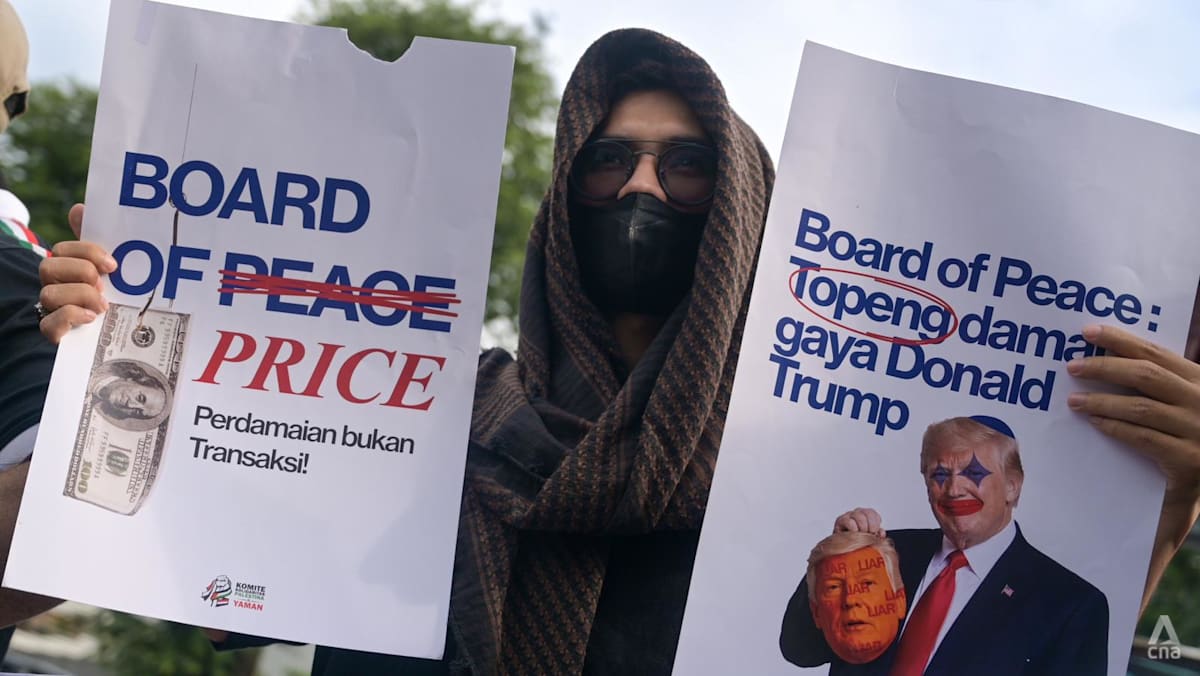
JAKARTA: When Indonesia President Prabowo Subianto accepted the United States’ invitation to join the Board of Peace (BoP) on Jan 22, he cast it as a strategic step to achieve lasting world peace and elevate Indonesia’s global standing as a middle power.
But public scepticism of Indonesia’s BoP participation has grown in the wake of the US-Israeli war on Iran and the death of three Indonesian peacekeepers in Lebanon last month.
The board was originally established to oversee post-conflict reconstruction in Gaza.
With politicians, including figures from Prabowo’s own coalition, now urging a reassessment of Indonesia’s membership, observers say the president risks being caught between domestic backlash and preserving ties with the US.
“The Board of Peace has become the Board of Problems,” declared Teuku Rezasyah, an international relations lecturer at Indonesia’s President University.
LATEST PUBLIC SENTIMENTS
Over half of respondents in a survey conducted last month disagree with Indonesia’s decision to join the BoP.
Conducted by three Indonesian research companies, the survey found that 50.9 per cent of more than 1,000 respondents disagreed with Indonesia’s decision to join the BoP, a body initiated by US president Donald Trump.
Only 33.8 per cent said they supported the decision while the rest were neutral, according to the findings released on Apr 2 by Indikator Politik Indonesia, Indonesian Survey Institute (LSI) and Saiful Mujani Research and Consulting (SMRC).
The result showed a marginal decline in support for BoP participation.
Before the US-Israeli war on Iran, another Indonesian research company, Media Survey Nasional (Median) conducted a similar study between Feb 10 and 14, showing that 50.4 per cent of the 1,200 respondents disagreed with Indonesia joining the BoP. In the February survey, 34.8 per cent said they supported the membership.
The latest survey was conducted between Mar 12 and 31, meaning some responses were given before the Indonesian peacekeepers were killed on Mar 29 and 30. Experts said support for the BoP would have been even lower if the study was conducted after the deaths.
A United Nations investigation found that a projectile fired from an Israeli tank resulted in the death of a peacekeeper on Mar 29.
Two peacekeepers were killed on Mar 30 by an improvised explosive device, most likely placed by Hezbollah, according to the UN.
Read the full article here


