






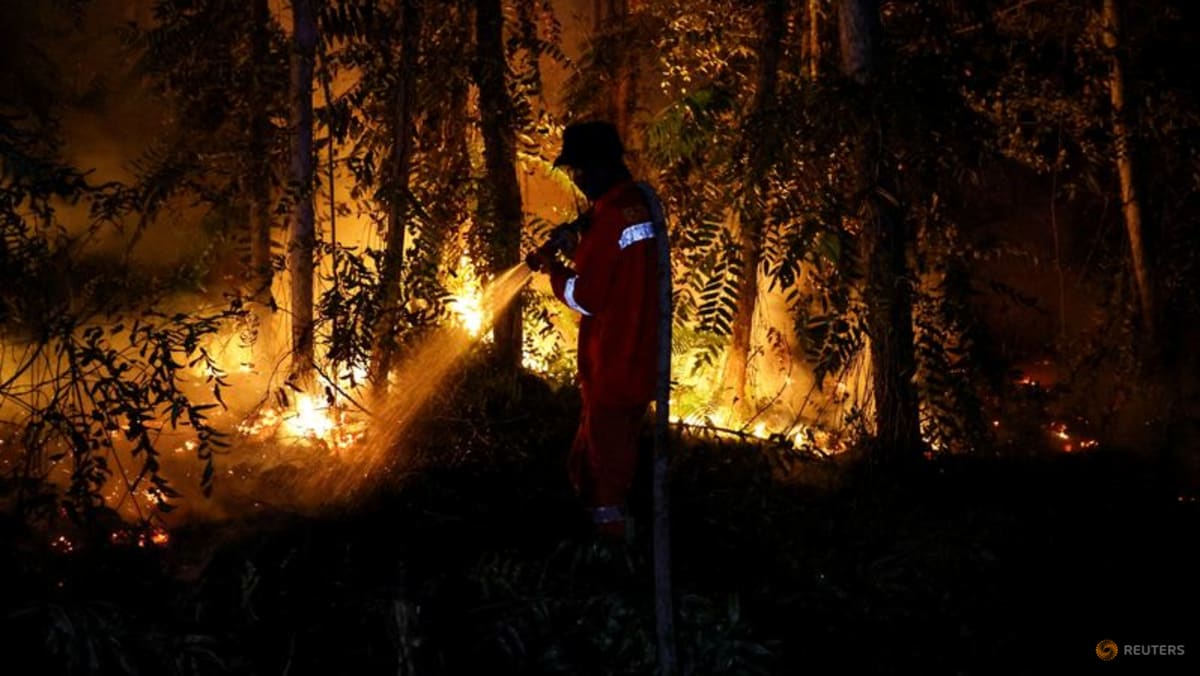
JAKARTA: Forty-two cases of forest and land fires in Indonesia are undergoing legal proceedings at its forestry ministry, as the government steps up efforts to tackle the haze and enforce the law.
The ministry’s Directorate General of Law Enforcement (Gakkum) is handling the cases, Forestry Minister Raja Juli Antoni said on Tuesday (Aug 25).
Raja Juli did not provide details on the parties facing legal proceedings or the locations of the fires linked to the cases, but said the government would take action regardless of who was responsible for the violations.
The cases appear to be in addition to the 72 suspects arrested by Indonesian police on Sunday in connection with 89 forest and land fire cases across five provinces in Kalimantan and four on Sumatra. There are no details if the cases overlap.
Fires, driven by an intensifying El Nino pattern and a prolonged dry season, have given rise to haze in the central and western parts of Indonesia, as well as in Malaysia.
According to Raja Juli, enforcement action is not limited to criminal proceedings. The Forestry Ministry may also impose administrative sanctions.
On Monday (Aug 24), the ministry announced administrative sanctions against six Forest Utilisation Business Licence (PBPH) concession holders after finding fires covering a total of 1,511.55 hectares in the areas they manage in West, Central and East Kalimantan.
The six companies were only identified by their initials by the authorities: PT WEL, PT FI, PT MPK and PT WSP in West Kalimantan, PT NES in Central Kalimantan, and PT PSR in East Kalimantan.
The ministry found that they had failed to adequately prevent and control forest and land fires in their concession areas.
Five companies were ordered to take corrective measures, while PT MPK’s business licence was suspended because of extensive and repeated fires in its concession area.
Under the sanctions, the companies are required to improve their fire preparedness, including firefighting teams and equipment, water sources, observation towers, canal blocks, as well as early detection and response systems.
They are also required to restore vegetation in affected areas. For peatlands – wetlands consisting of partially decayed organic matter that release large amounts of carbon when burnt – they are to restore hydrological functions through water management, canal blocking, rewetting and groundwater-level monitoring.
Read the full article here


