



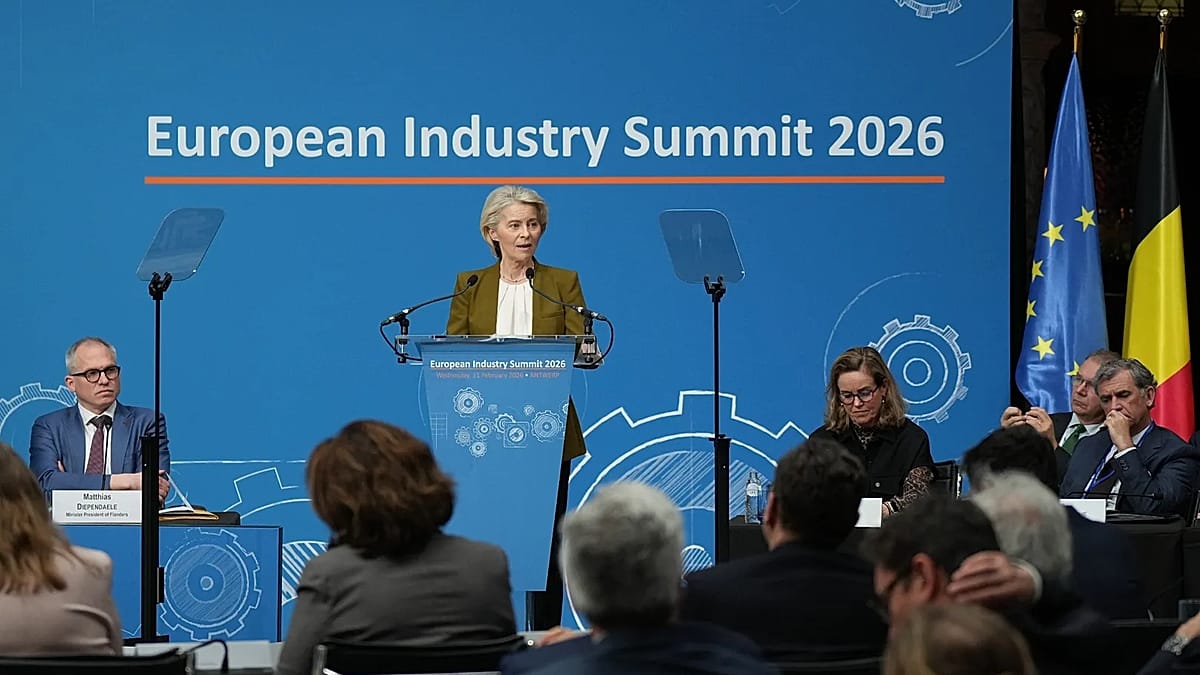
High energy prices in Europe are setting back energy-intensive industries and the European Union must take urgent measures to bring power costs down, industry leaders demanded after a summit in Antwerp on Wednesday.
“EU electricity prices in Europe still remain higher inside Europe than in competing countries. Carbon costs are unique to Europe, and the system is designed to increase costs year-on-year,” reads the declaration, which is signed by more than 100 organisations.
Energy-intensive industries like chemicals, steel, aluminium, cement and ceramics are all affected by high energy prices, which drive up production costs and hamper the EU27’s ability to compete globally.
Industry leaders fear that if European electricity prices remain high relative to global peers, investment will shift elsewhere and capacity will be lost.
The steel industry warned that “persistently high and volatile” electricity prices, exacerbated by high taxes and carbon costs, have become one of the largest obstacles to investment, electrification and decarbonisation for the industry.
“If the EU wants investment in low-carbon steel to happen in Europe, it must deliver total electricity costs closer to €50/MWh – across all member states. Bringing power prices down is now the litmus test of Europe’s economic and climate credibility,” said Henrik Adam, EUROFER’s President and Executive Chairman of Tata Steel Netherlands Holding.
Led by the trade chemical lobby, the European Chemical Industry Council (Cefic), the industry is calling for restoring electricity prices to pre-2021 levels of €44/MWh, saying the goal is key to Europe’s efforts to regain industry sovereignty and safeguard industrial value chains.
“Europe is losing industrial capacity at a speed we have never seen before. This is not a temporary downturn – it is a structural competitiveness shift affecting all manufacturing sectors,” said Markus Kamieth, Cefic’s president and CEO of chemical giant BASF.
EU leaders convene at Draghi summit
Rising carbon costs have also been shunned by the industry, as they’re obliged to comply with the bloc’s carbon market, the Emissions Trading System (ETS), which requires them to pay for the emissions they produce.
Since the decision to break free from Russian energy, EU leaders have been working to accelerate clean power production and modernise the power grid to optimise the growing influx of solar and wind energy – a step that would help lower energy prices across Europe and shield it from price volatility.
Despite industry backing, revamping the grid will take time, and will not provide immediate relief given “ruthless global competition”.
Industry leaders urged EU leaders, who will discuss how to boost the bloc’s competitiveness during an informal summit in Alden Biesen on Thursday, to “take urgent measures” that reflect the crisis facing European industry today.
“We urge you to move from diagnosis to delivery, and from plans to results with a single objective: Save our industry. We need Alden Biesen to deliver joint actions that achieve results in 2026, a package of Emergency Industrial Policy Measures,” reads the declaration.
In her address to EU leaders in Antwerp, European Commission President Ursula von der Leyen recognised the “high and volatile” prices affecting energy-intensive sectors.
“We know the reason for this: gas drives prices up, renewables and nuclear drive prices down. The good news is we are well-positioned to lower costs,” von der Leyen said, adding that improvements to the electric grid will be key alongside offshore wind power projects to be linked to the Danish and German national grids.
More ETS revenues for industry
The next step is to channel more financial resources from the ETS into energy-intensive industries, von der Leyen said.
“Channelling more ETS revenues back to industry will therefore be a core focus of the upcoming reform of the Emissions Trading System. Because these resources come from the industry and they must be reinvested in the industry.”
Since its inception in 2005, the ETS has slashed emissions by 39%, with revenues exceeding €260 billion, according to the EU executive.
But EU countries invest less than 5% of ETS revenues in industrial decarbonisation, von der Leyen said, urging national governments to “step up and match our level of support”.
Veteran MEP Peter Liese (European People’s Party/Germany), the coordinator on the European Parliament’s environment committee, also recognised the challenges faced by heavy-industry due to high prices and carbon costs during a press briefing on Tuesday.
“It is completely unrealistic for cement plants, the chemical industry and the aviation sector to have zero emissions by 2039,” Liese said. “The cause of their problems, however, is not the ETS; that’s rather a solution.”
The EU executive is set to revise the bloc’s carbon market by July as part of the bloc’s climate law, which sets a 90% CO2 emissions cut target for 2040.
Federico Terreni, climate policy manager at the campaign group Transport & Environment (T&E), said the upcoming ETS review should “strengthen the system” instead of “weakening it.”
“It is a stable and ambitious ETS that gives industry the certainty to electrify, innovate and compete globally,” Terreni told Euronews.
“If Europe wants a competitive industrial base, the answer lies in cheaper, clean transport and energy solutions and a strong carbon market, not deregulation.”
Read the full article here


