



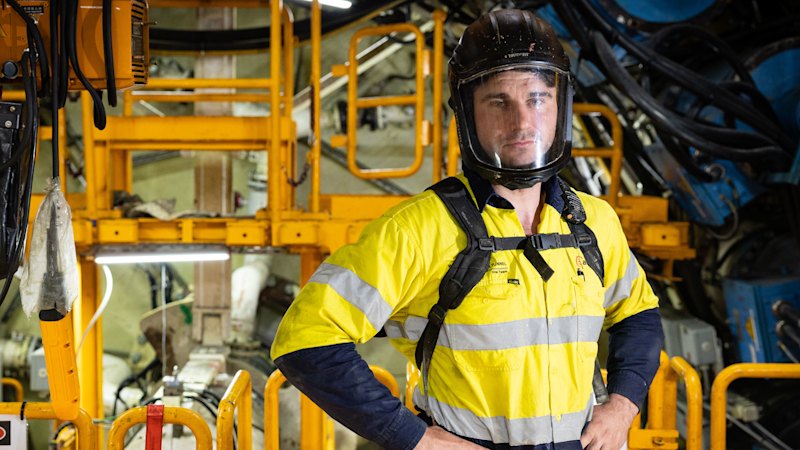
Twenty tunnellers working on a giant boring machine are enclosed in submarine-like cramped and noisy conditions as they carve their way under the inner west and Sydney Harbour with laser-like precision.
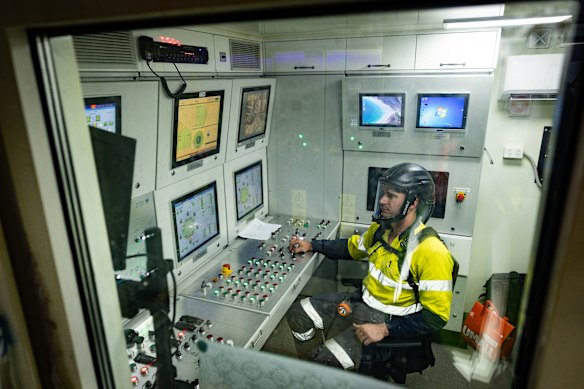
In the belly of the beast named Barangaroo is pilot Andrew Jones, whose role is critical in keeping the 137-metre-long machine within five millimetres of its course. He maintains 100 per cent focus as he checks control panels and displays – without him, the machine would not work.
“It’s stressful but rewarding. I love it,” Jones said in the control room of the machine, commonly referred to as TBM. “I’m confident in the machine. I would feel more nervous in a submarine than what I would on this machine.”

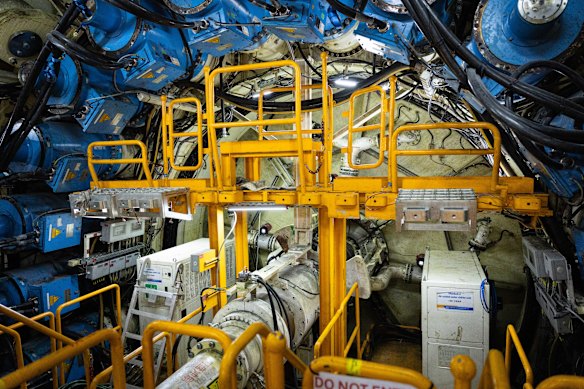
Jones, who joked that his recently arrived third child is “TBM3”, has worked on boring machines that carved out tunnels for Sydney’s metro rail lines.
The 4400-tonne Barangaroo has started her 1.5-kilometre grind northwards beneath Birchgrove, leaving in her wake one of the twin tunnels for the $7.4 billion Western Harbour Tunnel motorway. Once complete, the three-lane tunnels will link the Warringah Freeway on the north shore to the WestConnex toll road at Rozelle, in the south.
Ahead of her is another boring machine – Patyegarang – which has dug more than 110 metres from one of two giant launch chambers deep under Birchgrove Oval, her team of 20 workers keeping watch, her tail almost disappearing from the launch chamber into the tunnel she is carving out.
The riskiest part of their journeys will be through a 200-metre section of clay, silt and sand under the harbour. The so-called paleo channel is an ancient riverbed below the harbour that has silted up over millennia.
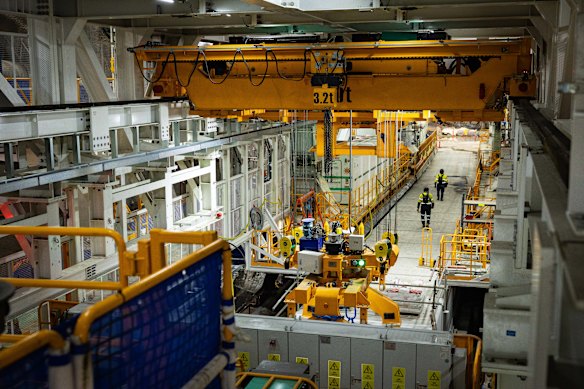
To lower the risk, one boring machine will pass through the paleo channel at a time – the first before Christmas. Operating 24 hours a day, each will take about six weeks to pass through the most hazardous section.
An indication of the dangers, two hyperbaric chambers are at the ready in the machines operated by Spanish contractor Acciona as a precaution for workers due to the pressures beneath the harbour, especially in the paleo channel.
Acciona project director Andrew Marsonet said it was unlikely that the hyperbaric chambers would need to be used, but “it’s our back-up”.
“We want to avoid having to send workers in under compression, but we will do it if we have to,” he said. “There’d have to be some kind of problem while we’re crossing the paleo channel.”
Each boring machine has a robotic arm to change disks on the 462-tonne cutter heads, helping to avoid workers doing the riskier job while halving the time it takes to replace parts. They will work up to 47 metres below the water surface.
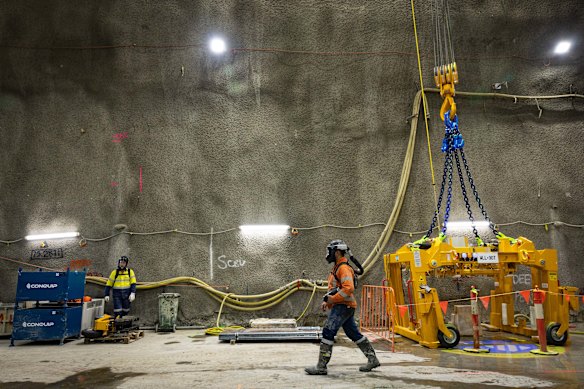
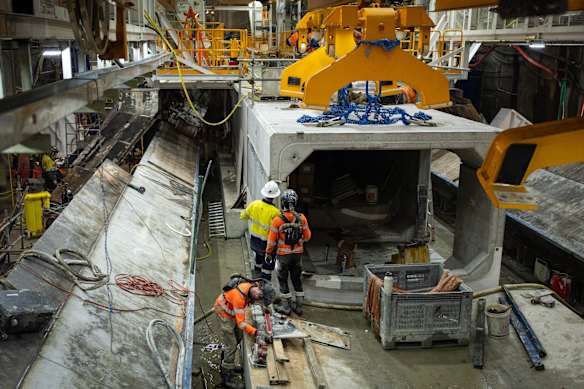
“This is all about managing pressures. We’re basically tricking the ground into thinking nothing is happening. We’re replicating the external pressures,” said Marsonet, who worked on the Sydney Harbour Tunnel, as well as the Airport Link and WestConnex tunnels.
“When we’re in rock, that’s not a problem because the rock takes the load. But when we’re in soft material, and when we’ve got high water ingress, then you’ve got water pressure, and you have to balance that pressure.”
For perspective, the width of each of the tunnels is almost 16 metres, compared with the seven-metre-wide tunnels dug for Sydney’s metro rail lines. That makes each tunnel large enough to fit three metro rail tunnels.
“What we’re seeing in here is as big as it gets,” Marsonet said. “These are the two biggest TBMs in the southern hemisphere at 15.71 metres cutting diameter. That is to accommodate three lanes of traffic.”
Up to 600 people are working underground on the mega project at any one time. Trucks daily cart about 120 loads of spoil churned out by the boring machines from beneath Birchgrove to sites in western Sydney.
In keeping with the accuracy of the machines, each 15-tonne concrete segment used to line the tunnels is fitted with millimetre precision. The 10 segments making up a ring take about an hour to install.
“Every millimetre counts. It’s so critical,” said Tom Murray, a mechanical engineer on Barangaroo. “There are so many components and subsystems that comprise the TBM.”
He admits that working underground on the machine is a lifestyle because half of it involves night shifts. “I love it. It [gets me] out of bed. It’s so rewarding,” he said.
The motorway project is now more than half-completed, and the two boring machines are forecast to reach the lower north shore between April and June. Their breakthrough into two giant receival chambers at Waverton will complete tunnelling on the project, and be followed by fit-out and commissioning work.
NSW Roads Minister Jenny Aitchison said the second boring machine’s journey northwards meant the government was a step closer to making motorists’ travel easier across Sydney.
“The Western Harbour Tunnel is going to be a game changer, and we can’t wait for motorists to experience what it has to offer when it opens,” she said.
The 6.5-kilometre motorway is due to open for traffic in late 2028, easing congestion on a key part of Sydney’s road network as an alternative to the Harbour Bridge and Harbour Tunnel.
Start the day with a summary of the day’s most important and interesting stories, analysis and insights. Sign up for our Morning Edition newsletter.
Read the full article here


